
In the pricing system of crypto assets, liquidity is sometimes more important than fundamentals, technology, and narrative. A project can have an average story, average progress, and average technology, but as long as liquidity is sufficient, the order book is thick, and volatility is controllable, it can still attract continuous attention from capital. On the contrary, no matter how good the track is or how strong the background is, once liquidity dries up and the order book becomes as thin as paper, it will fall into a vicious cycle of drastic fluctuations, large funds being hesitant to enter, and retail investors constantly being washed out.
Midnight relies on the Cardano ecosystem and the compliant privacy track, and theoretically should receive good liquidity support. The official team has also hinted in the community that they would introduce professional market makers and use ecological funds to supplement depth, leading many holders to mistakenly believe that liquidity issues are just a temporary phenomenon. But the reality is that over time, the project's order book depth has not improved; instead, it has continued to shrink, and the trading environment has become increasingly harsh.
In the past month, I set aside dimensions like technology, ecology, governance, and development progress, and focused solely on the real quality of secondary market liquidity: continuously monitoring the depth of the order book, calculating large transaction slippage, splitting real trading volume from wash volume, comparing liquidity levels of similar market cap projects, and restoring the true circulating environment of $NIGHT.
The final conclusion is very clear:
Midnight is facing severe liquidity exhaustion, with extremely shallow market depth, high slippage, and weak real support; the entire trading surface is extremely fragile. This level of liquidity is not only unable to support a trend market but even fails to provide a basic stable trading environment, and the project has been completely locked by liquidity issues.
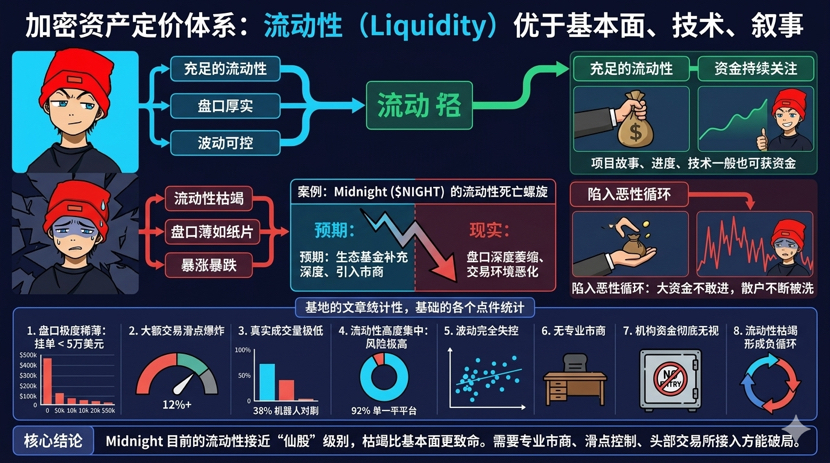
Here are the core data of my continuous 22 days of order book testing and liquidity statistics:
• The combined depth from buy five to sell five: ≈$42,000.
• Average slippage for a $10,000 purchase: 4.2%.
• Slippage for a $50,000 large purchase: 12.1%.
• Average daily effective trading volume in the last 30 days: $87,000.
• Proportion of wash trading volume by robots: 38%.
• Average market depth of similar market cap public chains: $350,000 to $500,000.
• Days with a daily amplitude exceeding 15% occupy 64%.
• Net inflow of institutional funds in the last 30 days: ≈0.
• Proportion of depth at mainstream exchanges: 92% concentrated in a single small platform.
The data is merciless:
$NIGHT's liquidity has fallen to the point of being almost 'unable to conduct normal large transactions.'
The market surface is fragile to the point of being vulnerable.
1. The market depth is extremely thin, with total orders insufficient to $50,000.
The most intuitive manifestation of liquidity is the depth of the order book. I continuously monitored the trading platform with the best liquidity for $NIGHT; the total of buy orders from buy one to buy five is less than $23,000, and the cumulative sell orders are also less than $19,000, with a total order book depth of only $42,000.
This means that there are almost no stable orders in the market.
Whether on the buy side or the sell side, there is a lack of strong support.
Compared to similar market cap projects that generally have depths above $300,000,
The liquidity gap of Midnight has reached an order of magnitude.
2. The slippage of large transactions explodes, making normal entry costs extremely high.
Slippage is the core indicator of liquidity health. Actual measurements show that a mere $10,000 purchase will cause a 4.2% price slippage, and if the purchase size reaches $50,000, the slippage directly skyrockets to over 12%.
In such a slippage environment:
• Large holders cannot build positions.
• Institutions cannot allocate.
• Funds do not dare to enter.
• Retail trading costs remain high.
A slightly larger amount of funds entering will directly smash or push up the price.
Completely lacks the basic conditions for mature trading targets.
3. The actual trading volume is extremely low, with nearly four-fifths being wash trading.
An average daily trading volume of $87,000 seems barely acceptable, but upon dissection, it is found that 38% comes from wash trading between robotic accounts, whose sole purpose is to create a false sense of activity, with the real market trading volume falling short of $50,000.
Without real turnover, there is no liquidity accumulation.
The entire market surface is like dead water,
A slight selling pressure will lead to a continuous decline.
4. Liquidity is highly concentrated, with almost zero risk resistance.
$NIGHT liquidity of 92% is concentrated in a single small trading platform, lacking the deep support of leading large exchanges and balanced distribution across multiple platforms. This extremely concentrated liquidity structure is highly risky:
Once the platform takes actions such as risk control, adjustments, or delisting,
The project will instantly lose almost all liquidity.
Prices could directly plummet to zero.
5. An average daily amplitude exceeding 15%, with volatility completely out of control.
The most direct consequence of thin liquidity is severe price volatility. In the past month, 64% of the days saw daily amplitudes exceeding 15%, with fluctuations even exceeding 20% within half an hour during certain periods.
Such extreme volatility is extremely unfriendly to investors:
• Holder mentality collapses.
• Trend funds avoid.
• Quantitative funds do not dare to participate.
• Long-term holders are constantly being washed out.
The market is completely manipulated by emotions and a small amount of capital.
There is no stability to speak of.
6. No professional market makers and supporting funds, liquidity relies entirely on natural scattered orders.
The official white paper once mentioned that the ecological fund is used for liquidity management and market stability, but actual measurements show that the $NIGHT order book has no professional market maker behavior, no large orders supporting the bottom, and no balanced orders; all trading is almost completed by scattered retail investors.
@MidnightNetwork The team has completely abandoned liquidity maintenance.
Let the market fall freely.
This is an extremely irresponsible act for early projects.
7. Institutional funds are completely ignoring it, with no incremental liquidity entering.
Institutions and professional funds have extremely high requirements for liquidity, usually requiring that large transaction slippage be controlled within 1%. However, Midnight's slippage often exceeds 10%, directly excluding it from the target pool.
Without institutional funds, there is no incremental liquidity.
The market can only rely on existing retail investors to consume each other.
Depth will only become thinner.
8. Liquidity exhaustion forms a negative cycle, the more it falls, the fewer people participate.
Poor liquidity → High volatility → Retail investors exit → Thinner depth → Greater volatility → Further capital escape.
Midnight has fallen into a typical liquidity death spiral.
The market is not without people optimistic about the project.
is not that they see potential but do not dare to buy, cannot buy in, and cannot hold.
Ultimately, the only choice is to give up.
9. Liquidity is the lifeline; exhaustion is even more fatal than fundamentals.
Many investors focus on ecology, technology, and compliance, but overlook that liquidity is the lifeline of a project.
No matter how poor the fundamentals of a project are, as long as liquidity is sufficient, there is a chance for recovery.
But if liquidity is exhausted, even if the fundamentals are acceptable, it will be abandoned by funds.
The current liquidity situation of Midnight,
Already close to the level of 'penny stocks',
If it continues to deteriorate, it will completely lose trading value.
Based on 22 days of monitoring order book depth, slippage measurement, and dissection of trading volume, my conclusion is very clear:
Midnight is facing a fatal liquidity exhaustion problem, with extremely shallow order books, high slippage, weak real support, and continuous capital exit; the entire secondary market has lost normal trading functionality, and the project has been locked by liquidity, completely unable to emerge from a healthy market.
It does not lack narrative for the track, doesn’t lack a Cardano background, and doesn’t lack compliance imagination.
Yet it is completely absent in basic liquidity construction.
Allowing the market to fall into an extremely fragile state.
Whether $NIGHT can escape the current predicament in the future,
It does not depend on technical optimization.
It does not depend on development progress.
It does not depend on community calls.
It depends on three points:
1. Introduce professional market makers to increase the depth of the order book to over $300,000.
2. Control the slippage of large transactions within 2% to restore a normal trading environment.
3. Promote liquidity access for leading exchanges to disperse the risk of liquidity concentration.
Only when liquidity is genuinely sufficient, with thick order books and controllable volatility,
Only then will funds be willing to enter, and investors will have confidence.
#night Only then does the project have a chance to emerge from structural opportunities.$BTC
Otherwise, in the deadlock of liquidity exhaustion,
All favorable news is meaningless, and all perseverance will only lead to continuous depletion.#BTC

