

I have always felt that the real problem with Web3 is not innovation, but verification. Everything seems transparent and decentralized on the surface, but when you dig deeper, you find that the system is still operating on assumptions. Wallet activity is considered identity, participation is guessed, and rewards are distributed based on incomplete signals. This is the gap that the SIGN Protocol attempts to solve.
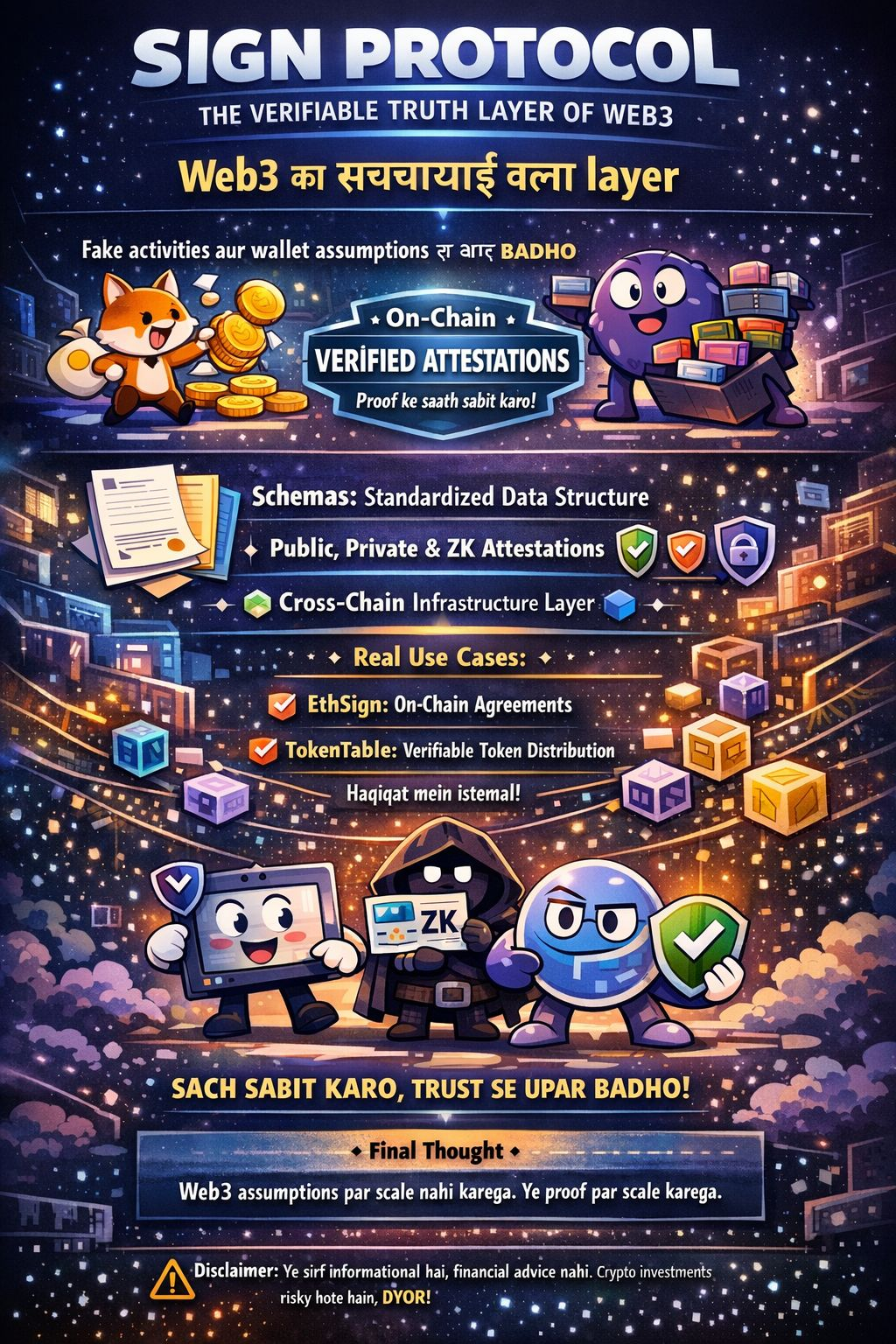
The SIGN Protocol introduces a structured system where digital claims can be verified on chain through something called attestations. Attestations are basically cryptographically signed proofs that confirm a fact, such as a user participating in an event or fulfilling a specific condition. This means that there is no longer a need to blindly trust a platform; you can verify directly. It shifts Web3 from an assumption-based system to a proof-based system.
Is system ka ek bahut important part hai schemas. Schemas define karte hain ki data ka structure kya hoga inside an attestation. Ye chhoti cheez lag sakti hai, lekin interoperability ke liye bahut critical hai. Jab data standard format me hota hai, to wo easily different platforms aur chains ke beech share aur verify ho sakta hai. Simple words me, schemas raw data ko ek universal proof bana dete hain jo har system samajh sake.
One more strong aspect of the SIGN Protocol is its different attestation types. It supports public, private, and zero-knowledge based attestations. Public attestations are visible to everyone, while private ones allow selective disclosure. Zero-knowledge proofs take this a step further where you can prove something without revealing the actual data. This achieves a perfect balance of privacy and transparency, which has been missing in Web3 until now.
This protocol is not limited to just one chain. SIGN has been designed as cross-chain infrastructure. This means it is a foundational layer that different blockchains and applications can integrate. Its goal is simple: to replace trust with standard verification. In the future, such infrastructure layers could be as important as smart contracts are today.
The SIGN ecosystem also strengthens this vision. Tools like EthSign simplify digital agreements and on-chain signatures, while TokenTable enables structured and verifiable token distribution. All these products are based on the same core idea, that every important action should be validated with proof. This makes it clear that SIGN is not just a theory but is working on real-world use cases.
If we look at the broader impact, the SIGN Protocol can redefine identity and incentives in Web3. Now rewards and access can be based on verified credentials rather than wallet assumptions. This will reduce manipulation and make the system fairer. Governance models can also improve where power will be decided not just by tokens, but by real contributions.
It is also important to understand that SIGN is not replacing existing systems, but enhancing them. It adds an evidence layer that ensures there is proof behind every claim. In Web3, where the risk of misinformation and exploitation is high, this shift is crucial.
Going forward, the success of the SIGN Protocol will depend on adoption. The technology is strong and relevant for the next phase of Web3. As projects prioritize fairness and transparency, the demand for verifiable data layers will increase. The protocols that can provide this will shape the ecosystem in the long term.
In conclusion, the SIGN Protocol is not just a simple project but a shift from trust to proof. Through structured attestations, privacy options, and cross-chain compatibility, it is building a reliable Web3 foundation. And in a system where anyone can claim anything, proving the truth can become the most powerful feature.
Final Thought
Web3 will not scale on assumptions. It will scale on proof. The SIGN Protocol is building that very foundation.
Disclaimer
This article is for informational purposes only. It is not financial advice. Crypto investments are risky, so make sure to do your own research (DYOR).
$SIGN @SignOfficial #SignDigitalSovereignInfra
