
The Web3 industry has never lacked funding or the narrative of hype, but it has always faced an extremely fatal bottleneck: a gap in developers and poor commercial-grade experiences.
Looking globally, Web2 has over 30 million mature software developers, while active Web3 developers linger only in the tens of thousands. The towering technical barriers and unpredictable on-chain costs have kept the vast majority of traditional enterprises and excellent independent developers at bay.
To break this deadlock, we see the industry undergoing two significant underlying shifts, and the involvement of tech giants like Google Cloud is a microcosm of this wave.
❚ Shift One: Web2 cloud computing giants have transformed from 'bystanders' to 'dustmen'
In the past, Google Cloud or AWS merely passively provided servers for nodes to run. However, in recent years, giants represented by Google Cloud have begun to participate directly as validators in the underlying network.
This means that the infrastructure of Web3 is aligning with 'cloud service standards'. Enterprise-level applications no longer require makeshift node networks but need stable, highly available, and service-level agreement-protected underlying infrastructure like Web2.
❚ Shift Two: Eliminating 'Gas Fees', compromising towards SaaS subscription models
For traditional enterprises used to AWS or Alibaba Cloud, Ethereum's Gas fee model is simply incomprehensible: each system interaction requires a payment of 'toll' that fluctuates dramatically based on network congestion, making it impossible for enterprises to budget their operational costs annually. The industry's 'account abstraction and payment delegation mechanism' has emerged to try to hide this complexity behind the scenes.
/
At the intersection of these two significant industry shifts, the Midnight Network, developed by IOG over many years, has welcomed its mainnet launch.
If you peel away the cryptographic outer layer of 'rational privacy', you will find that the essence of Midnight is a 'cloud service platform' trying to reshape Web3 development and billing logic with a Web2 experience.
Dimensionality Reduction: Encapsulating 'Zero-Knowledge Proof' with TypeScript
Zero-Knowledge Proof (ZK) is recognized as the ultimate solution for Web3 privacy and scalability, but its development difficulty is extremely high, usually requiring developers to have a PhD-level foundation in cryptography and 'moon math'.
Midnight's breakthrough lies in its unique smart contract language, Compact.
Compact is not an obscure language that has been reinvented, but is built on TypeScript, which is most familiar to Web2 developers. This means that tens of millions of frontend and Node.js developers around the world can directly call Midnight's libraries and write applications with ZK privacy features without needing to relearn underlying cryptography.
Midnight actually plays the role of a 'technical translator', turning exclusive toys for geeks into standard components for general developers.
Economic Model Reconstruction: From 'Speculative Fuel' to 'SaaS Subscription'
Midnight's unique NIGHT + DUST dual-token model, rather than solving compliance issues, is more about a complete subversion of the traditional Gas model in Web3; it resembles a SaaS subscription model in cloud computing.
To understand this more intuitively, we can draw an analogy with AWS's billing logic:
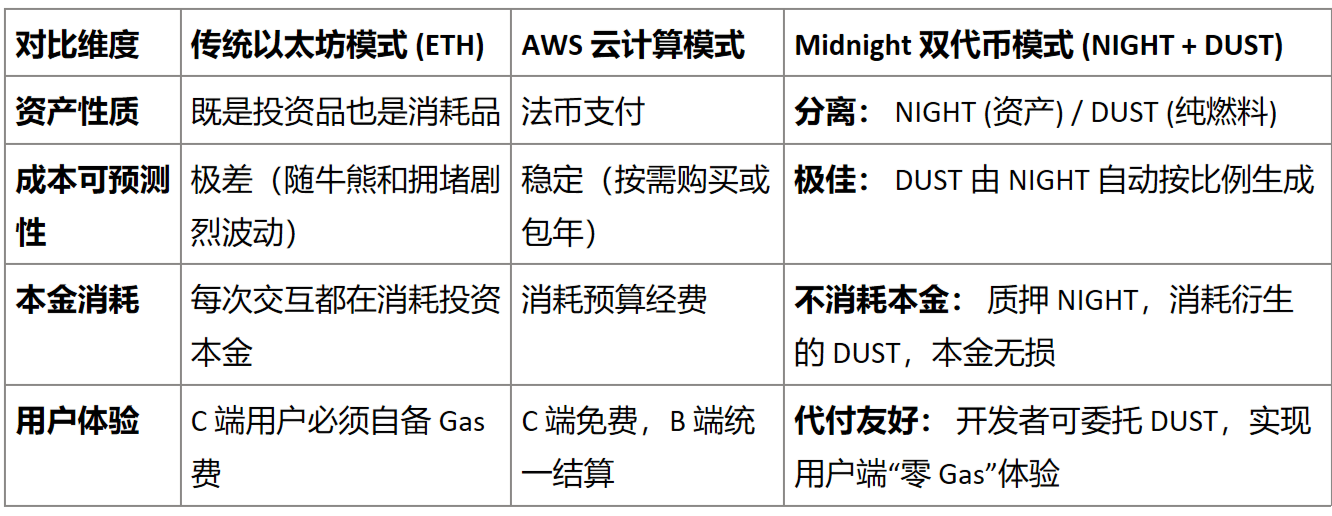
This mechanism known as 'battery charging' allows enterprises and developers to simply purchase and hold a certain number of NIGHT to continuously receive renewable DUST fuel. This completely dispels traditional enterprises' fears of 'uncontrollable on-chain costs'.
The market focus reflected by data: empowering the developer ecosystem
Since launching on Binance on March 11, 2026, the price of NIGHT has stabilized above $0.048, with a market cap of approximately $818 million. However, what truly deserves attention is not the short-term fluctuations in price, but the ecological actions behind it:
The struggle outside the spotlight: Currently, Midnight's 'Mindshare' has not squeezed into the top 30 in the GameFi or Meme tracks most favored by retail investors, indicating that its positioning is very clear—purely to B infrastructure.
Developer Traffic: The official team has recently launched an intensive recruitment for Nightforce Cohort 3 and has introduced the Midnight City simulator. Along with the previously distributed 240 million HODLer airdrop and Super Earn incentives, Midnight is using real funds to 'buy traffic' for the developer ecosystem after the mainnet launch.
Outlook: Can it become the 'invisible foundation' of Web3?
Evaluating the success or failure of Midnight Network should not solely focus on whether it is the highest market cap 'privacy coin', but rather on whether it can attract traditional enterprises that have suffered from data breaches in Web2 and are hesitant to easily touch the Web3 public ledger.
With the launch of the joint mainnet at the end of March and the integration of institutional nodes like Google Cloud, Midnight is laying down a 'highway' wide enough. As long as the army of TypeScript developers begins to get used to this 'privacy cloud service that does not consume principal', it is only a matter of time before NIGHT approaches a $10 billion FDV.
#night @MidnightNetwork $NIGHT
