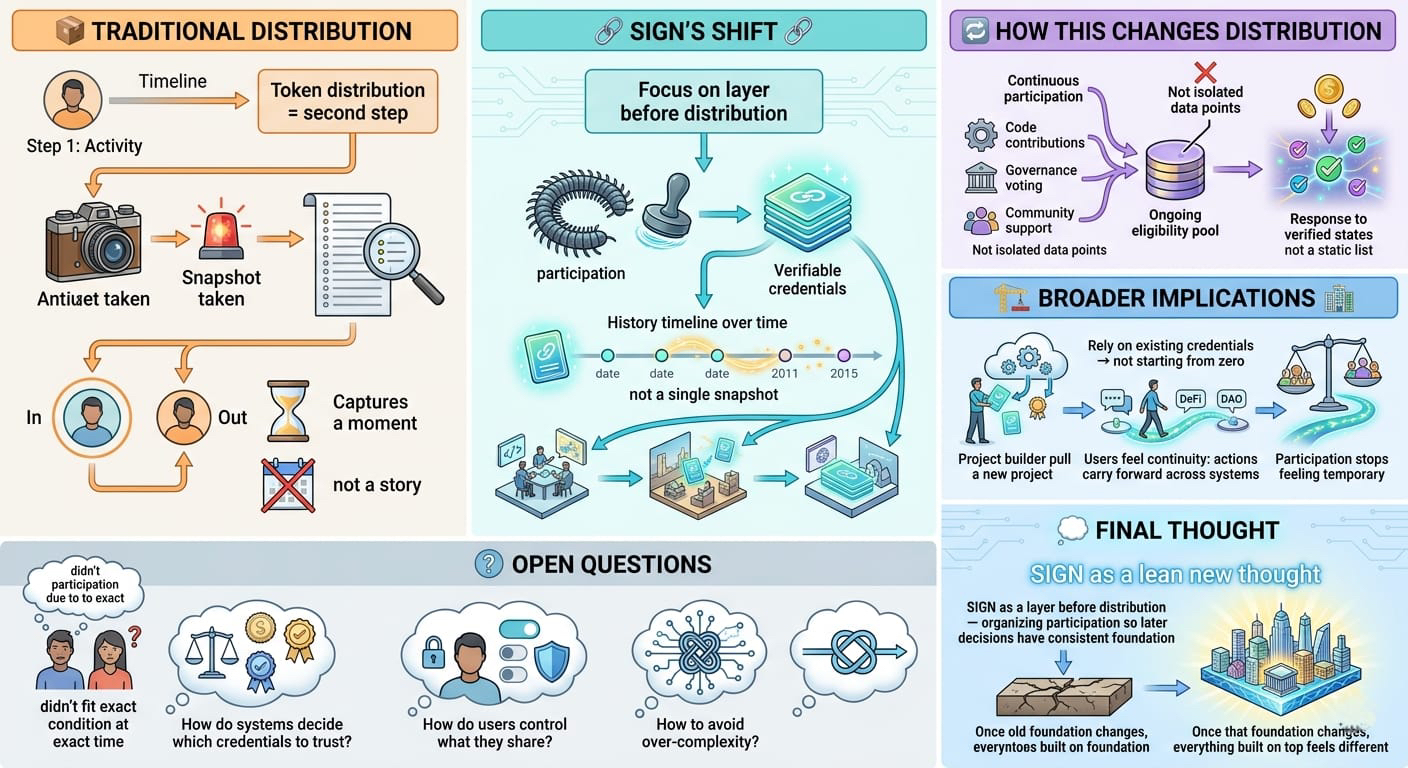
When I first started looking into SIGN, I was thinking about it in the usual order. First comes the token, then comes the distribution. That’s how most projects are structured. You create something, and then you figure out how to give it to people. It’s almost always treated as a second step.
But the more I thought about what SIGN is doing, the more that order started to feel a bit reversed.
It’s less about distributing something that already exists, and more about deciding who should receive something before it even gets there.
That difference is subtle, but it changes how the whole process feels.
In most cases, token distribution is tied to moments. A snapshot is taken. A list is created. Criteria are defined. If you’re on the list, you’re in. If not, you’re out. It works, but it always feels a bit rigid. It captures a moment, not a story.
I remember thinking about how often people miss out on things not because they didn’t contribute, but because they didn’t meet the exact condition at the exact time.
That’s where things start to feel a bit off.
Participation isn’t always clean or perfectly timed. It happens gradually. Sometimes inconsistently. Sometimes across different platforms that don’t even talk to each other.
And that’s the part I kept coming back to while thinking about SIGN.
Instead of focusing only on the final act of distribution, it seems to focus on the layer before that — the layer where participation is recognized and turned into something verifiable.
Not just a record, but something that can actually be used later.
At first, I didn’t think that would make a big difference. But then I started imagining how distribution would look if it wasn’t tied to a single snapshot.
If eligibility could be based on something that evolves over time.
If contributions didn’t disappear just because they happened in the wrong place or at the wrong moment.
That’s where the idea started to feel more practical.
Because most systems today don’t really capture that continuity very well. They rely on isolated data points. A wallet balance at a certain block. An interaction within a limited window. A condition that either applies or doesn’t.
There’s not much room for nuance.
SIGN seems to be trying to create that missing layer.
A way to turn actions, participation, or attributes into credentials that don’t just stay where they were created. They can move. They can be referenced later. They can be used by systems that weren’t even part of the original context.
That changes how distribution can be designed.
It becomes less about selecting from a static list and more about responding to verified states.
I found myself thinking about how that might affect fairness, not in a perfect sense, but in a practical one. If systems can recognize a wider range of contributions, distribution might start to feel less arbitrary.
Not completely fair, but maybe a bit more aligned with what actually happened.
Another thing that stood out to me is how this shifts the responsibility of decision-making. Instead of each project building its own criteria from scratch, they can rely on credentials that already exist. That doesn’t remove decision-making, but it gives it a different foundation.
You’re not starting from zero every time.
You’re building on something that’s already been verified.
That can make systems feel more connected, even if they operate independently.
I also started thinking about how this affects users over time. Right now, a lot of participation in crypto feels temporary. You interact with something, maybe you qualify for something, and then it’s over. There’s not always a sense that your actions carry forward.
If credentials can persist, that changes the feeling a bit.
What you do in one place doesn’t just stay there.
It becomes part of a broader context.
That doesn’t mean everything becomes portable or universally accepted, but it introduces the idea that participation has continuity.
And continuity is something most systems struggle with.
Of course, there are still open questions.
How do systems decide which credentials to trust?
How do users control what they share?
How do you prevent the system from becoming too complex?
Those are things that don’t have simple answers.
But they don’t take away from the underlying shift.
The more I thought about SIGN, the less it felt like a distribution tool and more like a layer that sits before distribution even begins. A way of organizing information about participation so that decisions made later have something more consistent to rely on.
Not perfect.
Not complete.
But structured in a way that feels closer to how real participation actually works.
And maybe that’s the part that matters.
Not the distribution itself, but what it’s based on.
Because once that foundation changes, everything built on top of it starts to feel slightly different.
Even if it takes a while to notice.