
I was scrolling through a few charts late at night, the kind of quiet hour where everything feels slower, and I kept noticing something subtle. It wasn’t about price action or volatility this time. It was the way different chains were moving almost independently, like separate ecosystems with their own rhythms, yet still somehow tied together. You’d see one network picking up activity while another cooled off, and it didn’t feel like competition in the usual sense. It felt more like… rotation.
That’s when the whole idea of “multi-chain” stopped feeling like a buzzword and started feeling like something more natural. Not a narrative pushed by projects, but something that’s quietly happening underneath everything.
I remember a time when people treated chains like tribes. You picked one, you defended it, you stuck with it. Ethereum, BNB Chain, Solana, whatever it was, there was this unspoken expectation that you stayed loyal. But now, it feels like most active users don’t think like that anymore. They just move where things are happening.
Liquidity moves. Attention moves. Builders move. And users follow without really thinking about it.
What stood out to me recently was how normal it’s become to bridge assets without second guessing. A couple of years ago, bridging felt risky, almost experimental. Now it’s just part of the flow. You see people jumping across chains for a mint, a yield opportunity, or even just to try a new app. It’s not even discussed much anymore, it’s just assumed.
And that shift says a lot.
Because if users don’t care what chain they’re on, then what actually matters is the experience, the tools, and the communities built around them. The chain itself starts to feel more like infrastructure than identity.
I noticed something interesting while watching how new projects launch. Many of them don’t even try to lock themselves into a single chain narrative anymore. Instead, they talk about expansion from day one. It’s almost like they expect to exist everywhere eventually. Not because it sounds impressive, but because it’s becoming necessary.
From what I’ve seen over the past few cycles, every time the market matures a bit, it moves toward flexibility. Early on, things are rigid. Later, they become fluid. Multi-chain feels like part of that natural evolution.
There’s also this quiet realization happening among developers. It’s not just about building on the “best” chain anymore, whatever that means at the time. It’s about reaching users wherever they already are. That mindset changes how things are designed. You start seeing more modular architectures, more abstraction layers, more focus on interoperability.
It’s one of those things in crypto that doesn’t get talked about enough. The user experience is slowly detaching from the underlying chain. Wallets are improving. Interfaces are hiding complexity. And over time, people might not even know which chain they’re interacting with at any given moment.
That idea used to feel distant. Now it feels close.
At the same time, there’s still this tension between chains. Not in an aggressive way, but in how they differentiate themselves. Some focus on speed. Others on security. Others on ecosystem depth. And that differentiation still matters, because it shapes what gets built on top.
So even in a multi-chain world, chains don’t become irrelevant. They just become specialized.
I’ve also been paying attention to how partnerships are forming across chains. It used to be more siloed. Now you see protocols integrating with multiple ecosystems, sometimes even simultaneously. Bridges, messaging layers, shared liquidity solutions, they’re all trying to stitch everything together.
It feels less like isolated networks and more like a fragmented but connected system.
And then there’s the role of users who don’t even realize they’re part of this shift. Someone swaps on one chain, stakes on another, maybe mints something somewhere else, all within the same week. No big announcement, no grand strategy. Just normal behavior.
That kind of organic usage is probably more important than any roadmap.
What made me pause the other day was noticing how narratives follow this multi-chain movement. When activity spikes on one chain, the conversation shifts there. When it fades, attention drifts elsewhere. It’s almost like the market itself is multi-chain in mindset now, constantly scanning for where things are happening.
It makes the whole space feel more dynamic, but also harder to pin down.
There’s also a subtle shift in how risk is perceived. Instead of being tied to one ecosystem, exposure is spread out. People experiment more, but in smaller pieces. That changes behavior in ways that aren’t immediately obvious.
It encourages exploration.
And exploration is kind of what crypto has always been about, even if we forget that sometimes.
I keep thinking about how this all plays out over time. If everything continues moving toward a more connected, multi-chain environment, then the winners might not be the chains themselves, but the layers that make moving between them seamless.
That’s where things get interesting.
Because if the friction disappears, then the boundaries start to blur. And when boundaries blur, competition changes. It’s no longer chain versus chain. It becomes experience versus experience.
What stood out to me recently is how little people talk about “which chain is best” compared to before. That conversation still exists, but it feels less central. Instead, people talk about apps, yields, communities, and opportunities.
The chain is there, but it’s not always the main character anymore.
Still, there’s something unfinished about all of this. Multi-chain sounds smooth in theory, but in practice, there are still rough edges. Bridges can fail. Liquidity can fragment. UX can break in small but frustrating ways.
It’s not fully solved. It’s just… improving.
And maybe that’s the point. Crypto rarely jumps from broken to perfect. It moves through phases where things are messy but getting better. Multi-chain feels like it’s in that phase right now.
Not quite seamless, but no longer awkward.
I also wonder how this affects long term identity in crypto. If users aren’t tied to chains anymore, what do they anchor to? Is it communities, protocols, or just opportunities? Maybe a mix of all three.
It’s a different kind of loyalty.
Not fixed, but fluid.
Sometimes I think back to earlier cycles where everything felt more defined. Clear leaders, clear narratives, clear divisions. Now it feels more like a web, constantly shifting, harder to map, but also more alive.
And maybe that’s what a mature ecosystem looks like.
Not simple. Not linear. Just interconnected.
Sitting there watching the charts that night, it didn’t feel like one chain was winning or losing. It felt like the whole space was learning how to coexist in a more complex way.
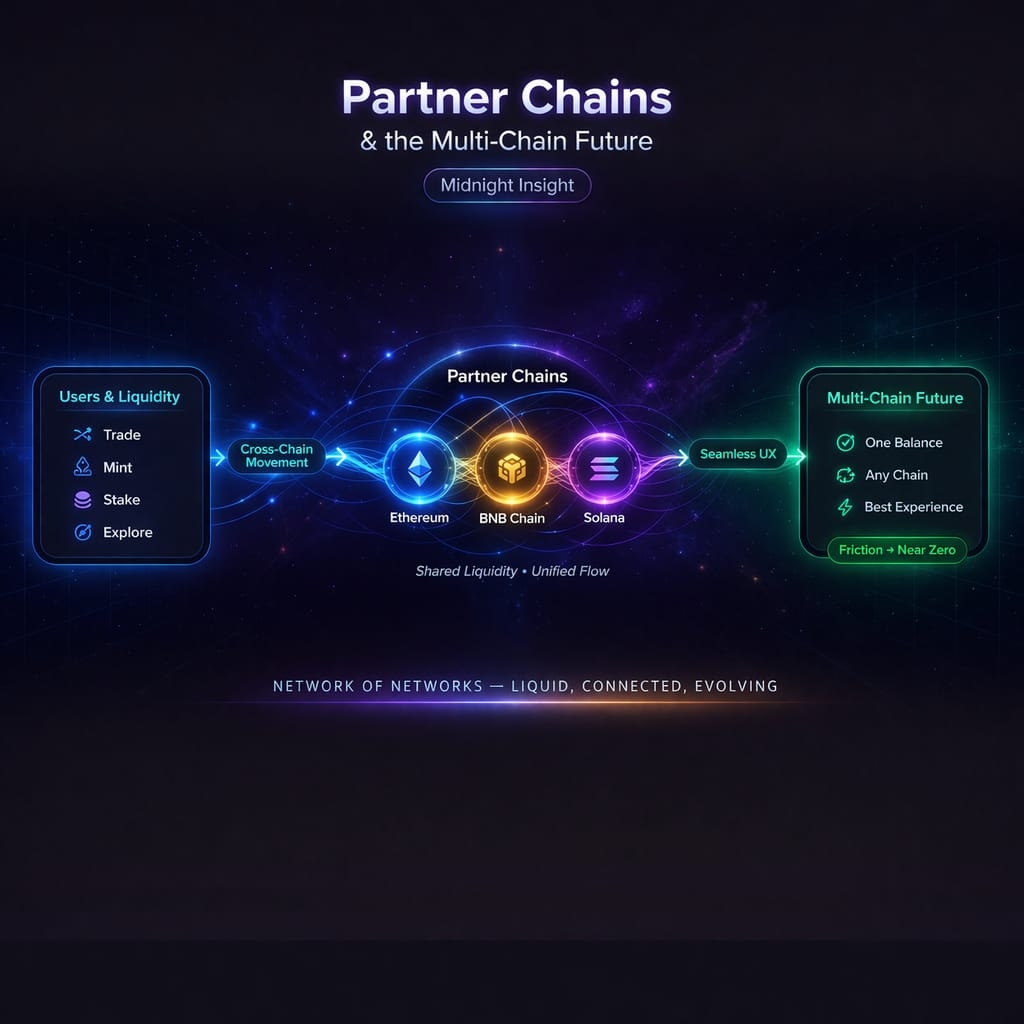
Partner chains, shared liquidity, cross-chain users, it all blends together into something that’s still taking shape.
And the interesting part is, it’s happening quietly. No single moment where everything changed. Just a gradual shift in how people build, move, and think.
It makes me wonder what this all looks like a year or two from now. Whether we’ll still talk about chains the way we do today, or if they’ll fade further into the background.
Either way, it feels like we’re already past the point of going back to a single-chain mindset.
The future doesn’t look like one dominant ecosystem anymore.
It looks more like a network of networks, loosely connected, constantly evolving, and still figuring itself out in real time.
@MidnightNetwork #night $NIGHT #Night
