


Featuring insights from PromptRaise Founders.
The marketing world is facing a tectonic shift, the kind that happens once a decade. While traditional agencies continue operating on autopilot, polishing meta tags and building backlinks for Google, their clients have already changed their habits.
According to the latest market data from SparkToro and Similarweb in March 2026, 72% of B2B buyers now begin their purchase journey with ChatGPT, Claude, Perplexity, or Gemini.
If a neural network does not mention a brand among the 2 to 7 recommended answers, that brand simply does not exist for the present market.
The Transformation of Traditional SEO
Traditional SEO was built on playing hide-and-seek with Google's algorithms but now GEO is an added cherry on the top. Today's user wants one verified, clear answer.

The statistics we see are striking:
Conversion from AI search stands at 14.2%, while the average Google figure barely reaches 2.8%.
Traffic from neural networks is 5x more valuable because AI has already done the preliminary work: it has warmed up the user, addressed basic objections, and surfaced a specific brand as the expert solution.
When an LLM tells a user that a certain company is the best fit for their task, it delivers a verified lead with the highest possible level of trust. Brands absent from that answer are losing a customer to a competitor who invested in AI visibility.
The AI Slop Phenomenon
The internet has been flooded with what is known as AI Slop which is a low-quality, AI-generated content created purely for volume. Brands attempt to saturate the internet with articles, hoping for indexation.
Modern LLMs have learned to filter out this noise. They analyze authority and authenticity.
For investors: When an institutional fund requests a niche analysis and AI ignores a project, that project loses a funding round before the first call.
For reputation: If data about a brand is outdated or distorted, AI will broadcast those errors to millions of users.
Addressing AI Slop means replacing information noise with clearly structured, verifiable data that neural networks process as authoritative and reliable. This is where the shift from simple SEO to systematic data management becomes critical.
How PromptRaise Manages AI Visibility
While many brands are still trying to understand how generative engines select their sources, PromptRaise has already moved into the execution phase.
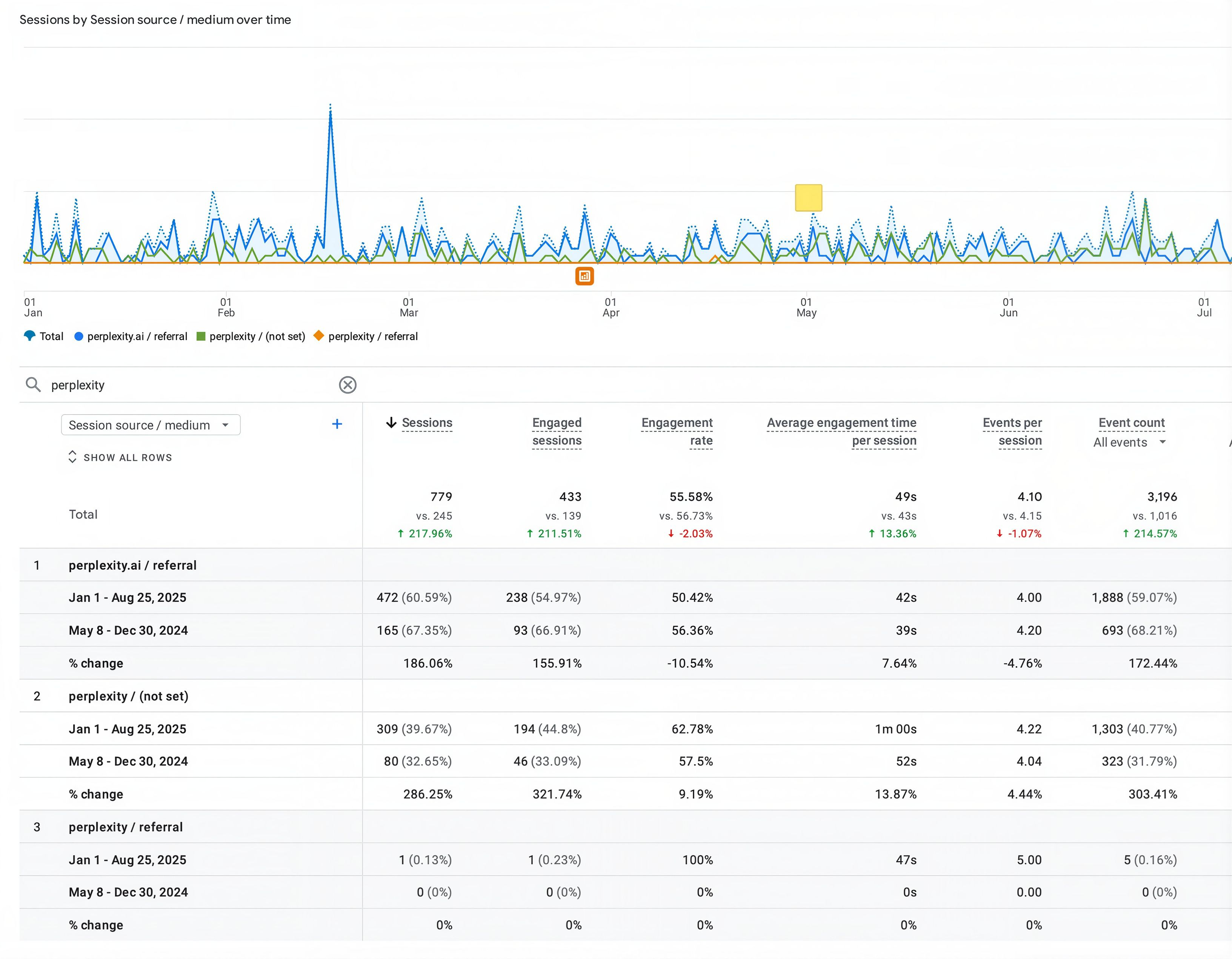
Data shows that consistent visibility in AI responses leads to a direct and measurable increase in high-quality referral traffic.
To address these shifts, PromptRaise was developed as a linear and full-cycle brand visibility management system built on Generative Engine Optimization. PromptRaise work is built on three fundamental pillars:
Deep AI Audit: Brands are analyzed across 9+ critical metrics on 20-30 tailored prompts on each LLMs along with source attribution of the responses. Then each response is decomposed into source references, entity mentions, and ranking position within the generated answer. This produces a structured visibility map rather than a generic score.
Strategic Content Engineering: Rather than producing generic articles, PromptRaise algorithm creates data nodes, content optimized for the learning and visibility mechanisms of LLMs, embedded where neural networks draw their knowledge: whitepapers, expert media, technical forums.
Closing the Loop: Most tools on the market simply confirm the fact of a brand's invisibility by sharing a report of where a particular brand is. We instead actively change the output, working until AI systems begin surfacing the brand in relevant responses.
GEO is not content marketing. It's information architecture i.e. building a version of your brand that AI systems can find, trust, parse, and repeat accurately.
These three pillars form a closed-loop system that takes full ownership of the outcome, from the first audit to the moment AI starts recommending a brand by name.
Case Studies and Real Analytics
The PromptRaise methodology has been tested and refined in some of the most competitive markets, including Web3, Infrastructure, and High-Tech, where the competition for AI attention is at its highest.
— Case Study 1: GA4 Analytics as Proof of Performance
Take a look at the Google Analytics data from our clients, the very screenshots we keep as evidence of success.
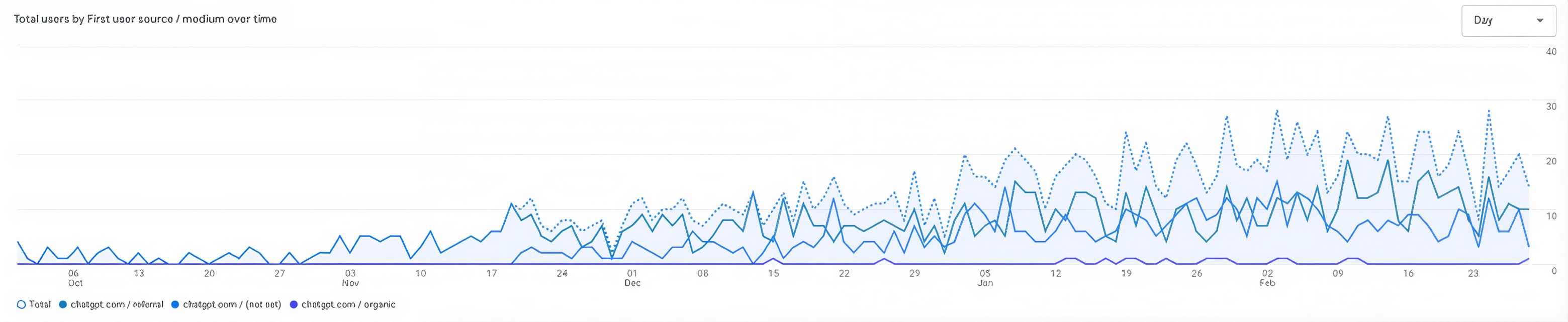
ChatGPT as the #1 traffic source: The graphs clearly show that sessions from ChatGPT frequently outperform organic Google traffic and direct visits.
Mobile dominance: 100% of this traffic comes from mobile devices. This is a modern, dynamic audience making decisions in real time.
Engagement: The average engagement time is approximately 46 to 50 seconds. These are people who arrived at the site on a direct AI recommendation and already know exactly what they need.
— Case Study 2: Global Reach and a 1400% Jump
One of PromptRaise clients in the Web3 infrastructure space had a strong reputation in Europe but was a complete blind spot for AI users in Asia.
Result: After 3 months of work, brand mentions in ChatGPT responses to regional queries grew by 1400%.
Effect: The project became the #1 answer to investor queries from India and Singapore, leading to organic partnership growth with zero spend on paid advertising.
These results are the natural outcome of a methodology built for the way AI actually works today. Every metric tracked points to the same conclusion: brands that invest in AI visibility early consistently outperform those who wait.
Why Timing Matters
AI models are pre-trained on massive datasets. The longer a brand is absent from those datasets, the harder it becomes to shift how neural networks perceive it. Companies entering GEO today are building a durable competitive position, one that becomes significantly harder to displace over time.
Investors, partners, and clients are already asking AI questions. The brands showing up in those answers are capturing attention, trust, and deals that others are not even aware they are losing.
Notes from PromptRaise Founders
We spoke with the founders of PromptRaise to get their perspective on how this shift is playing out on the front lines of Web3 and AI marketing.
Maxim Moris, who leads PromptRaise while also serving as the CEO of Cicada Market Making, shared his take on why traditional playbooks are no longer enough.
As someone with a journalism degree and 10+ years in PR, I can say this shift is long overdue. Web3 projects are still running 2021 playbooks: buy KOLs, push volume, hope for virality.
The problem is that the audience has moved. Investors, partners, and users are increasingly asking ChatGPT or Perplexity before they ask Twitter. And no KOL tweet shows up in that answer.
LLMs don't rank posts, they synthesize sources. Which means the question is no longer “how many impressions did we get” but “what does AI actually know about this project”. Creating content that genuinely explains what a project does, why it matters, and how it compares - that's harder than a KOL campaign.
It takes more time, more expertise, more patience. But it's exactly the kind of signal that LLMs pick up. Web3 marketing will have to grow up at some point. Might as well be now.
We also caught up with Zain Khan, Co-Founder of PromptRaise, whose background in anthropology and AI marketing provides a different lens on how users interact with these new interfaces.
My master’s in Anthropology taught me one truth: tools change, but behavior is immune to change. As humans we default to the path of least resistance, and today that path is enabled by AI.
In the Web3 industry, information has always been fragmented, from whitepapers, Discord threads, Telegram groups etc. This made distribution the A game. But AI changed the interface and levelled the playground. Decisions are increasingly shaped by synthesized answers, not scattered sources.
Visibility is no longer about being talked about. It’s about whether your project is consistently represented in the knowledge layer these models construct.
At PromptRaise, we make projects legible to AI, ensuring they are accurately indexed and reliably retrievable when models synthesize answers about the volatile, fast-moving crypto landscape. Because in a market full of noise, AI doesn’t amplify, it compresses.
What survives that compression becomes perceived truth and captures the digital mindshare of visibility and ranking. I am obsessed with solving this ranking and visibility problem for the industry.
These insights highlight a clear consensus: the industry is moving away from shouting and toward legibility. To survive the AI compression, a brand must be architecturally sound.
Conclusion
The old school of marketing operated on a simple principle: be where the customers are. Today, customers are now inside an AI interface. They are asking a single question and trusting a single answer.
The brands that understand this shift are actively shaping what AI knows about them, how it describes them, and who it recommends them to.
Don't Be the Search Result. Be the Answer.