

I did not realise how deep the problem was until i stopped comparing blockchain in features and started comparing them on how they think about ownership. Because if you strip everything down $ETH and most modern chains are built on one core assumption that value should live inside accouns. It sounds you normal and even obvious. You have a wallet and it has a balance and every transaction just updates numbes, clean, simple and easy to understand. But the more i think about it the more it feels like this model was designed for convenience not for scale, not for privacy and definitely not for the kind of systems we are trying to build today. $NIGHT 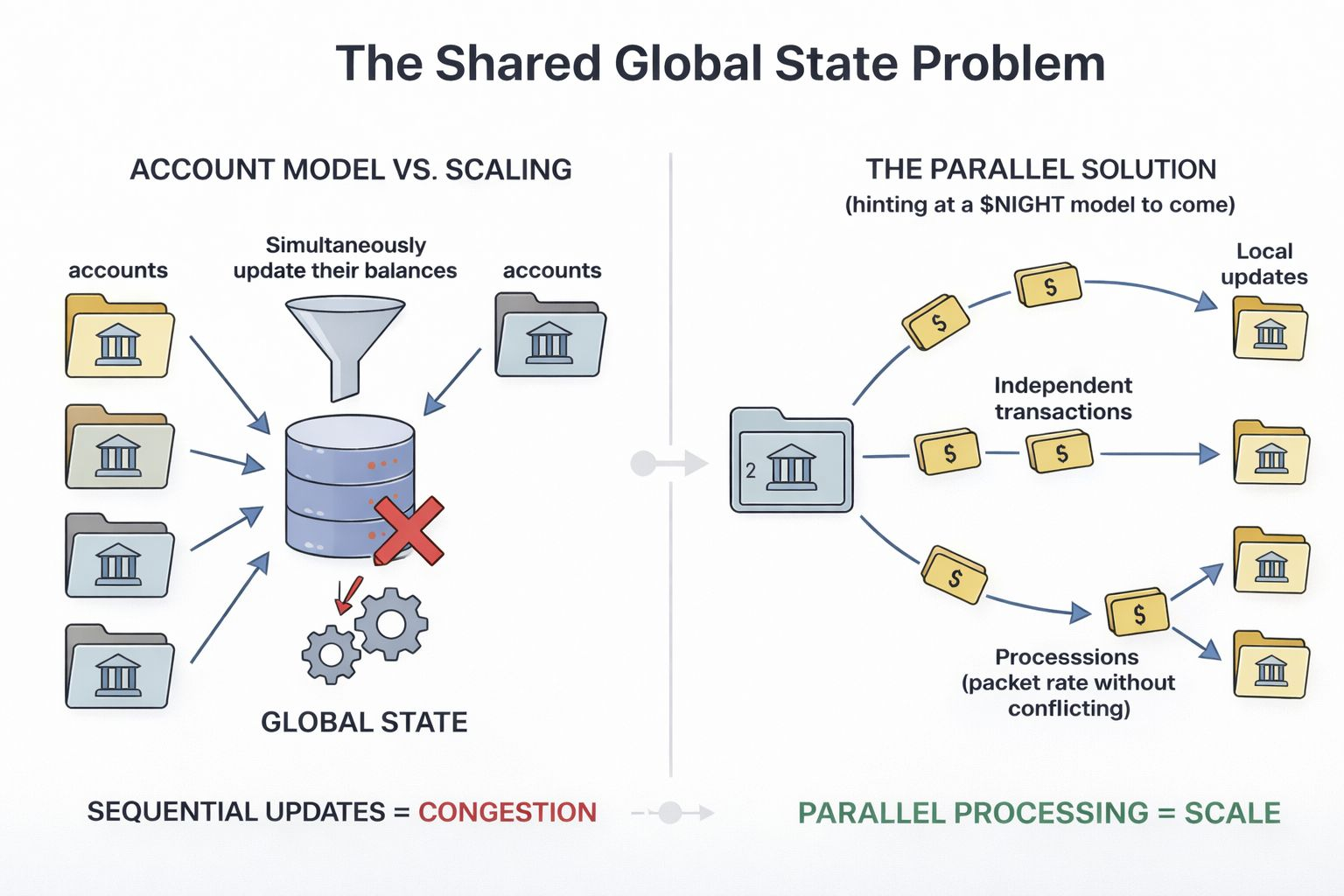

As every time you send a transection on #Ethereum you are not just moving value but you are modifying a shared global state. That means every transaction depends on what came before it. Every update has to be processed continuous and traceable link back to the same identity. That is not just a technical limitation. It is design choice that quietly shapes everything as from gas fees to MEV and to the fact that you entire financial behavior can be mapped over time.
For a long time i thought these were just trade offs of decentralization. But now I am starting to think they are consequences of choosing the wrong foundation. why I am thinking this is wrong because @MidnightNetwork approches this from a completely different different angle and honestly it took me a while to fully grasp why it matters. Because it does not start with accounts. It starts with outputs. In midnight network value is not stored as a balance tied to your identity. It exists as discrete pieces as UTXOs. When you spend you do not update anything globally. You consume one piece and create new ones. Because here no shared balance and no single state being rewritten as just transections.
At first this feels you like a small architecture tweak. But if you really sit with it you start to see the ripple effects. In Ethereum two transections touching the same account can not happen at the same time. They complete. That is where congestion begins. In a UTXO system transections are independent as long as they do not touch the same inputs. That means parallelism is not an optimization but it is native. And suddenly, scalability stops being about squeezing more into blocks and starts being about structuring the system differently. 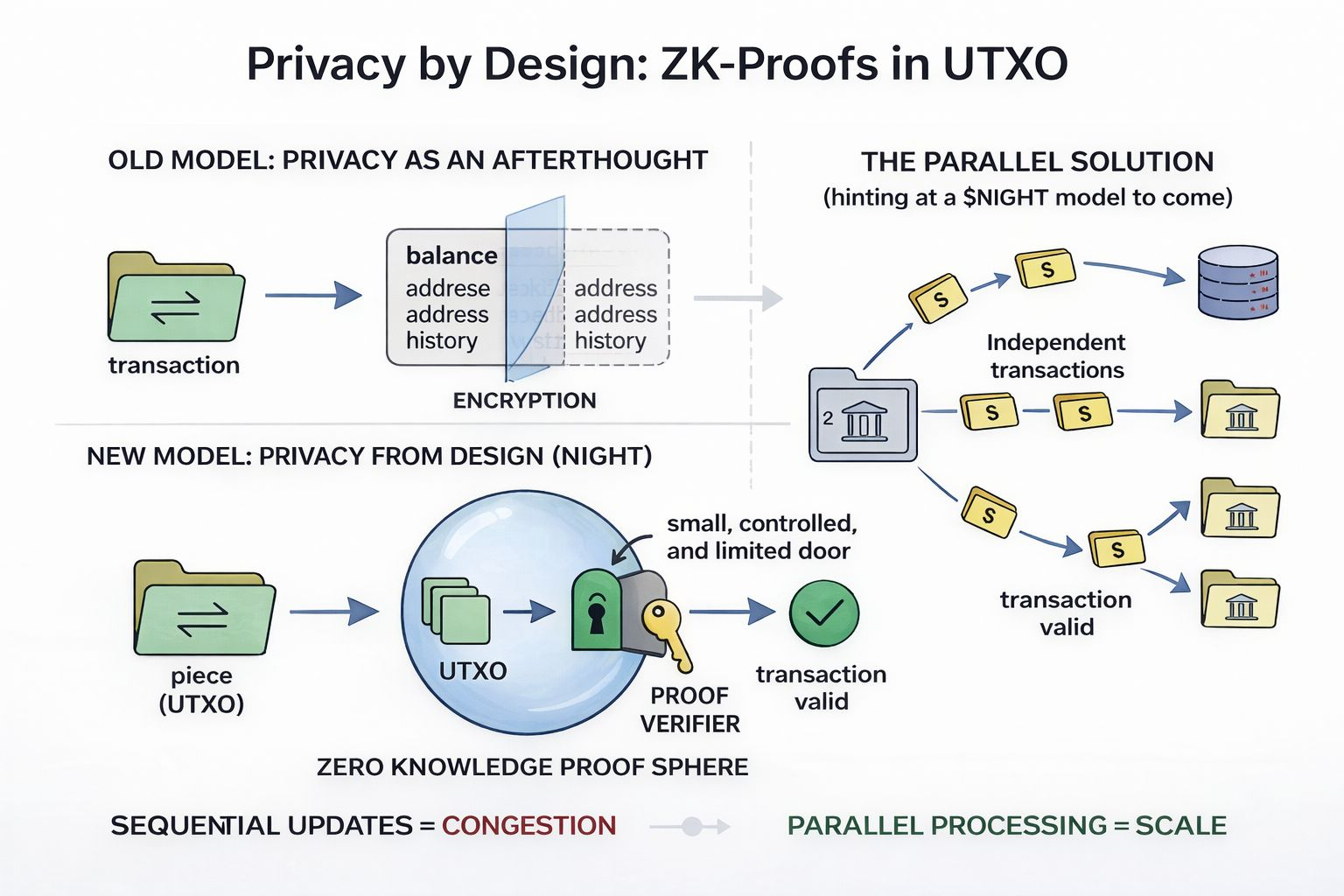
But the part that changed how I see things is not even performance. It is privacy. Because in an account model your entire activity revolves around a single identity. Even if addresses change and the logic still encourages linkage. Your balance is the anchor that ties everything together. In midnight model there is no single anchor. Your wealth is just a collection of separate pieces. When you spend those pieces are destroyed and recreated. There is no continuous thread that needs to exist. And when you combine that with zeri knowledge proofs something interesting happens. Privacy is not something you bolt on. It emerges from how the system works. You can prove a transaction is valid without the underlying details. Not by hiding everything blindly but by controlling what gets revealed and when. That is a completely different mindset of midnight from Ethereum where transparency is the default and privacy is an afterthought. And this is where i think most people are still underestimating midnight.
I think midnight is not trying to be a better Ethereum. It is questioning whether Ethereum's core model should have been the standard in the first place. Even the flexibility here feels intentional.
Midnight doesn't force everything into UTXO. It still supports account style tokens for cases where that model actually makes sense like complex DeFi logic. But for value transfer, privacy and efficiency. It leans into UTXO where it actually has advantages. That hybrid approach says a lot because instead of forcing the ecosystem to adapt to one model. It adapts the model to the use cases.
And the more i think about it the more uncomfortable it gets to ignore this shift for me because if scalability issues, privacy leakdvand high fees ara all symptoms. Then maybe the real problem is not execution. Maybe it is the assumption that accounts were the right starting point. And if that assumption is wrong.
Then midnight is not just improving blockchain it is connecting it.
Thnx for pay attention to this matter. Let's me know your deep thoughts on this matter for buliding a bright future in Web3 and blockchain Era.