If you only consider @MidnightNetwork as a 'privacy chain', then you basically only understand 30%.
Its real technical goal is:
Complete computation and verification without exposing data
The difficulty of this matter is far greater than traditional blockchains.
1. Core issue: Why is it difficult to achieve privacy with blockchain?
Traditional blockchains (like Ethereum) have a fundamental principle:
All nodes must validate all transactions
This means:
Data must be public
Logic must be transparent
Otherwise, the network cannot reach consensus.
Whereas the requirement for privacy is precisely the opposite:
Data cannot be seen
This forms a classic contradiction:
How to confirm that data is correct without 'looking at data'?
Two, Midnight's technical core: ZK + dual-layer architecture
$NIGHT 's solution can be broken down into two keywords:
Zero-knowledge proof (ZK) + layered execution architecture
1️⃣ Zero-knowledge proof (ZK): verification ≠ exposure
Core idea:
Prove 'you are right', but do not tell others 'what you specifically did'
Here's a more technical example:
Traditional chain verification:
Directly view transaction data
Midnight verification:
Verify a 'proof'
This proof will demonstrate:
The input is legitimate
The computation is correct
The result complies with the rules
But will not expose:
Input data
Intermediate process
This is the essence of ZK:
Computations are verifiable, but data is not visible
2️⃣ Layered architecture: separation of execution and verification
Midnight does not put all computations on-chain, but adopts a 'modular blockchain' approach:
🔹 Execution layer (Off-chain / private computation)
Smart contracts execute in a private environment
Data will not be made public
🔹 Proof layer (ZK Proof)
Generate proof
Prove the correctness of computation
🔹 Settlement layer (On-chain)
Submit proof to the chain
The network only verifies proof
Similar to a one-sentence summary:
"Logic does not run on the chain, it only verifies results"
Three, key differences between Midnight and traditional privacy chains
Many people will compare it with
Monero
but the technical paths are completely different.
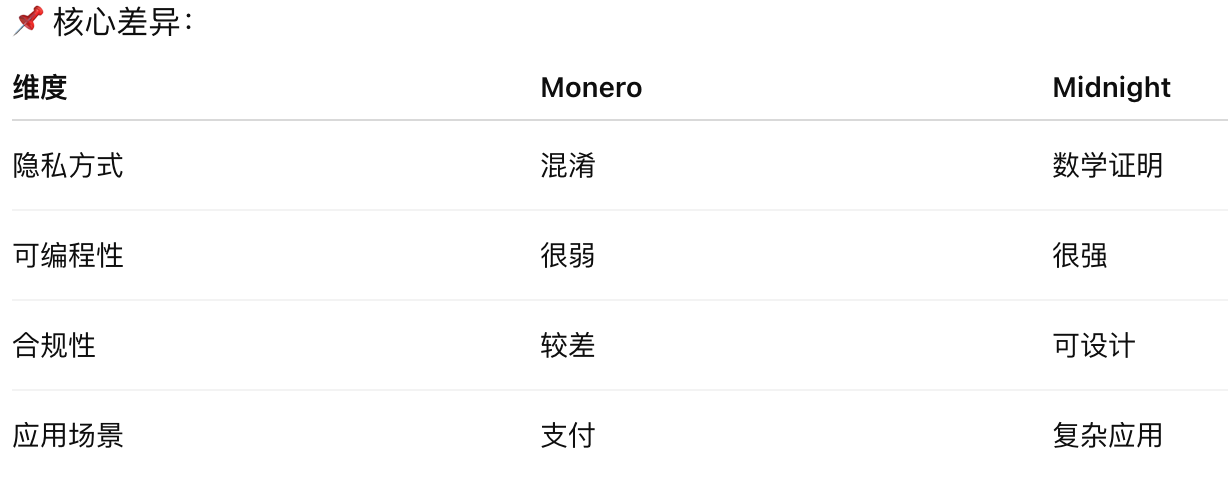
Monero model (Privacy = Obfuscation)
Ring Signature
Stealth Address
Mixing mechanism
Essence:
Make data difficult to trace
🔻 Midnight model (Privacy = Proof)
Zero-knowledge proof (ZK)
Programmable verification logic
Essence:
Do not expose data, but still verifiable
Four, the evolution of smart contracts: from 'public execution' to 'private execution'
On Ethereum:
Contract code is public
Input is public
Output is public
Completely transparent
While Midnight's smart contracts are closer to:
Confidential Smart Contracts
It has three key capabilities:
🔹 1. Private Inputs
User data will not be exposed
🔹 2. Private State
Plaintext state is not stored on-chain
🔹 3. Verifiable Outputs
Ensure correctness through ZK proof
This essentially integrates 'privacy' into the computational model
Five, cross-chain and ecosystem: why must it rely on Cardano?
Cardano's role in the Midnight system is more like: #night
Secure settlement layer + Ecological entry
There are three reasons:
1️⃣ Security inheritance
Midnight can leverage Cardano's consensus and security model
2️⃣ Asset flow
Users can switch between public chains and privacy chains
3️⃣ Application interoperability
DeFi / Identity / NFT, etc., can connect to the privacy layer
This is similar to:
Public world (Cardano) + Private world (Midnight)
Six, technical challenges: Midnight's real challenge
Although the design is advanced, there are also several real-world challenges:
⚠️ 1. ZK computation cost is high
Generating proof consumes a lot of resources
High requirements for user devices/networks
⚠️ 2. High development threshold
Developers need to understand ZK
Contract model is more complex
⚠️ 3. User experience issues
Private key + Privacy + Proof = More complexity
This is also why the ZK track has not fully exploded yet