
24/03/2026
1. The Current State of the Strait
As of today, the Strait of Hormuz, through which 20% of the world's oil passes, is under the iron control of the Iranian Revolutionary Guard. After 23 days of hostilities, commercial navigation is practically paralyzed.
2. The "New Regime" of Tolls
Iran has formally proposed a "new navigation regime." Under this premise, Tehran argues that it has the right to charge for the security and maintenance of the route.
Currency: The use of the Chinese Yuan and other local currencies is promoted to undermine the U.S.-led financial system.
Conditions: To obtain the "safe passage", nations must demonstrate neutrality. Iran has demanded that countries expel the ambassadors of Israel and the U.S. as proof of "good will".
3. Status for Countries and Regions
Iran allows transit under strict supervision to only a small group. These countries are holding direct talks with the Revolutionary Guard to avoid attacks.
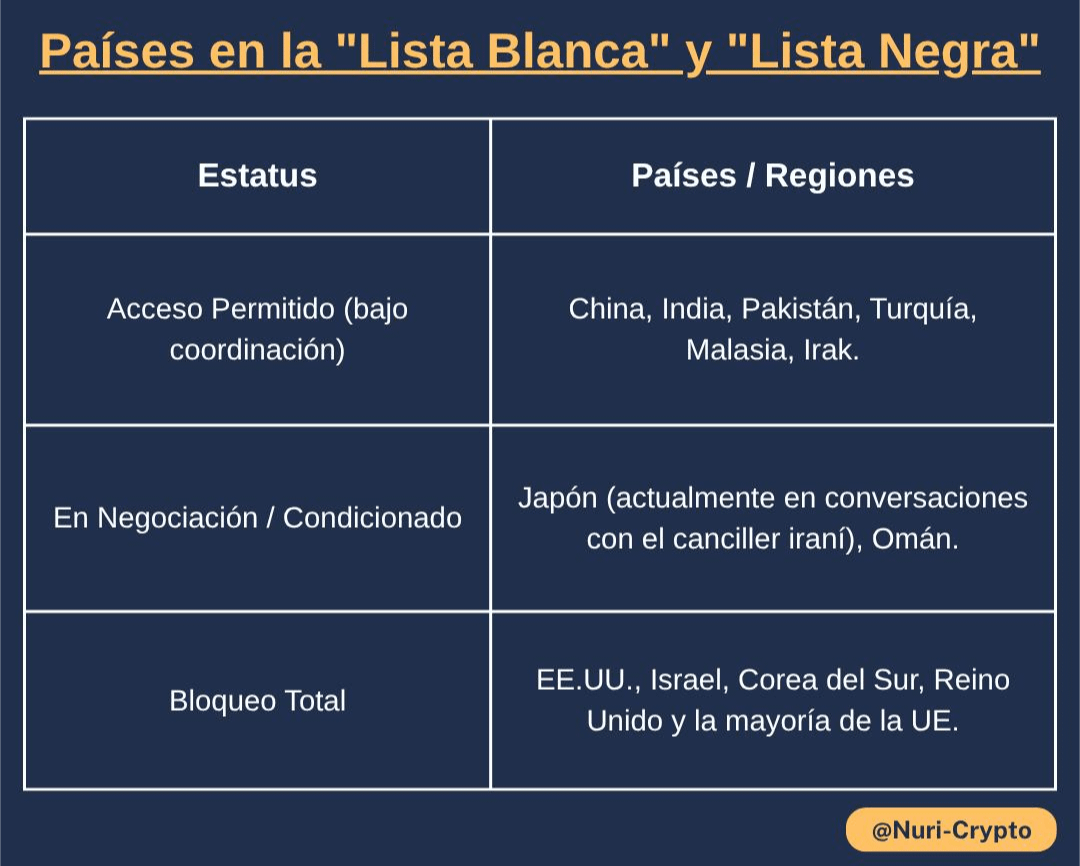
Condition of Neutrality: Tehran has demanded Gulf nations and other trading partners to demonstrate their neutrality (even suggesting the expulsion of Western diplomats) to ensure that their exports are not blocked.
4. Global Economic Impact
Oil Price: The Brent barrel reached $126 USD in early March. Today, following news of possible negotiations, it fluctuates near $97 - $100 USD, but remains at crisis levels.
Inflation and Logistics: Insurance premiums for "war risk" have risen by up to 400%. This adds a cost of approximately $250,000 USD extra for each journey of a supertanker, a cost that is directly passed on to the end consumer in gasoline and manufactured goods.
Trade at Risk: An estimated $1.2 trillion in annual trade is at risk if the blockade persists for more than 28 days, particularly affecting the fertilizer industries (8-10% of the global supply comes from this area) and aluminum.
5. Impact on the Crypto Ecosystem
The cryptocurrency market is functioning as a thermometer of geopolitical fear:
Bitcoin (BTC): It has experienced significant volatility, dropping today to levels of $67,300 - $68,000 USD. While some see it as "digital gold", in times of imminent war, investors typically liquidate risky assets to seek refuge in cash (dollars) or physical gold.
Market Sentiment: The announcement of the U.S. ultimatum triggered massive sell-offs in Asia, as a total military escalation could destabilize mining nodes and technological infrastructure in the region.
6. The U.S. response (Donald Trump)
The administration of Donald Trump has adopted a "maximum pressure" stance with a reported tactical shift today:
Military Deployment: Despite the pause, the U.S. Navy has mobilized the amphibious groups USS Tripoli and USS Boxer to the area, along with Marine units, ready for a forced reopening operation if diplomacy fails this weekend.
New movements are still expected for the rest of the day.
Verifiable Sources (Consulted on 03/24/2026):
Financial Times / UNITED24 Media: Reports on the toll of $2 million and the control of the Revolutionary Guard.
The Hindu: US-Israeli war on Iran LIVE updates (03/24/2026).
CBS News / The Hindu: Update on the postponement of Trump's ultimatum and the alleged negotiations.
Bloomberg / Gotrade: Analysis of the impact on Bitcoin's price and commodity markets.
#noticias #TRUMP #IranVsUSA #BTC #nuricrypto


