
I have been going through everything written about Midnight's economic design for the past week and the thing that keeps hitting me is that nobody is talking about the liquidity fragmentation problem and what it actually means for the long term health of the entire ecosystem and I think when people finally start paying attention to this one it is going to reframe a lot of conversations that are currently happening in completely the wrong direction 😂
let me start with something that sounds obvious but has implications that run much deeper than the surface.
Midnight is not one network. it is two networks running simultaneously sharing the same underlying infrastructure. you have the public layer where state is visible, transactions are transparent, and the normal rules of blockchain economics apply in ways that are familiar and well understood. and you have the private layer where state is shielded, transactions are hidden, and the economics behave in ways that are genuinely novel and not well mapped yet.
most discussions of Midnight treat these two layers as complementary by design. public for what needs to be public. private for what needs to be private. a clean separation that serves users by letting them choose the appropriate layer for each piece of their activity.
that framing is not wrong exactly. but it misses something important about what happens to liquidity when it has to exist across two fundamentally different economic environments simultaneously.
liquidity is not just a number. it is a behavior. it is the aggregate result of thousands of individual decisions about where to deploy capital based on where that capital can do the most useful work at the lowest risk for the highest return. liquidity moves toward efficiency. it clusters in places where it can be used most productively and it drains away from places where it is stranded or underutilized or exposed to unnecessary risk.
on a transparent chain liquidity clustering is visible and self-correcting. you can see where liquidity is concentrated. you can see where it is thin. market participants respond to visible liquidity signals by moving capital toward opportunities and away from risks. the transparency of the chain makes liquidity a self-organizing system that tends toward efficiency over time even without any central coordination.
on Midnight the private layer breaks this self-organizing property in a specific and important way.
liquidity in the shielded environment is invisible. not just to outside observers. to other participants in the shielded environment as well. nobody can see the aggregate private liquidity position across Midnight applications. nobody can observe where private capital is concentrated or thin. nobody can respond to private liquidity signals because those signals do not exist in any form that market participants can act on.
the efficient allocation of liquidity requires information. the private layer systematically eliminates the information that efficient liquidity allocation depends on.
and here is where the fragmentation problem actually starts.
an application developer building a Midnight application that requires liquidity — a private lending protocol, a shielded trading mechanism, a confidential yield product — faces a fundamental uncertainty that transparent chain developers do not face.
on Ethereum a developer building a new DeFi protocol can look at existing protocols, see their liquidity depth, understand the competitive landscape, and make informed decisions about where their protocol sits in the ecosystem and what liquidity they can realistically expect to attract.
on Midnight's private layer that competitive intelligence does not exist. the existing private liquidity positions of competing applications are invisible. a developer building into the private layer is building into an information vacuum. they cannot see what they are competing against. they cannot calibrate their incentive structure to the actual liquidity environment they are entering. they are making capital allocation decisions without the market information that makes those decisions rational.
the result of that information vacuum across many application developers is fragmented liquidity. capital deployed into multiple private applications based on assumptions about the competitive landscape that cannot be verified because the competitive landscape is invisible.
fragmented liquidity is expensive liquidity. it means thin depth in each application rather than concentrated depth that serves users efficiently. it means price impact for users who need liquidity that would not exist if the same capital were concentrated in fewer places. it means applications that cannot serve large users effectively because their private liquidity pool is too shallow even though the aggregate private liquidity across the ecosystem might be sufficient if it were less fragmented.
on a transparent chain liquidity fragmentation is self-correcting. capital sees better opportunities and moves toward them. arbitrageurs actively profit from liquidity imbalances and in doing so eliminate them. the market for liquidity allocation is efficient because it is transparent.
on Midnight's private layer there is no market for private liquidity allocation in the same sense. capital cannot see better opportunities in the private layer because those opportunities are invisible. arbitrage between private applications is not possible in the traditional sense because neither the arbitrageur nor their capital can observe the state they would need to observe to execute the arbitrage.
private liquidity that is fragmented tends to stay fragmented. the self-correcting mechanism that works on transparent chains does not operate the same way in the shielded environment.
now let me add another layer to this because it gets more complicated when you think about the interaction between public and private liquidity on the same network.
a sophisticated participant on Midnight has a choice about where to deploy capital for every decision they make. some opportunities are better served through the public layer. some are better served through the private layer. the rational participant allocates capital to whichever layer offers better risk-adjusted returns for each specific use case.
but that rational individual allocation across both layers creates an aggregate effect that nobody planned and nobody is managing.
public layer liquidity is visible. participants who see thin public liquidity can respond by deploying more capital there. the public layer self-organizes toward adequate depth because the signals are visible and the responses are immediate.
private layer liquidity is invisible. participants who are considering deploying capital to the private layer cannot see whether that layer is already adequately supplied or desperately thin. they are making deployment decisions without the information those decisions require.
the predictable result of this asymmetry over time is systematic underprovision of private layer liquidity relative to public layer liquidity. not because participants are irrational. because rational participants respond to visible signals and the private layer produces no visible signals.
the public layer ends up with capital competing aggressively for yield because competition is visible and efficient. the private layer ends up with insufficient capital because the case for deploying there cannot be made visible to the participants who could supply it.
and the users who depend on private layer liquidity — the ones who chose Midnight specifically for its privacy guarantees — are the ones who experience the consequences of that underprovision. thin depth. high price impact. limited capacity for large transactions. a private financial environment that is cryptographically sound but economically shallow.
I keep thinking about what the design response to this actually looks like because the liquidity fragmentation problem is not just a consequence of having a private layer. it is a consequence of having a private layer without any mechanism for aggregating and communicating private liquidity information in a way that enables rational capital allocation without destroying privacy.
that is a genuinely hard problem. the information you need to solve the fragmentation problem is exactly the information the privacy model is designed to suppress.
but zero knowledge proofs give you a tool that is relevant here and I think is underutilized in thinking about this problem.
you can prove aggregate facts about private state without revealing individual state. a ZK proof can demonstrate that the aggregate private liquidity across a set of applications exceeds a threshold without revealing the liquidity position of any individual application. it can demonstrate that demand for private liquidity in a certain category exceeds current supply without revealing who is demanding it or exactly how much.
that kind of aggregate privacy-preserving signal is not the full transparency that transparent chain liquidity markets depend on. but it is more information than nothing. it gives capital allocators something to act on. it creates the possibility of a market for private liquidity provision that is less efficient than a fully transparent market but significantly more efficient than a completely dark one.
the infrastructure for generating and distributing those aggregate ZK proofs of private liquidity state would need to be built deliberately. it would not emerge organically from the existing architecture. it requires someone to decide that aggregate private liquidity signaling is a valuable infrastructure component and invest in building it.
that investment is not currently visible in any of the ecosystem discussions I have been following.
which brings me to something I want to say directly because I think it is the most practically important point in this entire analysis.
th liquidity fragmentation problem on Midnight is not a theoretical future concern. it is a day one concern. the moment the first private financial application launches on Midnight and needs to attract liquidity it is operating in an information environment where rational capital allocation is compromised by the same privacy design that makes the application valuable in the first place.
every private financial application that launches after that is competing for invisible liquidity in an information vacuum. the fragmentation starts immediately and compounds as more applications launch.
the applications that will win the private liquidity competition on Midnight are not necessarily the ones with the best design or the most useful functionality or the most sophisticated cryptographic architecture. they are the ones that find ways to make the case for their liquidity depth visible to potential capital providers despite the privacy constraints.
that might mean operating a public liquidity tranche alongside their private one. it might mean publishing aggregate ZK proofs of their private liquidity state. it might mean building reputation through third-party audits and public attestations that give capital providers confidence without revealing private state directly.
those are workarounds. they are not the elegant solution that the architecture promises. they are the pragmatic responses that developers will reach for when they discover that the private layer's information vacuum is making it impossible to attract the capital their application needs.
the most important applications in the Midnight ecosystem — the ones that justify the privacy network's existence by delivering genuine value to people with genuine privacy needs — are financial applications. lending, trading, yield, insurance, payments. all of them require liquidity. all of them will face the fragmentation problem.
building those applications well requires solving the private liquidity information problem. not after the applications launch. before. as infrastructure. as a first class concern that the ecosystem invests in before the applications that depend on it arrive at scale and discover the problem the hard way.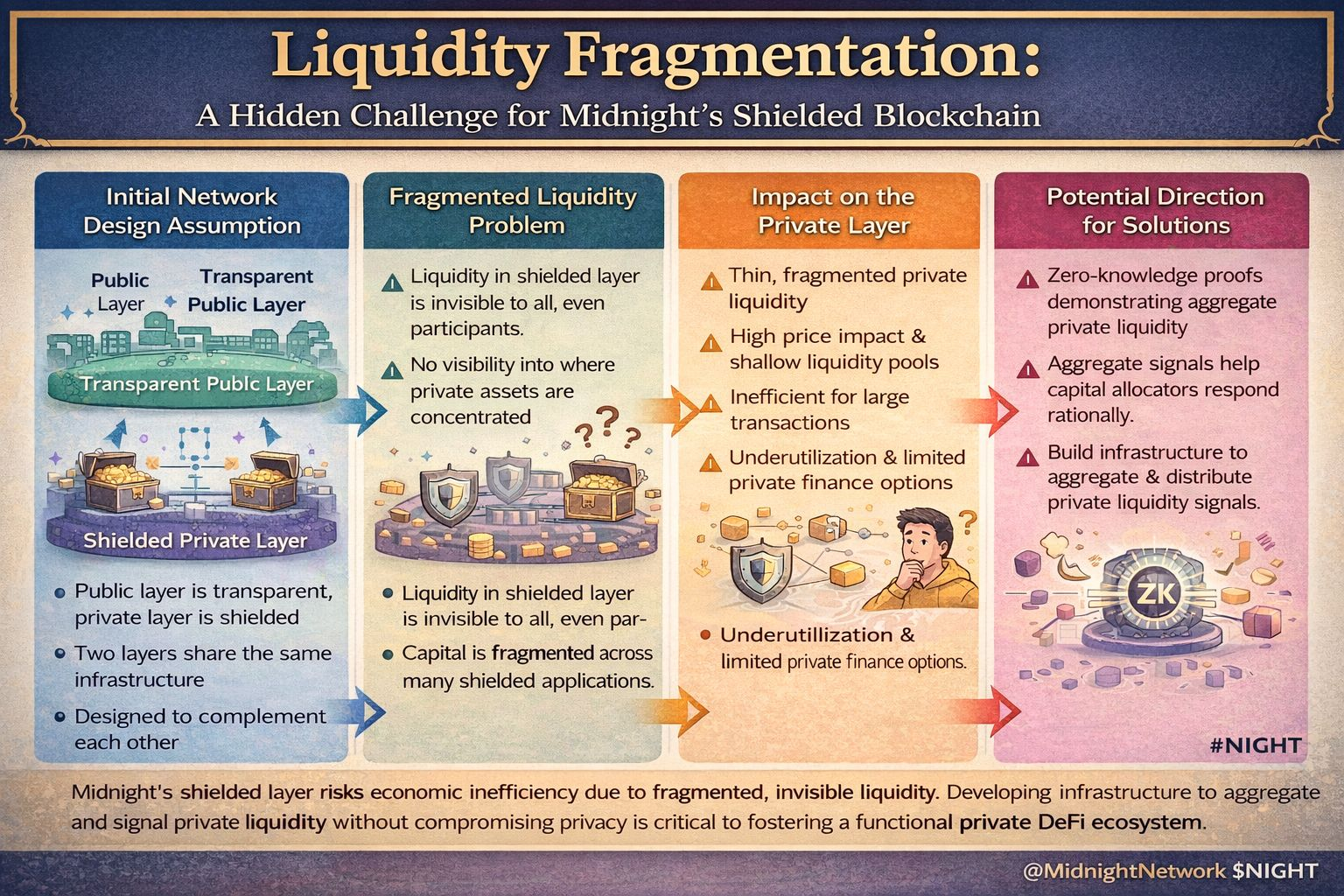
the cryptographic architecture supports privacy-preserving aggregate signals. the economic infrastructure to produce and distribute those signals does not exist yet.
that gap is where the private financial economy on Midnight either develops into something genuinely functional or stalls at a depth that never quite serves its users as well as the technology should allow. 🤔