
I remember standing in a line once, waiting to get something verified that should have taken five minutes. People had all their papers ready, checking again and again if everything was correct. Still, some got approved quickly, while others were told to come back later. No clear reason. Same documents, different outcomes. It didn’t feel fair, but it also didn’t feel broken enough for anyone to question it. Just one of those systems that works… until it suddenly doesn’t.
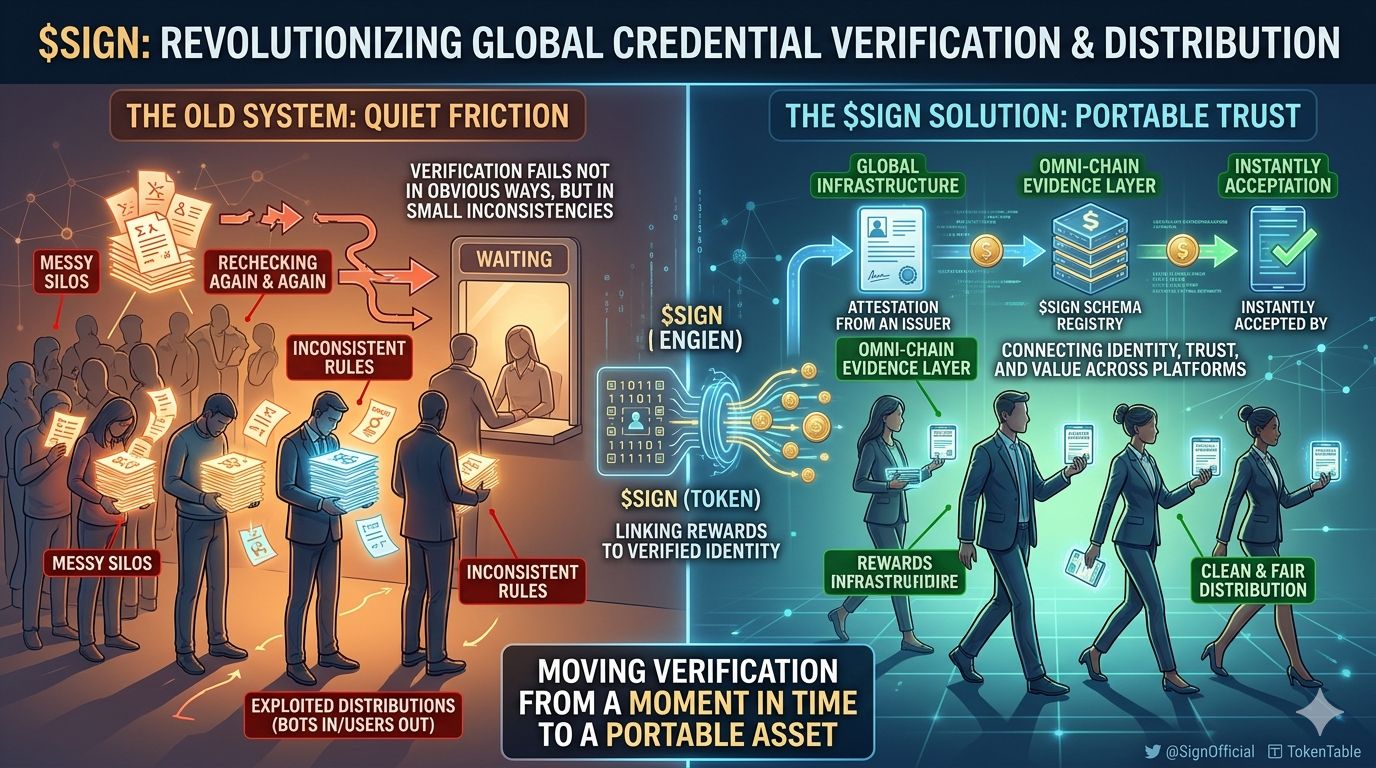
The more I think about moments like that, the more I realize verification is rarely about truth alone. It’s about whether the system can recognize that truth properly. And that’s where things quietly start to fail. Not in obvious ways, but in small inconsistencies that people slowly get used to.
That’s the mindset I had when I started looking at SIGN @SignOfficial.
On the surface, it sounds simple. A global infrastructure for credential verification and token distribution. But when you sit with it a little longer, it becomes something deeper. Because this isn’t just about checking credentials. It’s about building a system where identity, trust, and rewards actually connect without breaking every time they move across different platforms.
Most projects don’t go that far. They focus on what people can see. Fast verification, smooth interfaces, quick results. But underneath, verification is always messy. It depends on who issued the credential, who accepts it, and whether those rules stay consistent everywhere. And usually, they don’t.
That’s where SIGN starts to feel different. It’s trying to make credentials portable. Something that doesn’t need to be rechecked again and again. And at the same time, it connects that verification directly to token distribution.
That part matters more than it sounds.
Because distribution in crypto has never really been clean. Airdrops and rewards often look fair from the outside, but inside, they get exploited. Bots find their way in. Real users get filtered out. Or the criteria changes quietly without people realizing.
So linking rewards to verified identity sounds like a logical step forward.
But it also brings a bigger question.
What does “verified” actually mean when this system grows?
A credential might make sense in one place but not in another. So the system has to choose. Either make strict rules to keep everything efficient, or stay flexible to reflect real-world differences. But both options come with problems. Strict systems exclude people. Flexible systems create confusion.
There’s no clean solution here.
And then there’s the role of the token itself.
SIGN isn’t just sitting in the background. It becomes part of how the system works. It connects identity to value. It decides how rewards move. And when you think about that, it starts to feel more serious.
Because once value is tied to identity, people start adjusting their behavior around it.
They try to fit into the system. Qualify for it. Position themselves in ways that increase their chances. And slowly, participation changes. It’s no longer just about being part of the network. It’s about being recognized in the “right” way.
That shift is easy to miss, but it matters.
Another thing that stays in my mind is scale. Systems like this usually look strong in the beginning. Everything feels clear and controlled. But as more users join, things get complicated. More edge cases appear. More situations that don’t fit the original design.
Verification takes longer.
Disagreements increase.
Small gaps become more visible.
Not because the idea is wrong, but because real life is always more complex than any system built to manage it.
So the real question isn’t whether SIGN works right now.
It’s whether it keeps working when things stop being simple.
There’s also a deeper balance here between fairness and efficiency.
If the system becomes too strict, it works faster but leaves people out.
If it becomes too flexible, it includes more people but becomes harder to manage.
So where does it settle?
And who decides that as the system evolves?
That’s the part most projects don’t really address. They talk about what the system can do, not how it behaves under pressure. But infrastructure only proves itself when it’s pushed.
That’s why SIGN feels worth watching. Not because it promises something perfect, but because it’s trying to operate at a layer that actually matters. Verification and distribution aren’t small features. They shape who gets access, who gets rewarded, and who gets ignored.
If it works, it could remove a lot of the quiet friction people deal with every day. It could make systems feel smoother, more consistent, more fair.
But if it doesn’t fully handle the complexity underneath, it risks becoming another system that looks clean on the surface while carrying the same old problems inside.
And that’s the part I keep coming back to.
Because the real issue isn’t verifying something once.
It’s doing it again and again, across different situations, without slowly losing trust.
SIGN is trying to solve that kind of problem.
And that’s not small.
Because in the end, verification isn’t really about data.
It’s about whether the system can see you clearly, treat you fairly, and keep doing that even when things get complicated.
And that’s where everything gets tested.
Not at the beginning, when everything is working smoothly…
@SignOfficial #SignDigitalSovereignInfra $SIGN
but later, when the system is under pressure and still expected to hold its shape.