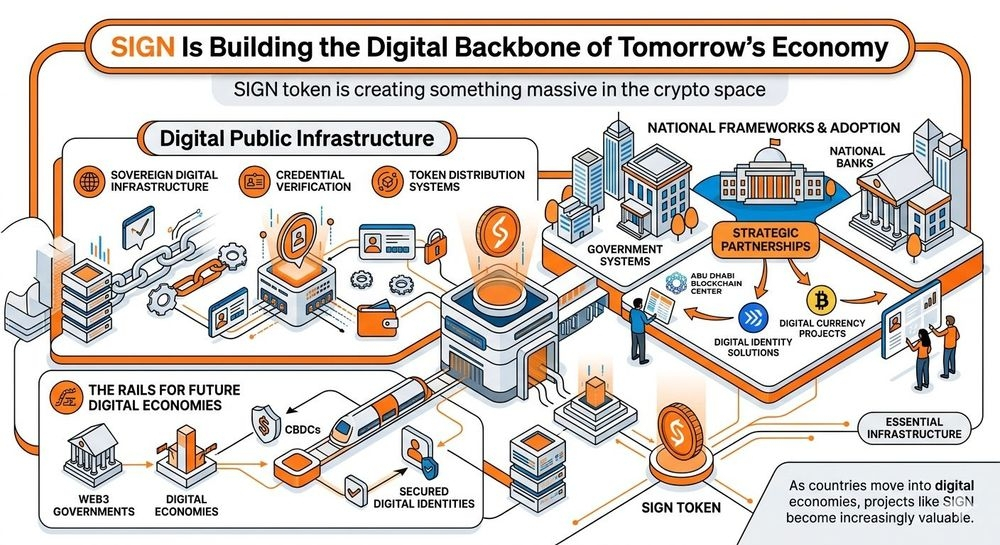
When I look at @SignOfficial I do not see just one product. I see a full attempt to rebuild how trust works online. The latest official documentation describes S.I.G.N. as sovereign-grade digital infrastructure for national systems of money, identity, and capital, with Sign Protocol as the shared evidence layer underneath it. In simple terms, the idea is to make claims, approvals, identities, and distributions verifiable in a way that can be reused across systems instead of being rebuilt from scratch every time.
The story begins with a very old problem. A person says they are eligible. A company says it is compliant. A payment system says a transfer happened. A registry says an asset record is correct. Traditional digital systems often treat those claims as isolated facts, but Sign’s current framework says they should be structured, signed, queryable, and auditable. I’m drawn to that because it is not trying to make trust disappear. It is trying to make trust visible.
The newest documentation places identity at the center of everything. The official whitepaper says digital identity is the prerequisite layer for financial inclusion, public service delivery, and broader economic participation, and it ties that idea to National Digital Identity and Self-Sovereign Identity principles. It also explains that citizens should be able to control what they share, use selective disclosure, and rely on cryptographic verification instead of repeatedly handing data back to centralized databases. If a system cannot prove who someone is without exposing everything about them, it becomes weak at the exact moment it is supposed to be strong.
That is where Sign Protocol enters the picture. The official docs say it is not a blockchain itself. It is a protocol layer for producing and verifying structured claims, using schemas and attestations as its core primitives. In plain language, a schema is the template for the claim, and an attestation is the signed record that says the claim is true, or true under certain conditions. That matters because it lets the same proof travel across applications, chains, and workflows without being rewritten every time. We’re seeing a shift from scattered proofs to reusable evidence, and that shift is one of the most important parts of the whole project.
The documentation also shows that Sign Protocol is designed for real-world flexibility rather than one rigid format. It supports public, private, and hybrid attestations, and it can anchor evidence across chains and systems. It also supports selective disclosure, which means a user can prove only the part that matters, instead of revealing a full identity record when only one detail is needed. That is a simple idea, but it is powerful. I’m not saying privacy is easy. I’m saying the architecture shows that privacy and verification do not have to fight each other.
The whitepaper goes further by describing the identity stack in practical standards language. It refers to W3C Verifiable Credentials and DIDs, OpenID for Verifiable Credential Issuance and Presentation, W3C Bitstring Status Lists, and even compatibility with mobile driver’s license patterns where relevant. That tells me the project is not trying to invent every layer from zero. It is trying to connect open standards into something that can actually work across government, institutions, and wallets. They’re building around interoperability because identity only matters when it can move.
The money and capital side of the stack is equally important. The official architecture describes a dual-path approach: one public path for transparent operations and one private path for privacy-sensitive financial activity. The whitepaper says governments can deploy public Layer 2 or Layer 1 smart contracts for transparent services, while also using a private Hyperledger Fabric X-based path for CBDC-style operations with tighter controls. It also describes a bridge between the two, so value can move between transparent and privacy-focused environments under controlled rules. If you think of the whole system as a city, this is the road network that lets different districts function without collapsing into one another.
TokenTable is the part that makes distribution feel less like a manual spreadsheet and more like infrastructure. The official docs say TokenTable is the sovereign-grade allocation, vesting, and distribution engine for capital, benefits, and tokenized programs. It is meant for government benefits, grants, incentive programs, tokenized assets, ecosystem distributions, regulated airdrops, and unlocks. The key shift is that TokenTable decides who gets what, when, and under which rules, while Sign Protocol provides the evidence and verification layer behind it. That separation is clean, and it matters because distribution without evidence becomes guesswork, while evidence without distribution becomes history with no action.
The TokenTable docs also explain why the product exists at all. Traditional distribution systems rely on spreadsheets, opaque beneficiary lists, scripts, centralized processors, and slow audits. Those systems can work for a while, but they are fragile when scale, compliance, and fairness all matter at the same time. TokenTable replaces that with deterministic allocation tables, versioned rules, vesting schedules, revocation logic, and reproducible outputs. It becomes easier to explain what happened after the fact because the process was designed to be auditable from the start.
Sign Protocol’s querying layer makes the system practical, not just philosophical. The docs say SignScan can aggregate attestations across chains, storage layers, and execution environments, and builders can query data through REST, GraphQL, or SDKs. That is important because a trust system is useless if nobody can inspect it. The project’s own framing says verification should be repeatable, attributable, and compatible with oversight, and the architecture reflects that with structured data, indexing, and audit references rather than one-off proofs buried in different contracts.
The newer whitepaper also connects these ideas to national use cases. It lists digital registries, voting, border control, e-visa issuance, financial services, and asset tokenization as areas where onchain identity and attestations can reduce friction while improving traceability. The language is ambitious, but the logic is straightforward. A registry is only useful if records can be checked. A vote is only credible if eligibility and secrecy can coexist. A benefits program only feels fair if eligibility can be proven without turning the process into a maze.
What makes the latest materials especially interesting is that they do not stop at theory. The official docs now describe S.I.G.N. as a system-level blueprint for deployments that must remain governable, auditable, and operable under national concurrency. That means the project is thinking about scale, operations, and oversight at the same time as identity and token flow. It is not just asking how to prove something. It is asking how to govern it safely, how to maintain it, and how to keep policy separate from one vendor or one ledger design. That kind of thinking is what makes infrastructure feel real.
Recent coverage also shows that the project is still evolving on the distribution side. A March 2026 report says SIGN launched an Orange Basic Income program that reserves 100 million tokens for self-custody-based rewards, with the first season distributing up to 25 million and a portion dedicated to holding rewards. The report says the program favors wallets that keep tokens in self-custody instead of centralized exchanges, tying rewards to balance and time held onchain. Whether one sees that as incentive design or community strategy, it fits the same deeper pattern: Sign is trying to make behavior, ownership, and proof line up more closely.
I think that is the heart of the whole journey. Sign starts with a simple promise that feels almost old-fashioned in its honesty: prove what is true, prove who is eligible, prove what was distributed, and keep the proof usable later. From there it builds outward into identity, evidence, distribution, governance, and cross-chain operations. It’s a rare kind of project because it treats verification as a public utility rather than a hidden backend. If it becomes easier to trust the record, then it becomes easier to trust the system, and if the system becomes easier to trust, more people can actually use it. That is why the project matters. It is not only building tools. It is building a calmer way for digital societies to remember, verify, and share value.