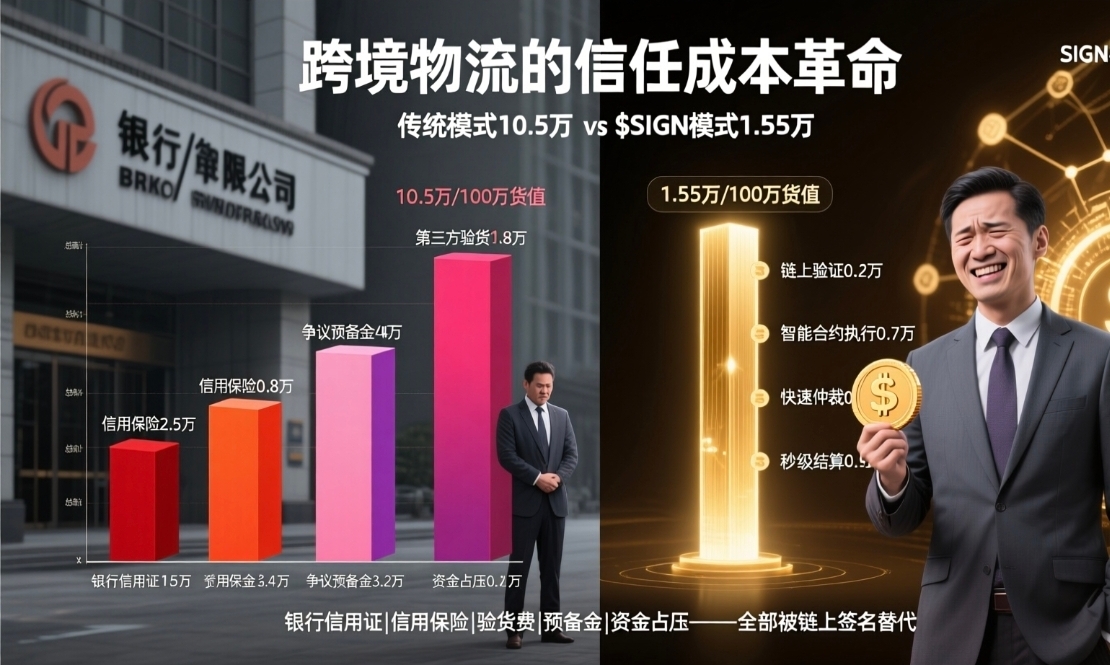
I recently did some calculations with a friend who works in cross-border logistics, and the results really surprised me. He said that for a shipment of goods worth 1 million RMB from the Middle East to Southeast Asia, the trust cost in the traditional trade model accounts for as much as 8%-12%. This includes: bank letter of credit fees (1-2%), trade credit insurance fees (1-3%), third-party inspection and endorsement fees (0.5-1%), dispute resolution reserve funds (3-5%), and financial costs due to slow document processing. In short, these various costs directly increase the cost price of the goods.
"Of the 1 million yuan worth of goods I sold, 100,000 yuan of it was tuition fees paid for trust," he said with a wry smile.
These words made me realize something: SIGN's value may not be limited to solving geopolitical risks. I think the core point is that it's initiating a revolution in trust costs. You heard me right, I think this is a revolution.
First, let me talk about the high cost of the traditional trust system.
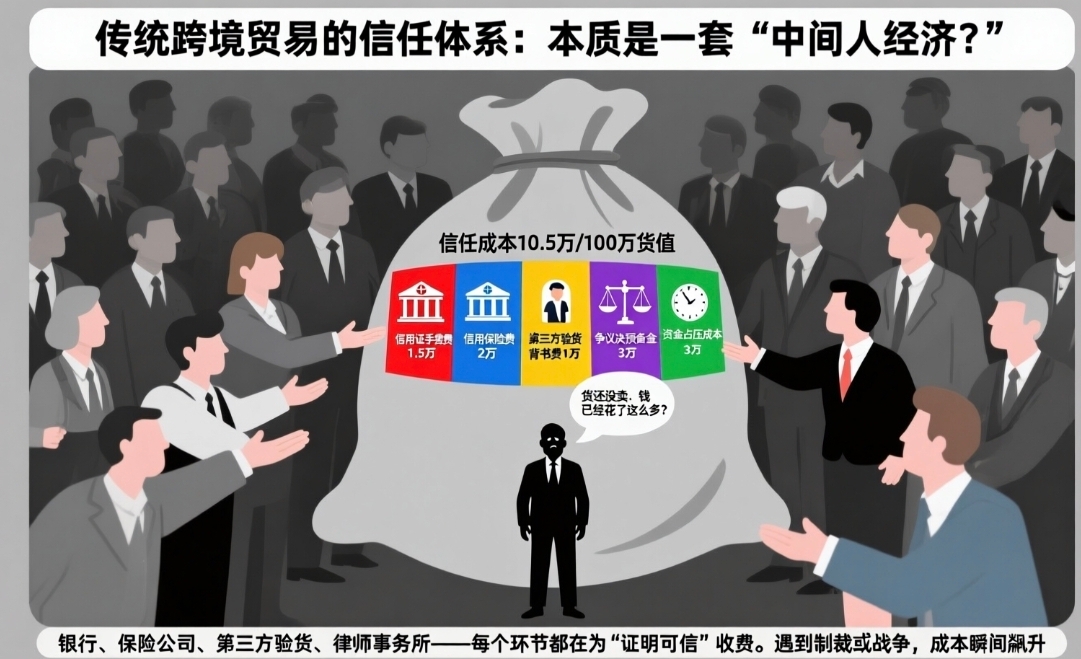
Based on my research, I believe the traditional trust system in cross-border trade is essentially a middleman economy, much like a bank's lending and deposit system. Banks, insurance companies, third-party inspection agencies, and law firms all charge fees for issuing certificates or providing guarantees at each stage. This system can function when global trade and the economy are stable. However, if sanctions, war, or political turmoil occur, these costs will skyrocket as certificates, guarantees, and trust become scarcer and more valuable.
I think the more crucial point is that these costs need to be paid in advance. Before you even receive payment or start a transaction, you have to pay letter of credit fees, insurance premiums, and legal fees. I believe this approach places extremely high demands on the cash flow of small and medium-sized enterprises (SMEs), and most companies simply can't manage it.
Second, the subtraction of the $SIGN model directly reduces trust costs to the bottom.
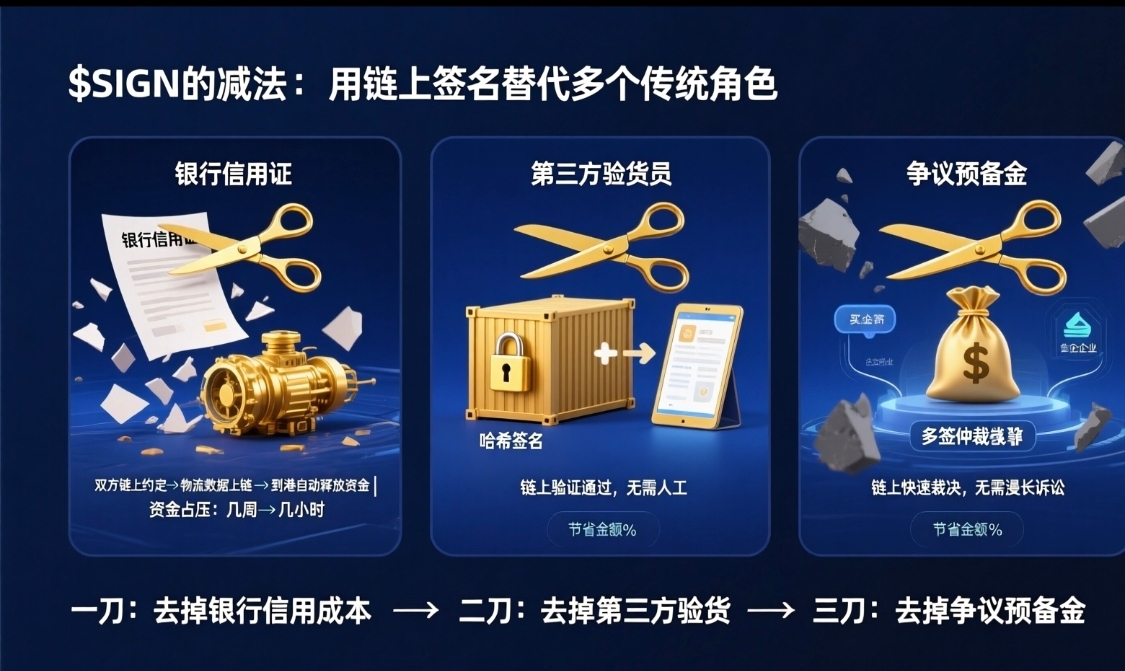
The development logic I've observed in SIGN is about subtraction. It believes that instead of introducing new intermediaries, on-chain signatures can directly replace the multiple traditional roles mentioned above.
The first step is to eliminate the cost of bank credit. Both parties agree on the transaction terms directly on the blockchain. After the goods are shipped, logistics data is uploaded to the blockchain via an oracle, and the smart contract automatically releases funds based on the arrival signal. There is no bank review, no letter of credit fees, and the period of capital tied up is reduced from several weeks to just a few hours.
The second step is to simultaneously eliminate the cost of third-party verification. For each batch of goods, the quality inspection report, certificate of origin, and packing list are all recorded with an immutable hash signature on the blockchain. Buyers can verify this in real time, eliminating the need to spend money on third-party endorsements.
The third step is to directly eliminate the need for a dispute resolution reserve fund. Previously, a reserve fund was set aside for each transaction to guard against disputes. The SIGN multi-signature arbitration mechanism transforms dispute resolution from lengthy litigation into a direct and rapid on-chain adjudication. This allows businesses to release this reserve fund for working capital, thus reducing their financial burden.
Third, let's calculate how much trust costs can be reduced.
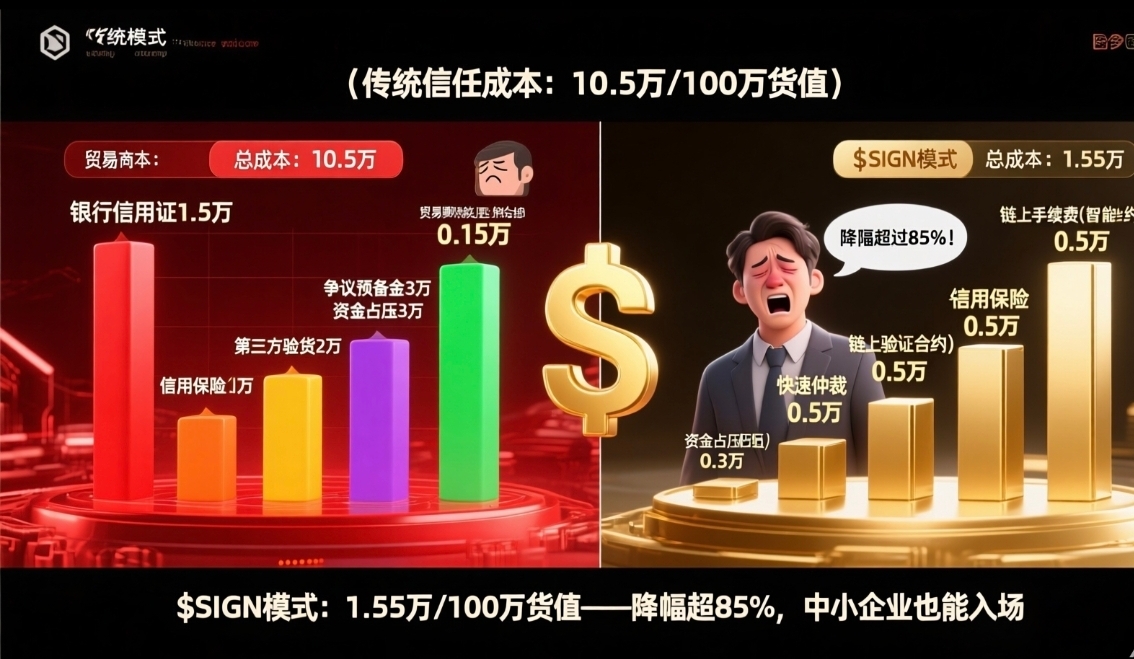
Assuming a single trade of 1 million, using the $SIGN model
1. Bank letter of credit fees: If the traditional fee is 15,000, then $SIGN only requires 1,500 (with only a small on-chain transaction fee).
2. Credit insurance costs: If the traditional cost is 20,000, then $SIGN only costs 5,000 (its smart contract executes automatically, significantly reducing risk).
3. Third-party verification and endorsement fees: Traditionally it costs 10,000 → $SIGN only costs 1,000 (because it is on-chain verification, no manual verification is required).
4. Dispute Contingency Fund: Traditionally it requires $30,000 → but $SIGN only requires $5,000 (allows for quick arbitration and has very low capital requirements).
5. Capital tied up cost: Traditionally it costs 30,000 → $SIGN only costs 3,000 (the settlement cycle is directly shortened from several weeks to a few hours).
After using the project's latest solution, the total trust cost of the transaction decreased from approximately $105,000 to approximately $15,500, a reduction of over 85%.
What I'm saying doesn't even include the cost and risk premium during periods of geopolitical tension. When traditional trust systems are frozen or rendered inoperable due to sanctions or war, on-chain signatures (c-21) might be the only remaining channel of trust, and trade transactions would rely entirely on them.
IV. I'll talk about the value leap from tools to standards.
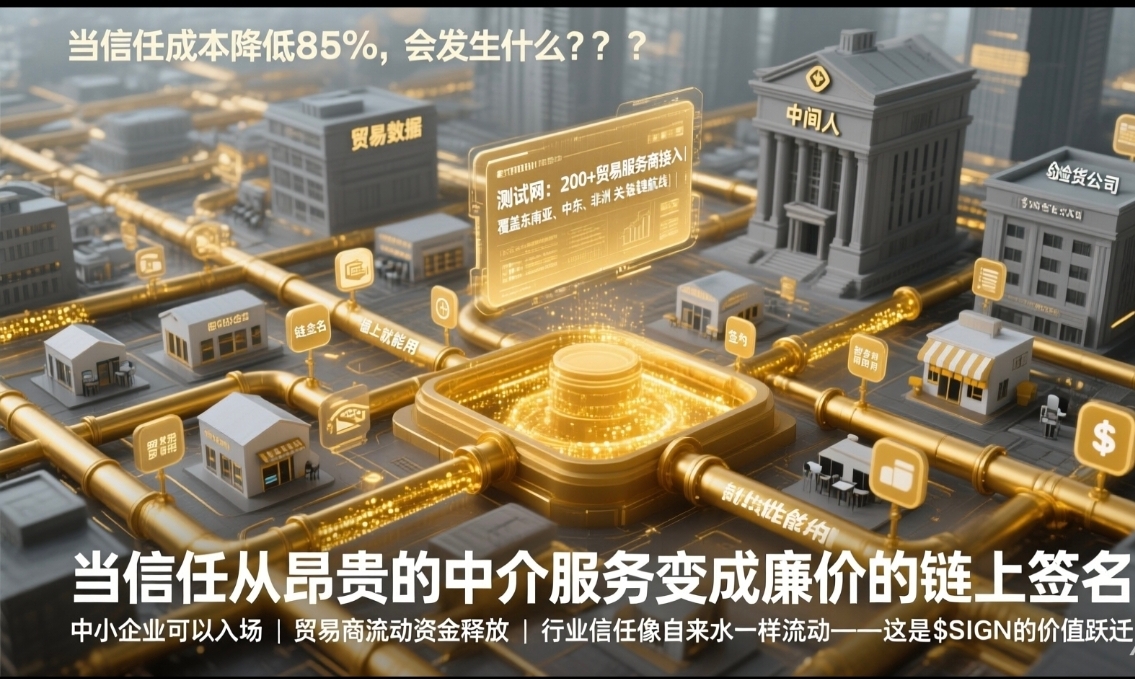
As I discussed earlier, what do you think will happen when the trust cost of trade transactions is reduced by 85%?
I think for SMEs, this means that cross-border trade, which was previously too costly to engage in, can now be started because the barriers to entry have been lowered. For traders, it means their working capital is freed up to take on more orders. For the industry as a whole, it means that guarantees and trust are no longer scarce, allowing trade to flow like water, making the entire industry easier to operate.
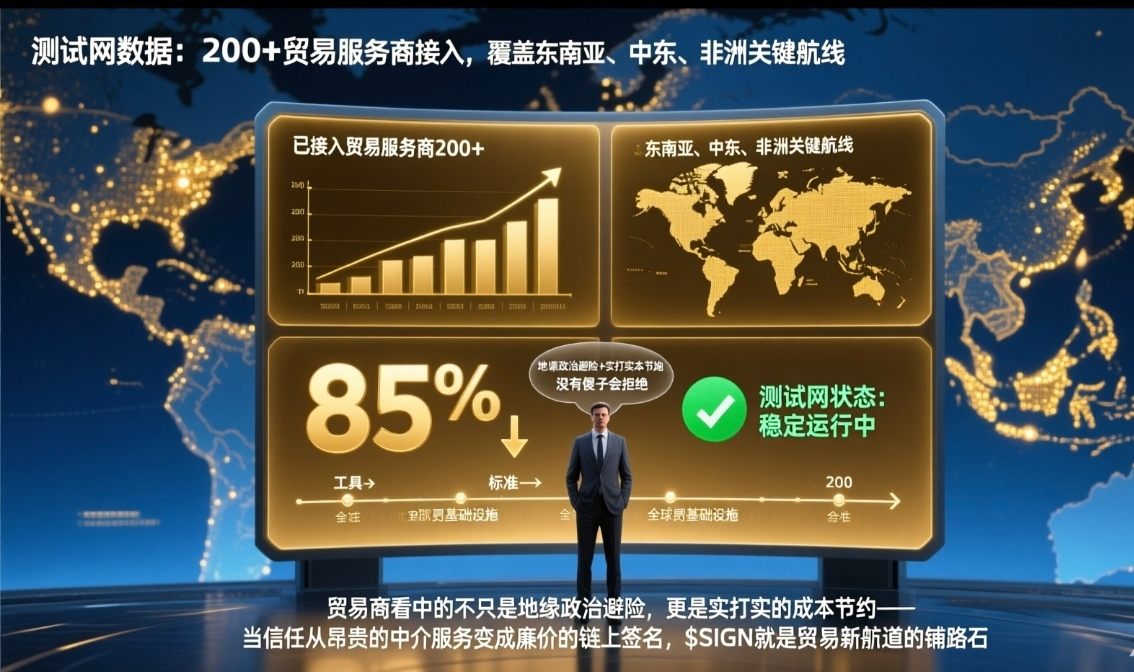
As I mentioned before, over 200 trade service providers have already connected to the $SIGN network on the testnet, covering key shipping routes in Southeast Asia, the Middle East, and Africa. I believe traders aren't fools; they're certainly interested in more than just geopolitical hedging. Tangible cost savings are definitely also a factor in their considerations.
I believe that when trust is transformed from expensive intermediary services into cheap and fast on-chain signatures, the value lies in SIGN paving a lower-cost and safer channel for new trade routes.
#Sign地缘政治基建 $SIGN @SignOfficial