When I first started looking into Midnight, I kept focusing on the obvious things. Privacy, zero-knowledge proofs, compliance all the usual areas people talk about. But after spending more time with it, I noticed something else that doesn’t get mentioned as much. The system isn’t just about what happens on the network. It’s also about when things happen, and how that changes the way people interact with it.
That might sound a bit abstract at first.
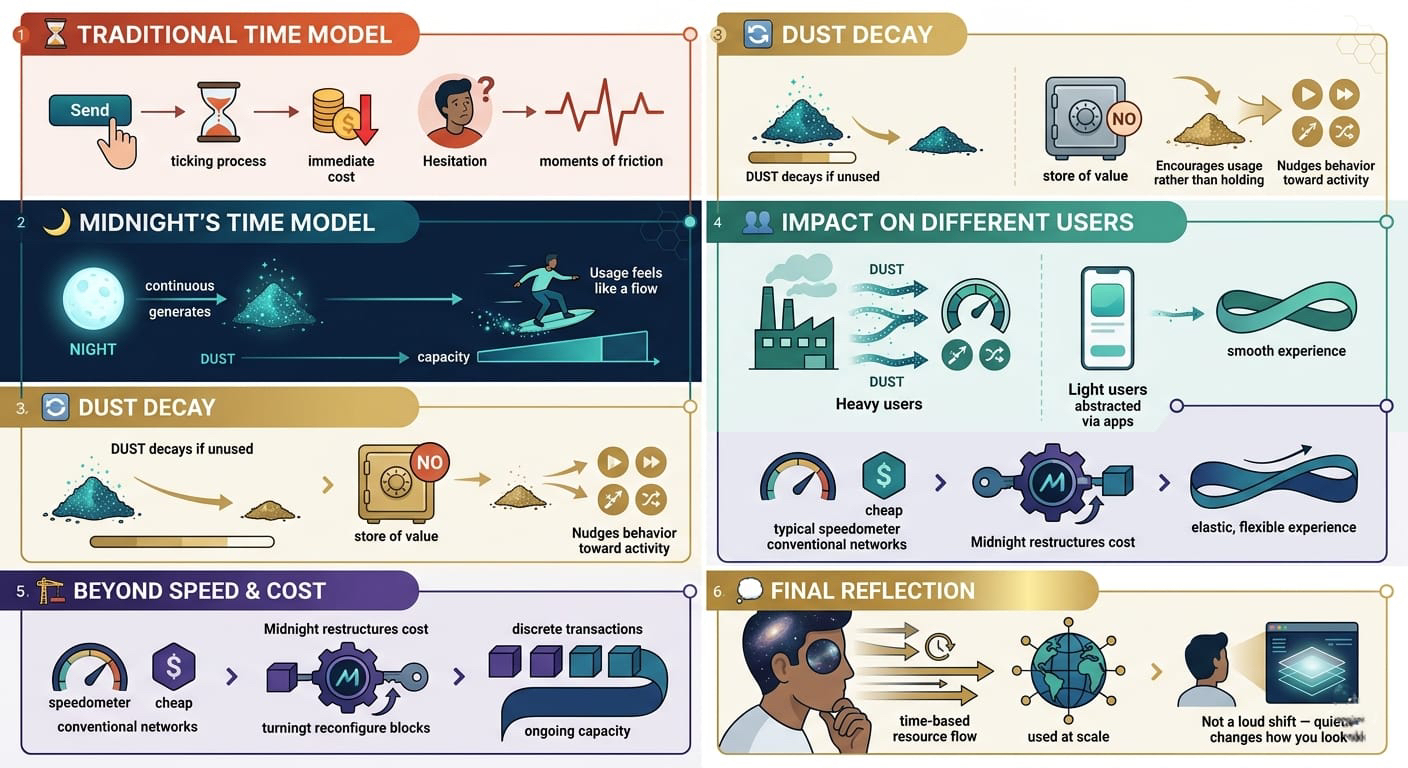
Most blockchains treat time in a very simple way. You send a transaction, it gets confirmed, and that’s it. The cost is immediate. The result is immediate. Everything feels tied to that single moment. But Midnight’s design feels slightly different when you think about how NIGHT and DUST interact over time.
When I first read that NIGHT generates DUST continuously, I didn’t think much of it. It just sounded like another mechanism. But the more I thought about it, the more it started to feel like the network is introducing a sense of flow instead of just discrete actions.
You’re not just paying for a transaction in that moment. You’re building the capacity to use the network over time.
That changes how usage feels.
In most systems, every action is a cost you feel immediately. You click something, and you pay for it. Over time, that creates a kind of hesitation. You start thinking before every interaction. Is this worth it? Should I wait? Should I do fewer actions to save on fees?
But if the system is based on something that builds up gradually, the decision-making process becomes different. Instead of thinking about cost per action, you start thinking about how much capacity you’ve accumulated.
I found that idea interesting because it feels closer to how people interact with resources in real life. Not everything is paid for instantly. Sometimes you build access over time and then decide how to use it.
Another detail that kept coming back to me is what happens when that capacity isn’t used. DUST doesn’t just sit there forever. It decays. When I first noticed that, I wasn’t sure what to make of it. It felt a bit counterintuitive. Why design a system where unused resources slowly disappear?
But then I started thinking about what usually happens in systems where resources don’t decay.
People store them.
They accumulate them.
They treat them as something to hold rather than something to use.
And over time, that changes the purpose of the system itself.
With DUST, that doesn’t really happen. Since it fades over time, holding it indefinitely doesn’t make much sense. The system quietly encourages usage instead of accumulation. It nudges behavior in a direction without forcing it.
That’s a small design choice, but it has a noticeable effect when you think about it long enough.
Another thing I found myself considering is how this affects different types of users. Not everyone interacts with a network in the same way. Some people use it occasionally. Others rely on it constantly. In a system where costs are immediate and fixed, those differences can create friction. Heavy users feel the cost more. Light users hesitate to even start.
But when usage is tied to something that builds over time, the experience can become more flexible. Someone holding more NIGHT generates more DUST, which means they naturally have more capacity. At the same time, someone interacting through an application might not even think about it if the system is abstracted for them.
That’s where things start to shift from just technology to experience.
I also kept thinking about how this model fits into the broader direction of blockchain systems. For a long time, most networks have focused on efficiency. Faster transactions. Lower fees. Better throughput. Those things matter, but they don’t always address how people actually feel when they use a system.
Midnight’s approach seems to be looking at that from a slightly different angle.
Instead of just making transactions cheaper or faster, it changes how the cost is structured in the first place.
That’s not something you notice immediately.
It becomes obvious only after you spend some time thinking through the implications.
Of course, designs like this always look clean when you’re reading about them. The real test comes later. When developers start building applications. When users interact with the system without thinking about the underlying mechanics. That’s when you see whether these ideas actually hold up or if they introduce new challenges.
And there are always trade-offs.
A system that introduces time-based resource generation might feel smoother in some ways, but it also requires people to understand a slightly different model. Even if that understanding stays in the background, it still shapes how the ecosystem develops.
That’s something that usually becomes clear only after adoption starts.
The more I thought about Midnight from this angle, the less it felt like just a privacy-focused blockchain. The privacy part is still important, but it’s only one layer of a broader design. The way the system handles time, usage, and resource flow seems just as central to how it’s meant to function.
It’s not trying to remove cost.
It’s reshaping how cost is experienced.
Whether that ends up making a big difference is something that will only become clear over time. Systems don’t change overnight, and user behavior tends to adapt slowly.
But it’s one of those ideas that sticks in your mind once you notice it.
Not because it’s loud or obvious, but because it quietly changes how you look at something that used to feel straightforward.