
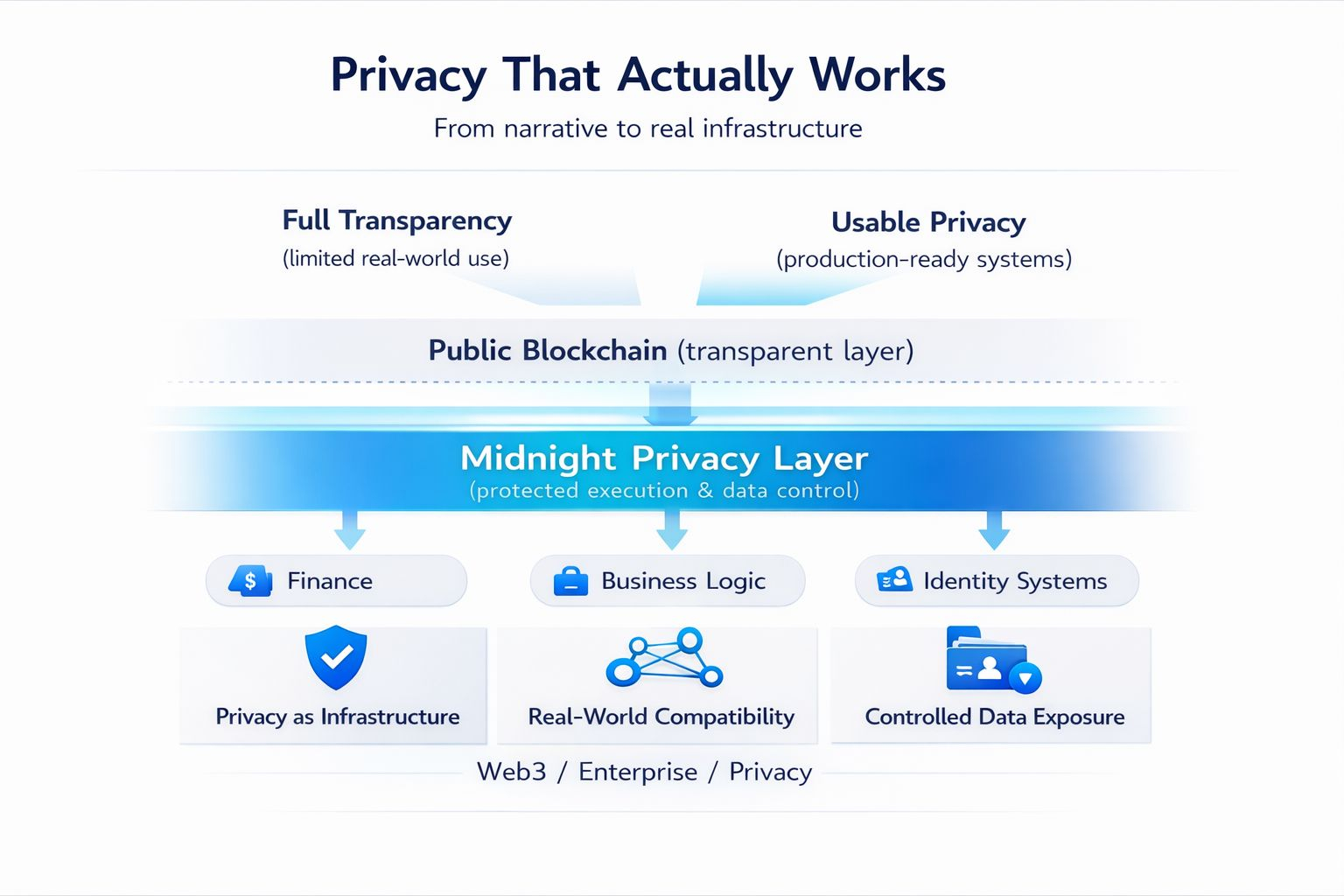
Lately, the more I think about @MidnightNetwork , the less it feels like a project built just to sound good in a tweet.
It feels… heavier than that.
And honestly, that’s probably why it stands out to me.
Most crypto projects are easy to get excited about because they follow familiar narratives. Faster, cheaper, more scalable, more community-driven.
Privacy projects have their own version too.
Freedom, secrecy, revolution… all very intense, all very easy to sell.
But those stories usually get a bit awkward when someone asks how they actually fit into the real world.
That’s where Midnight feels different.
Because it’s not really trying to make privacy sound exciting.
It’s treating privacy like something more basic.
Almost like infrastructure.
And that shift matters more than it sounds.
Public blockchains are great if you’re okay with everything being visible.
But for finance, business logic, identity, or anything sensitive, that model starts breaking down pretty quickly.
That’s always felt like a weird blind spot in crypto.
People talk about adoption like it’s inevitable, but ignore the fact that many real use cases simply don’t work in a fully transparent environment.
So they never show up.
Or they show up in a limited way.
Midnight seems to be addressing that directly.
Not by rejecting transparency completely, but by trying to make privacy usable enough for real systems.
That’s a harder problem.
And probably a more important one.
Because once you move from hype to infrastructure, the rules change.
People stop caring about narratives.
They start caring about whether the system actually works under pressure.
That’s the part I keep thinking about.
Right now, Midnight sounds coherent. The design choices make sense. The direction feels more grounded than most privacy narratives.
But that’s all before real usage.
Before real incentives.
Before real edge cases start showing up.
And that’s usually where things get tested properly.
Because solving privacy in theory is one thing.
Making it work alongside developers, institutions, regulations, and unpredictable user behavior is something else entirely.
That’s a much heavier challenge.
And I think Midnight knows that.
It doesn’t feel like it’s trying to be flashy.
It feels like it’s trying to solve a problem the industry has kind of avoided for years.
That public blockchains are powerful, but also too exposed for many serious use cases.
If Midnight gets that right, it could open doors that weren’t really accessible before.
But if it doesn’t, then it risks becoming another “good idea on paper” that struggled when things went live.
So for me, the interesting part isn’t whether Midnight sounds important.
It clearly does.
The real question is whether it can carry that weight once the system is actually in use.
Because ideas like this don’t fail loudly.
They fail quietly, when real-world complexity starts pushing back.
I’m still watching how @MidnightNetwork develops, especially as it gets closer to mainnet.
Because this feels less like a hype play and more like an attempt to fix something fundamental.
And those are usually the ones that take longer to prove themselves.