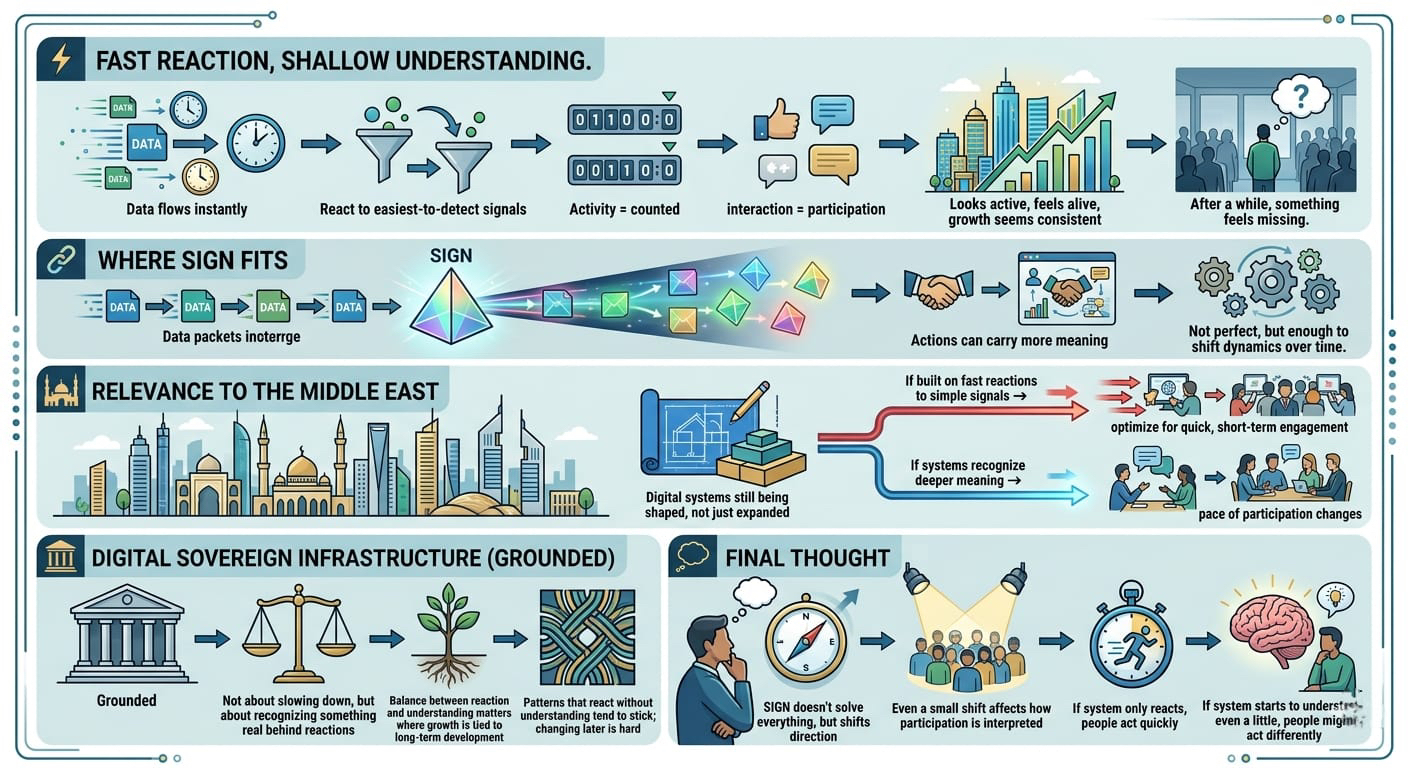
One thing that keeps coming to mind is how quickly most systems react compared to how little they actually understand. Something happens, it gets recorded instantly. Activity shows up, numbers move, everything updates in real time. But just because something is captured quickly doesn’t mean it’s understood properly.
Most of the time, systems just respond to whatever is easiest to detect.
If there’s activity, it gets counted. If there’s interaction, it gets treated as participation. And that works to a certain extent, but it also means everything gets reduced to what can be seen immediately. Anything that takes time to build, or doesn’t show up clearly in the moment, tends to get overlooked.
You don’t really notice this at first. Everything looks active, systems feel alive, and growth seems consistent. But after a while, it starts to feel like something is missing. Not in a technical sense, but in how participation is actually understood.
Because reacting to something isn’t the same as understanding it.
That’s where SIGN started to feel relevant to me, but not in an obvious way. It’s not trying to slow things down or make systems more complicated. It’s more like adding a bit of depth to what gets recognized. Instead of just reacting to surface-level activity, there’s a way for certain actions to carry a bit more meaning.
Not perfectly, and not for everything, but enough to make a difference over time.
And this becomes more important in places like the Middle East right now.
A lot of digital systems there are still being shaped, not just expanded. That means the way systems respond to participation today can influence how people behave inside them later. If everything is built around fast reactions to simple signals, then that’s what people will optimize for.
Quick actions, short-term engagement, whatever gets picked up immediately.
But if systems start to recognize things with a bit more depth, even slightly, it changes the pace of participation. People don’t just think about what works instantly, they start considering what holds value beyond that moment.
The idea of digital sovereign infrastructure fits into this in a way that’s actually pretty grounded. It’s not about slowing systems down, it’s about making sure they’re not only reacting, but also recognizing something real behind those reactions.
In regions where digital growth is tied to longer-term development, like parts of the Middle East, that balance probably matters more than it seems. Because once systems get used to reacting without really understanding, that pattern tends to stick.
And changing it later isn’t simple.
I’m not saying SIGN completely solves that, but it does move things in a slightly different direction. It gives systems a way to rely on something a bit more meaningful than just immediate activity.
Even if it’s a small shift, it affects how participation is interpreted.
And over time, that changes how people choose to engage.
Because if a system only reacts, people act quickly.
But if a system starts to understand, even a little, people might act differently.