
Ethereum scaling has entered deep waters, and ZK Rollup has transitioned from 'single-chain racing' to 'multi-chain collaboration.' As a benchmark for ZK Layer 2, ZKsync 3.0 reconstructs the scaling paradigm with Elastic Chain, upgrading a single Rollup to an infinitely scalable and natively interoperable ZK chain network, maintaining Ethereum's security foundation while breaking performance and ecological boundaries. This article fully interprets the industry significance of ZKsync 3.0's Elastic Chain from the perspectives of technological iteration, core capabilities, ecological value, and long-term planning.
1. From 1.0 to 3.0: The Technological Evolution of ZKsync
The iteration of ZKsync has always focused on three core aspects: security, scalability, and usability. The 3.0 Elastic Chain is a milestone upgrade:
- ZKsync 1.0: Basic ZK Rollup, focusing on transfers and payments, initial improvement in verification efficiency;
- ZKsync 2.0/Era: Launching zkEVM, fully compatible with Solidity, allowing developers to migrate with zero barriers, rapidly scaling the DeFi/NFT ecosystem;
- ZKsync 3.0 elastic chain (2024.6 v24 upgrade): From single chain to multi-chain federation, using ZK Stack as the foundation to create a native interoperable, infinitely scalable Elastic Network, with users experiencing seamless cross-chain and developers deploying chains with one click, completely solving multi-chain fragmentation and liquidity separation.
The official synchronization is advancing the orderly exit of Lite, fully focusing resources on Era and the elastic chain, allowing for smooth migration of user assets and a more focused ecological architecture.
Two, ZKsync 3.0 elastic chain: core technology and architectural breakthroughs
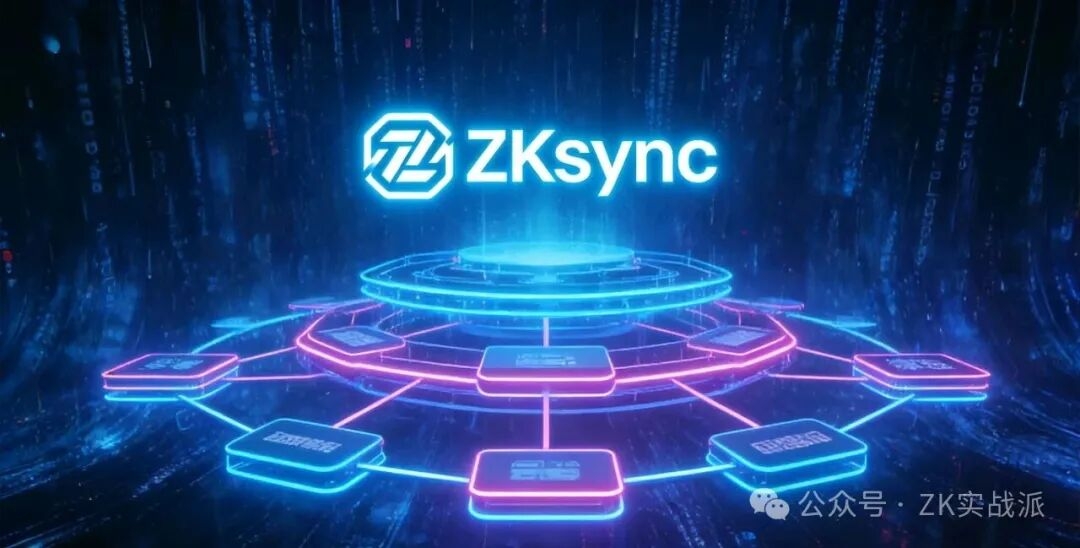
Elastic chain is not simply about adding chains, but about reconstructing the underlying architecture, with three core components supporting the entire ecosystem:
1. Shared routing + native Token Vault
Shared contracts on Ethereum are responsible for chain registration and state management, upgrading the native bridge to a unified asset treasury, achieving atomic interoperability of assets within the ecosystem, and eliminating trust risks from external bridges.
2. ZK Gateway
Middleware connecting Ethereum and ZK chains, all ZK chains inherit L1 security, inter-chain interactions require no trust and have no extra latency, achieving a 'multi-chain as one chain' experience.
3. ZK Stack modular framework
Developers can quickly deploy Rollup/Validium/Volition using a single set of tools, customizing Gas tokens, compliance rules, and privacy strategies, while seamlessly integrating with the elastic network without reinventing the wheel.
Key performance upgrades (Atlas + Airbender dual engine)
- TPS: 15,000–43,000, peak values approaching centralized systems;
- Finality latency: 1–500 milliseconds, sub-second confirmation;
- Transaction cost: as low as 0.0001 USD per transaction, mainnet within 1/100;
- Proof efficiency: Airbender zkVM replaces Boojum, with a single GPU processing 1 million transactions daily, significantly reducing proof generation costs.
Core experience innovation
- Unified address + single signature cross-chain, no need to switch networks, no need for manual bridging;
- Account abstraction + multi-token Gas + Dapp payment, significantly lowering the entry barrier for newcomers;
- Public chain + private chain collaboration, balancing openness and institutional compliance needs.
Three, The core value of the elastic chain: Breaking through the three major pain points of Web3
1. Ending liquidity fragmentation
Native interoperability among multiple chains, assets and data flow freely, DeFi/GameFi are no longer restricted by chain isolation, significantly improving capital efficiency.
2. Unlimited scalability without compromising security
Adding chains horizontally can improve performance, all proofs verified by Ethereum, ensuring safety through mathematics, without compromising on 'scalability for security.'
3. Lowering the threshold for ecological co-construction
ZK Stack allows projects and institutions to quickly build dedicated ZK chains, focusing on business rather than the underlying technology, evolving the ecosystem from 'a few public chains' to 'ten thousand interconnected chains.'
Four, Ecological implementation and current progress (2026)
The elastic chain ecosystem has moved from concept to scalability:
- With ZKsync Era as the core chain, over 20 ZK chains have been launched on the mainnet;
- Covering tracks such as DeFi, GameFi, SocialFi, RWA, AI agents, and institutional compliance;
- Leading projects like Lens, GRVT, Cronos zkEVM, etc., deeply integrated, advancing Prividium's enterprise privacy solution for bank-level compliance implementation;
- Ecological TVL steadily increasing, on-chain interaction experience approaching Web2, paving the way for large-scale user entry.
Five, Vision planning: The long-term blueprint of ZKsync 3.0
1. Technical layer: Deepening in three major directions (2026 roadmap)
- Prividium: Upgrading from a privacy engine to a bank-grade stack, supporting RWA and institutional finance with default privacy and compliance on-chain;
- ZK Stack: Upgrading from a single chain tool to a cross-public/private chain orchestration system, unifying liquidity and infrastructure, creating the Web3 'operating system';
- Airbender: Moving from high-speed zkVM to a general proof standard, prioritizing safety and rigor, extending capabilities to Ethereum and non-crypto scenarios.
2. Application layer: Four major scenarios become the core foundation.
- Inclusive DeFi: Low cost, high throughput, making small, high-frequency trading the norm;
- RWA scalability: Compliance + privacy + interoperability, activating the circulation of real assets on-chain;
- AI + Web3 agents: Sub-second finality + batch atomic transactions, supporting autonomous collaboration of agents;
- Web2 migration entry: Low barriers, excellent experience, strong security, becoming the first choice for traditional enterprises and users to enter the chain.
3. Industry layer: Defining new standards for ZK multi-chain
The elastic chain represents the next stage of Ethereum's scalability: modular + ZK + multi-chain collaboration, maintaining decentralized root security while achieving unlimited performance and ecological diversity, differentiating itself from other Layer 2 routes, becoming a mainstream infrastructure choice for Web3.
Six, Conclusion: Why is the elastic chain a key leap for ZKsync?
ZKsync 3.0 elastic chain is not just a version upgrade, but a paradigm shift from Rollup to a ZK ecological network. It addresses the three major challenges of scalability, interoperability, and compliance with technology, opening up both inclusive and institutional markets, rooted in Ethereum's security while facing infinite expansion in the future.
For developers: Lower costs, higher flexibility, larger ecosystem;
For users: Smoother, cheaper, safer;
For the industry: A practical, scalable, and compliant backbone for Web3.
With the technological implementation and ecological expansion in 2026, ZKsync's elastic chain will continue to solidify the position of ZK series Layer 2 leaders, becoming the core scalability and value carrier for Ethereum and the entire Web3.