
Affected by Trump's release of signals easing the US-Iran situation, global risk assets are experiencing a recovery trend, with Bitcoin rebounding above $70,000, and a rise of over 5% within 24 hours, while mainstream cryptocurrencies like Ethereum are also recovering. However, the total liquidation amount across the network in the past 24 hours still reached $665 million, highlighting the market's inherent high volatility with both long and short positions being liquidated. The current cryptocurrency market is undergoing a repositioning from "geopolitical conflict hedging" to "liquidity risk assets," with institutional funds marginally swaying, ETF fund flows weakening, and persistent leverage liquidation pressure. Investors need to stay clear-headed during the short-term rebound and focus on three core variables: substantive progress in US-Iran negotiations, the Federal Reserve's policy path, and the navigation status of the Strait of Hormuz.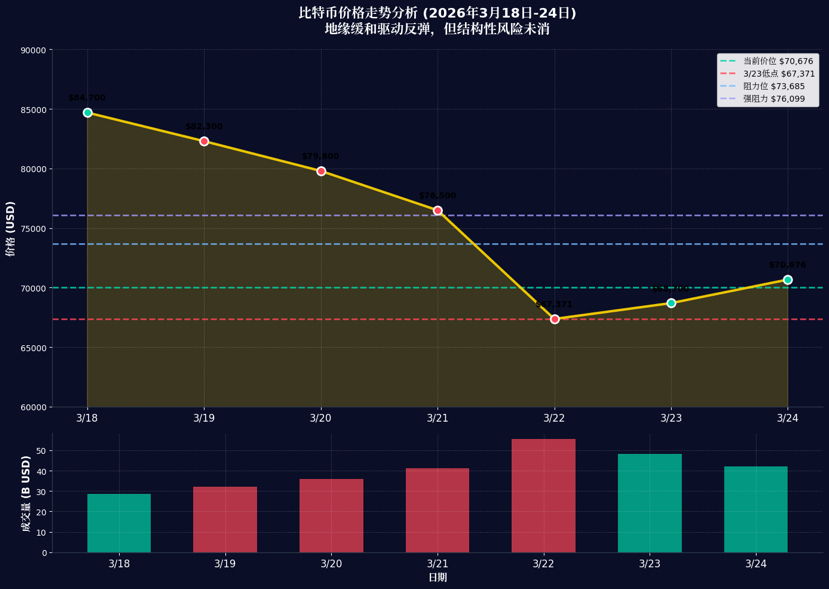
I. Market Overview
1.1 Bitcoin: Rebouncing to the $70,000 mark, narrowing the year-to-date decline
As of March 24, the Bitcoin price rebounded to approximately $70,676, up about 5% from the previous day's low of $67,371, with an intraday high of $71,780. This rebound was mainly driven by Trump's statement that 'the US and Iran have had productive dialogue' and the postponement of military strikes against Iran, quickly restoring market risk appetite. However, Bitcoin's cumulative decline this year still stands at 19.27%, having retracted more than 44% from the historical high of $126,272 set in October 2025.
From a technical perspective, Bitcoin is currently in a critical game zone. The short-term support level is in the range of $69,751 to $68,230, while resistance is at $73,685 and $76,099. The weekly level shows a bullish engulfing pattern, suggesting a short-term momentum tilted towards buyers, but it is necessary to be cautious that this is merely a technical rebound and not a trend reversal.
1.2 Ethereum and altcoins: Following the rebound, funding rates show that bearish sentiment still exists.
Ethereum synchronized in the rebound, but the decline still exceeded 4%, trading around $2,000. Notably, funding rates indicate that bearish sentiment in the market has not dissipated due to the rebound, with Ethereum's negative funding rate being particularly significant, suggesting that shorts still dominate the derivatives market. The Altcoin Season Index has dropped to 24, indicating that funds are flowing back from altcoins to Bitcoin, signaling a 'Bitcoin-dominant' phase in the market.
1.3 Liquidation data: High leverage remains the sword of Damocles.
Despite the market rebound, the total liquidation amount across the network in the past 24 hours reached $665 million, with long positions liquidating at $296 million and short positions at $369 million, reflecting a typical pattern of both bulls and bears being killed. This indicates that in extreme volatility, high-leverage positions face liquidation risk regardless of direction. Since March 23, more than 200,000 people have faced liquidation, totaling over $1 billion.
II. Core Driving Factors Analysis
2.1 Geopolitics: From 'escalating panic' to 'calming expectations'
On March 23, Trump suddenly released signals regarding US-Iran negotiations, stating that both parties had engaged in 'very good and productive dialogue' to 'completely end hostilities' and ordered a 5-day postponement of military strikes against Iranian energy facilities. This news quickly reversed the risk-off trading logic that had previously resulted from tensions in the Strait of Hormuz.
However, the Iranian side quickly denied the existence of negotiations, and the Strait of Hormuz has not yet returned to normal navigation. Alex Kuptzikevich, chief market analyst at FxPro, pointed out that the current situation is more accurately defined as 'the market is trading on the worst-case scenario being postponed' rather than 'Middle Eastern risks have been cleared.' In the next 5-day window, whether the US and Iran genuinely engage, whether navigation in the Strait can be restored, and whether the US, Iran, and Israel will take new military actions will determine whether global market volatility can truly cool down.
2.2 Macro liquidity: The Federal Reserve's 'wait and see' stance suppresses risk appetite.
On March 18, the Federal Reserve maintained the federal funds rate, inflation expectations rose, and the timing and frequency of rate cuts were pushed back and reduced, significantly differing from the market's previous expectations of multiple rate cuts. This policy stance has formed structural pressure on the cryptocurrency market:
• Tightening interest rate expectations: US Treasury yields are rising, and global risk appetite is contracting.
• Dollar liquidity stratification: Institutional funds are retreating from high-risk assets to cash and short-term bonds
• ETF fund flows weaken: The US spot Bitcoin ETF experienced net outflows for two consecutive days from March 19 to 20, indicating that institutional incremental funds have marginally decreased.
Yujia Ning, president of Hong Kong Uweb Business School, pointed out that Bitcoin's pricing is significantly constrained by the liquidity environment, institutional position structure, and risk appetite. After the approval of the spot ETF in 2024, hedge funds and quantitative institutions entering will classify Bitcoin as a high-volatility risk exposure in their risk control models. If geopolitical conflicts escalate or interest rate expectations tighten, these funds will first consider reducing portfolio volatility and recovering liquidity.
2.3 Market structure: From 'digital gold' to 'high Beta risk assets'.
In this round of geopolitical conflict, Bitcoin has failed to demonstrate the safe-haven properties of 'digital gold', instead moving in synchronization with risk assets like stocks and crude oil. When tensions in the Strait of Hormuz escalated and oil prices soared, Bitcoin fell alongside global stock markets; when expectations of de-escalation rose, Bitcoin rebounded in tandem with risk assets.
Zhao Binghao, director of the Financial Technology Law Research Institute at China University of Political Science and Law, commented: 'These trends are difficult to interpret as traditional 'safe-haven assets', more like a typical 'risk asset deleveraging.' Carbon Chain Value founder Wang Lixin's assessment is even more direct: 'It has revealed its true nature as a high Beta global liquidity asset.'
Wang Peng, a researcher at the Beijing Academy of Social Sciences, pointed out that unlike physical gold, which has thousands of years of history, Bitcoin's value is based on algorithms and relatively young market confidence. The core of safe-haven assets is 'stability', while Bitcoin's extremely high intraday volatility and liquidation risks prevent it from meeting the safety protection needs of funds under extreme conditions.
III. Technical and On-Chain Data Analysis
3.1 Technical Indicators: Is it a consolidation or a continuation of the downtrend?
From a technical indicator perspective, Bitcoin is currently at a critical decision point:
• Daily level: MACD red bars shorten, KDJ shows a high position death cross, indicating that short-term adjustment pressure has not been alleviated.
• Weekly level: A bullish engulfing pattern appears, indicating that buyer momentum is strengthening.
• Key price levels: Support $69,751/$68,230/$65,816; Resistance $73,685/$76,099/$77,620.
Technical analysts predict that if Bitcoin can break through $77,445 and hold, it may open a new upward channel, targeting $82,575; conversely, if it falls below the support of $64,355, it will confirm the continuation of the downtrend, possibly testing the low of $55,505.
3.2 On-chain data: Large whale accumulation coexists with retail panic
Santiment data shows that despite the extreme price volatility, the number of wallets holding more than 100 BTC has increased by 753 (up 3.9%) in the past three months, indicating that high-net-worth investors are utilizing panic sentiment to accumulate positions. This aligns with the institutional trend following the approval of the spot ETF in 2024, indicating that 'smart money' remains optimistic about medium to long-term value.
However, the Bitcoin network activity indicators (transaction volume and daily active addresses) have continued to decline since the peak in October 2025, indicating that retail participation and speculative enthusiasm are cooling. The 365-day MVRV (Market Value to Realized Value ratio) is in a negative range of -26%, which historically has often been a low-risk accumulation area for long-term investors.
3.3 Sentiment indicators: Contrarian opportunities in extreme fear.
The cryptocurrency fear and greed index is currently in the 26 (fear) range. Although it has recovered from last week's average of 14 (extreme fear), it remains at a historical low. Funding rates continue to be negative, indicating that shorts dominate the derivatives market, providing fuel for potential short squeeze rebounds.
Historical experience shows that when market sentiment reaches extreme pessimism, it often breeds contrarian investment opportunities. However, it is necessary to be cautious that in the current high-leverage environment, any rebound could trigger a new chain reaction of liquidations.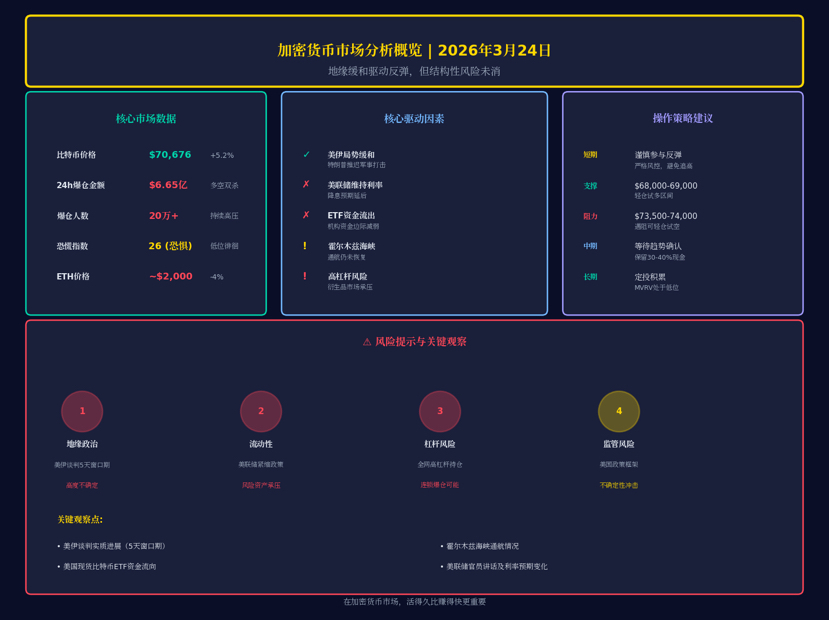
IV. Operational strategy recommendations
4.1 Short-term strategy (1-2 weeks): Participate cautiously in the rebound and enforce strict risk control.
Bull strategy:
• If Bitcoin stabilizes after a pullback to the $68,000-$69,000 range, consider light long positions, with stop-loss set below $65,800.
• Target levels to first look at the resistance level of $73,500; if broken, can look towards $76,000.
• Control positions within 10% of total funds to avoid high leverage.
Short strategy:
• If the rebound encounters resistance and falls back in the $73,500-$74,000 range, consider light short positions, with stop-loss set at $77,500.
• Target levels to look back at $69,000 and $65,000 support.
• Be aware of geopolitical news risks and set stop-loss orders appropriately.
Key observation points:
• Substantial progress in US-Iran negotiations (5-day window)
• Shipping conditions in the Strait of Hormuz
• US spot Bitcoin ETF fund flows
• Federal Reserve officials' speeches and changes in interest rate expectations
4.2 Mid-term strategy (1-3 months): Wait for trend confirmation and allocate in batches
Considering that the current market is in a game period of 'geopolitical calming expectations' and 'macroeconomic liquidity tightening', investors are advised to adopt the following strategies:
Asset allocation:
• Bitcoin: Maintain a core position of 30%-40% as an anchor asset in cryptocurrency allocation.
• Ethereum: 15%-20% position, focusing on its ecosystem development and ETF progress.
• Cash or stablecoins: Maintain 30%-40% liquidity to wait for clearer trend signals.
Batch accumulation plan:
• First tier: Bitcoin falls to the $65,000-$68,000 range, accumulate 20%.
• Second tier: Bitcoin falls to the $60,000-$62,000 range (near February lows), increase positions by 30%
• Third tier: If extreme panic selling occurs (Bitcoin falls below $55,000), increase positions by 50%
4.3 Long-term strategy (6 months or more): Focus on value accumulation and ignore short-term noise
For long-term investors, the current 365-day MVRV is at a historical low of -26%, which is statistically a relatively safe accumulation area. Recommendations:
• Stick to a regular investment strategy, buying fixed amounts of Bitcoin and Ethereum each month
• Pay attention to changes in supply and demand patterns after Bitcoin halving (the halving effect in April 2024 is still ongoing)
• Ignore short-term geopolitical noise and focus on the long-term adoption trend of blockchain technology.
V. Risk Notice
1. Geopolitical risk: The US-Iran situation remains highly uncertain; if negotiations break down after a 5-day window, it may trigger a new round of risk-off selling.
2. Liquidity risk: The Federal Reserve maintains a high-interest rate environment, and global dollar liquidity continues to tighten, which may lead institutional funds to further withdraw from risk assets.
3. Leverage liquidation risk: The current derivatives market has high leverage, and any sharp price fluctuation in either direction could trigger chain liquidations.
4. Regulatory risk: The US cryptocurrency regulatory framework is still being improved, and policy uncertainty may impact market sentiment at any time.
5. Technical risks: Infrastructure issues such as blockchain network security and exchange custody risks cannot be ignored.
The market rebound on March 24 brought some respite to the recently pressured cryptocurrency market, but investors must clearly recognize that this is more of a technical repair driven by geopolitical news rather than a fundamental trend reversal. With the Federal Reserve maintaining a tight stance, the geopolitical situation unresolved, and market leverage remaining high, the cryptocurrency market will still face severe tests.
Investors are advised to remain cautious during short-term rebounds, enforce strict risk control, and avoid chasing highs and selling lows. For long-term value investors, the current market panic might be nurturing a rare opportunity, but the prerequisite is to ensure proper capital management to survive until the next bull market cycle. Remember: in the cryptocurrency market, surviving longer is more important than making quick profits.
Disclaimer: This report is for reference only and does not constitute investment advice. The cryptocurrency market is highly volatile; investing involves risks, and caution is required.


