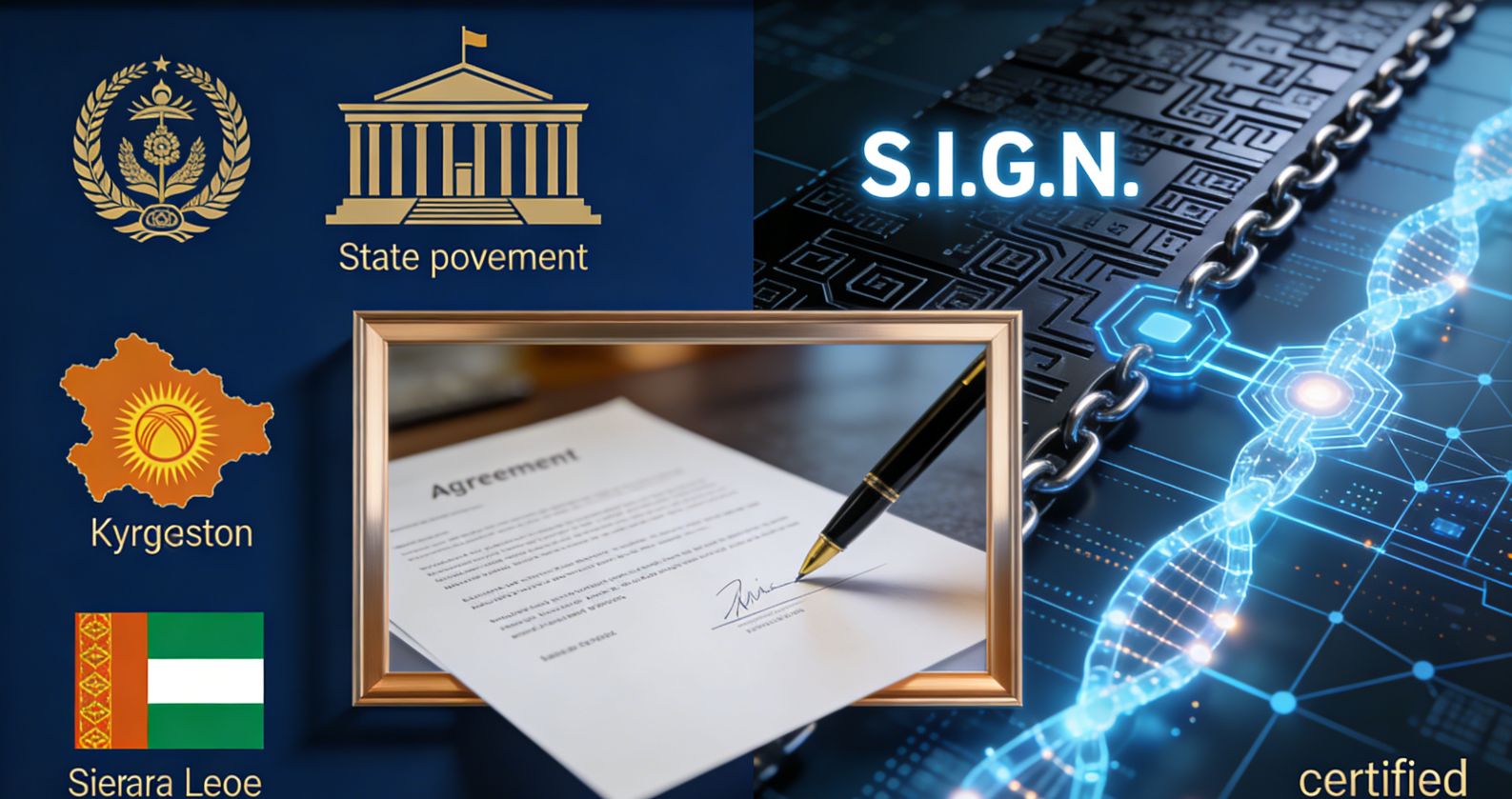
In October 2025, the deputy governor of the National Bank of Kyrgyzstan signed a technical agreement. It's not big news; most people didn't pay attention.
But I noticed. Because the signing party is @SignOfficial .
A Web3 project to build a central bank digital currency for sovereign nations. Would you have believed this three years ago? At that time, most projects were busy presenting PPTs saying 'we want to change the world.' Meanwhile, SIGN has been concretely changing a country's financial infrastructure.
To be honest, I used to be immune to this kind of 'infrastructure narrative' projects. The reason is simple – there are too many people boasting. It's always 'serving the globe' and 'empowering trillion-dollar assets,' but when you look at the on-chain data, the daily active users haven't even reached the number of a meme coin's chat group.
What changed my perspective about SIGN is not its narrative, but the contracts it has signed. The Digital SOM project in Kyrgyzstan is not a PoC, not a memorandum, but a serious technical service agreement. Following that, in November, Sierra Leone also signed a deal for digital identity and stablecoin payments. The interval between these two pieces of news is less than two weeks.
This is quite different.
You need to understand one thing: When sovereign countries choose technology suppliers, the process is long, the scrutiny is strict, and the requirements are many. Being able to secure contracts with two countries in succession indicates that SIGN's tech stack is not something that just sits in a lab; it can withstand audits and scrutiny. In official documents, this system is called S.I.G.N.—Sovereign Infrastructure, which sounds grand, but a closer look at the architecture reveals that it indeed hits the points that governments care about most: a dual-chain architecture, one public and one private, with CBDC running on the private chain to meet regulatory needs, and public services running on the public chain to ensure transparency.
This design logic is very clever. Most projects are either purely public chains that governments find uncontrollable or purely consortium chains that the market finds not open enough. SIGN accommodates both sides and uses the same standards for interoperability. This effectively dismantles the contradiction between 'sovereignty' and 'openness.'
Let's talk about money. In 2024, SIGN generated $15 million in revenue, not from financing, but from real cash collected from clients. Out of this money, 12 million was used to buy back $SIGN, with 8 million directly purchased on the open market. This is rare in the industry—most projects prioritize giving bonuses to themselves when they have money, and the ability to actively buy back indicates that the team either has price demands or confidence in their business model.
$SIGN The token economic structure needs attention. Total supply is 10 billion, with approximately 12% to 16% currently in circulation. In January 2026, a release of 290 million tokens occurred, accounting for nearly 18% of circulation, with continuous unlocking until 2030. This structure objectively exists, and short-term selling pressure is an unavoidable topic. However, looking at it from another angle, 40% of the tokens are reserved for community incentives, and a recent orange basic income plan has been launched, distributing 100 million SIGN based on the duration of on-chain holdings. This mechanism design is biased towards retaining long-term users rather than concentrating chips in the hands of a small group.
My criteria for judging whether a project is worth observing is simple: Is it solving real-world problems, or is it addressing the attention issues of the crypto space?
SIGN belongs to the former category. The things it does—building digital identities for governments, issuing CBDCs, and conducting compliant asset distribution—are not glamorous and even a bit tedious. But it is precisely this tedium that signifies it has a moat. Can you imagine a meme project trying to bid for Kyrgyzstan's CBDC? They wouldn't even have the qualifications to bid.
Of course, risks should be clarified. SIGN currently relies mainly on government contracts and TokenTable's corporate clients to sustain itself. This B2G and B2B model means long sales cycles and slow payment. Short-term prices are highly volatile due to unlocking, making it unsuitable for short-term speculators.
However, if you are looking at a three- to five-year horizon, the logic of the track becomes very clear—there are over 200 countries globally, most of which have not even completed basic digitization, let alone blockchain integration. SIGN has already run through the first two, and the next step is just about replication.
I tend to pay more attention to projects that can sign contracts with sovereign countries. Because in the crypto space, teams that can make money by selling products are significantly more reliable than those relying on selling tokens for financing.
$SIGN's purchase and the timing of that purchase is your own business. I am only responsible for telling you: someone is seriously doing their job, and it has already been certified by sovereign nations.#Sign地缘政治基建