
Let me be honest with you—I’ve been in the crypto space for so many years, and almost every token project follows the same pattern: insiders and early investors quietly take away 30-50% of the supply, airdrops are cleaned up by bots and witch farms, and the community that truly contributes ends up with only a few scraps. The data is there; most chains have a Gini coefficient exceeding 0.9. This is no longer a secret; it’s an old problem in the industry.
So SIGN caught my eye. It's not just another flashy token, nor is it some new launchpad. It genuinely feels like it wants to fundamentally change how tokens are distributed.
To be honest, the overall picture is quite sobering. The initial slogan of cryptocurrency was 'everyone can have a share,' but what happened? On-chain data clearly shows that the top 1% of addresses still hold the vast majority of chips—over 80% of Bitcoin, and early Ethereum's actual supply is close to 95%. What was meant to bridge the gap with airdrops has turned into a competition for task completion. Projects spend millions on marketing, only for the tokens to end up back in the hands of a few major players. The root of the problem lies not in human greed, but in the distribution mechanism that has never had 'verifiable proofs.' Without this, capital pricing will always be misaligned, and long-term incentives will never match up. This is the big problem that SIGN aims to solve.
So what exactly is SIGN? Let's cut to the chase. It is essentially a combination of two things: Sign Protocol (a full-link proof layer) and TokenTable (an intelligent contract engine responsible for executing real distributions).
Attestations are essentially structured records with signatures that anyone can issue and can be verified across chains. Simply put, whatever you contributed, the work you did, your KYC status, or any rules you want to set become a digital certificate. Then TokenTable reads these certificates and automatically executes airdrops, allocations, funding, or regular rewards. No more guessing who should get what, no more relying on wallet numbers for luck. Everything becomes programmable and verifiable, inherently fair by design.
They have already handled over $4 billion in distributions, covering 40 million users and more than 200 projects. This is not marketing copy; it is verifiable on-chain data.
Let's talk about opportunities, but without the exaggerated PPTs. I am not estimating some nebulous 'airdrop market,' but rather looking at the total capital that truly needs fair distribution each year: new token issuance, ecological funds, real-world welfare projects, and even sovereign digital infrastructure from various countries. That amounts to hundreds of billions of dollars globally. SIGN's TokenTable has already sliced off a substantial piece of the cake with $4 billion. If it can steadily capture 5-10% of the annual flow of $50-100 billion in the next 3-5 years, the logic will run itself. The real opportunity is not how big the market size is, but rather replacing all those 'distribution failures' hidden costs (dilution, regulatory risks, community backlash).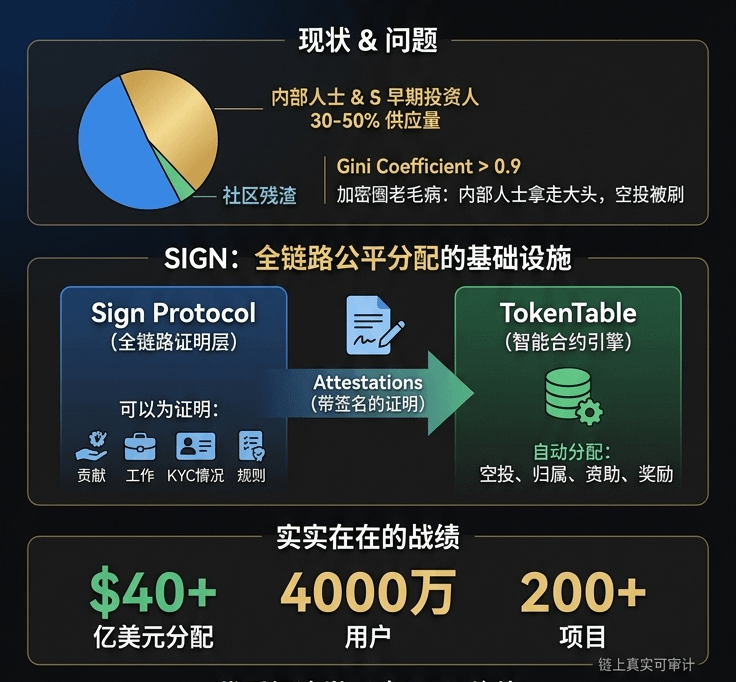
Now, let's talk about the most critical point regarding the $SIGN token—also a place where many projects mess up: the value of #Sign comes from the demand driven by risk-based staking.
40% of the supply is intentionally reserved for community rewards and staking incentives. When you stake, you are putting real money at risk—opportunity costs, price fluctuations, and lock-up pressure. In return, you can earn the protocol's usage fees, income-backed buybacks (they have already conducted a $12 million buyback), and tangible governance weight. The more projects use TokenTable for high-value distribution—large airdrops, government funding, compliance unlocks—the more willing everyone is to stake $SIGN to share in the pie.
The logic is quite simple: the larger the usage → the stronger the staking demand → the tighter the circulation → the true accumulation of value. This is exactly the logic that has made Ethereum staking the industry's biggest profit story.
I must be honest, SIGN's own tokenomics is not a perfect fairy tale either. 20% is allocated to early supporters, 10% to the team, and there is a standard vesting period. No project can completely avoid early concentration.
But SIGN's brilliance lies here: all distributions built on TokenTable in the future can be proven on-chain to be fairer than SIGN's own issuance. This protocol was designed from the start to 'eat its own dog food.' Project teams can now genuinely achieve contribution-weighted, anti-witch hunt, and optionally KYC distributions, which traditional VC models simply cannot do. The harsh truth is that most 'fair issuance' stories are just stories. SIGN forces the market to provide evidence on-chain. This is the true structural advantage.
In terms of regulation, the winds are changing rapidly now. The SEC, European MiCA, and various Asian frameworks are all demanding real traceability and compliance. Most projects are still playing 'hide and seek.' SIGN has completely flipped the rules: proving to regulators with a clean audit trail (who approved what, based on which rules), while zero-knowledge proofs and selective disclosures protect user privacy. TokenTable can even allow projects to directly embed KYC/AML requirements without throwing all data onto the chain. It’s not about praying for regulators to turn a blind eye, but rather proactively showing them what they most want to see. From a game theory perspective, this directly shifts the entire ecosystem from 'hiding and praying' to 'proving before scaling up.'
The timing is particularly fortuitous now. After 2024/2025, regulations will finally become clear, and sovereign nations are moving digital identities and welfare projects onto the chain, while large capital plans urgently need scalable infrastructure that traditional finance cannot provide. SIGN already has a real track record of $4 billion, running sovereign pilots, and is actively buying back with real income. Before the foundational proof technologies are copied by everyone, this window is likely only 12-24 months left. Being in this position truly has alpha.
Let me give you three realistic scenarios based on how I usually model investments:
Baseline scenario (which I believe is the most likely): By 2028, TokenTable captures 5% of addressable flow. The staking rate stabilizes at 35-40%. Protocol revenue continues to buy back, with staking annual yields of 8-12%. $SIGN FDV falls within the $1.5-2 billion range—very reasonable valuation for mature infrastructure.
Bull market scenario: Sovereign and corporate adoption suddenly accelerates (national welfare programs, large ecological funds). The staking rate surpasses 50%. Multiple rounds of buybacks commence, and FDV reaches $4-6 billion, alongside leading infrastructure layers. The flywheel of risk-driven staking truly begins to snowball.
Bear market scenario: Adoption speed remains at current levels, and regulation is stricter than expected. Staking rate drops below 25%. FDV compresses to $400-700 million, but there is still real income and community distribution supporting the bottom.
No matter the scenario, it all revolves around the same core: risk-driven staking demand. The only variable is how quickly verifiable distributions can become the new industry standard.
Ultimately, unequal token distribution is not some random bug, but an inevitable result of systems that 'cannot prove who should get what.' SIGN does not claim to solve all problems overnight. It merely replaces the old opaque system, where insiders called the shots, with a proof mechanism that ensures every distribution is precise, compliant, and truly linked to contributions.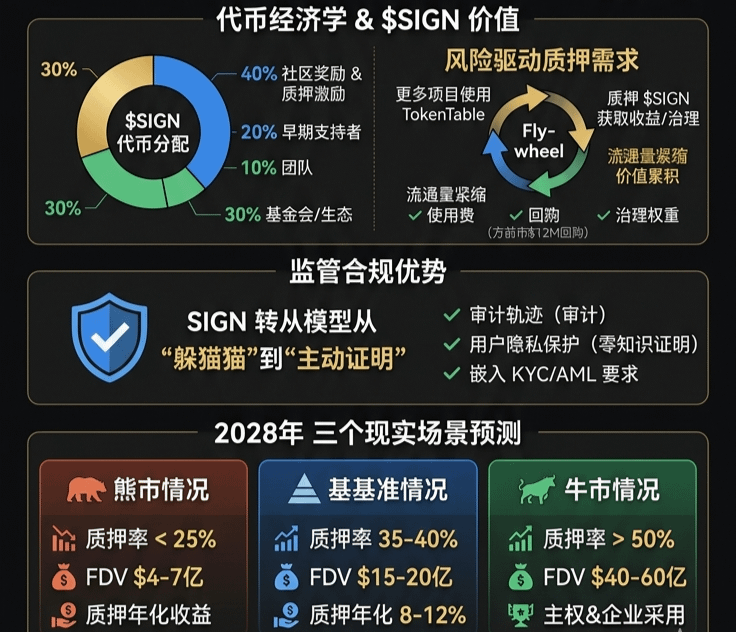
When risk-driven staking demand occurs within a protocol that has already massively liquid real capital, economics naturally starts to favor long-term holders. This is not hype, nor is it wishful thinking. This is the underlying logic of infrastructure, which happens to align perfectly with the regulatory reality that needs it most.
If you, like me, value clear facts over pretty narratives, then SIGN is the cleanest and most worthy bet I have seen to date—betting on the next chapter of token distribution evolution. The system can change, and data already shows that it is slowly starting to change.