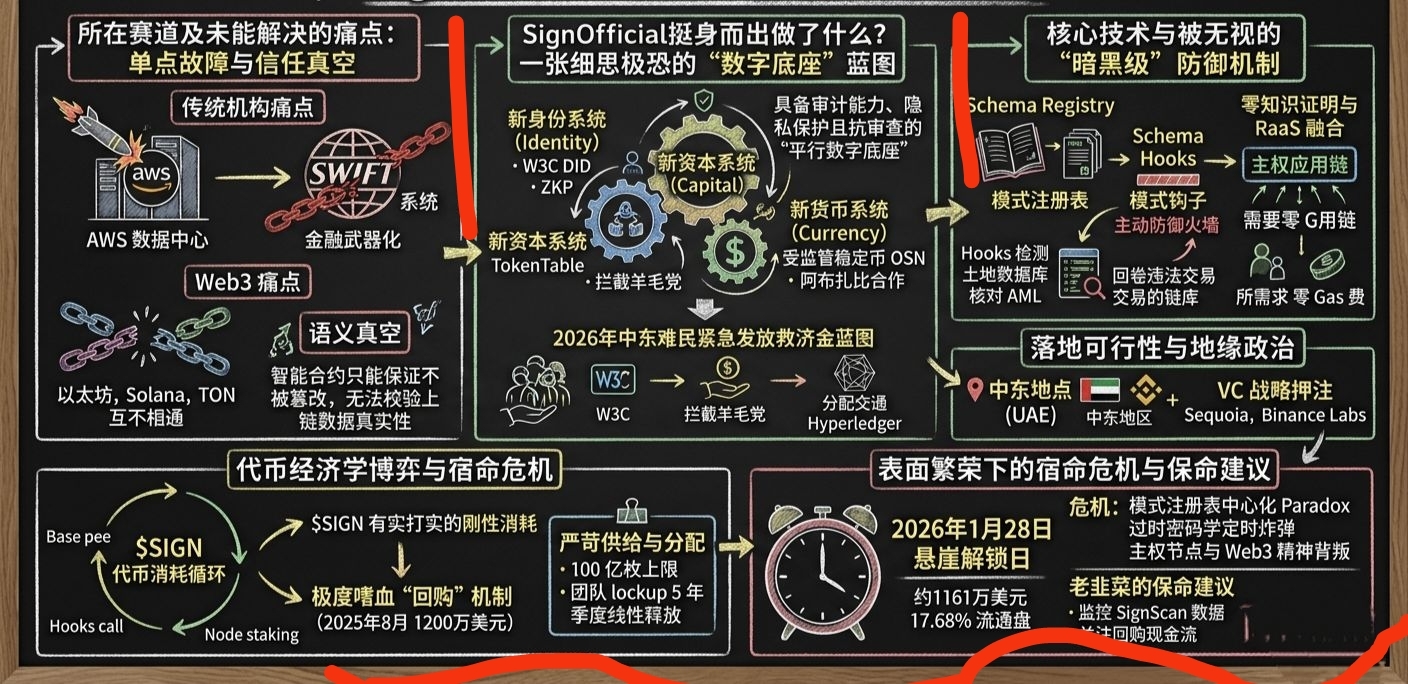
#sign has extended its business to national-level cooperation, especially in the Middle East and Central Asia.
In the current stage of reshaping the geopolitical landscape, where countries are accelerating the competition for digital financial discourse power, infrastructure projects that can directly serve national-level needs have a stronger moat.
Since #Sign地缘政治基建 will conduct token buybacks of its revenue in both the primary and secondary markets, we can see that $SIGN has been showing a rebound in price recently.
@SignOfficial In an environment where global order fluctuations are intensifying, whoever can become the provider of “new financial infrastructure” has a greater chance of achieving growth beyond cycles.
Therefore, the market value logic of Sign tokens is no longer limited to traditional crypto cycles, but is deeply tied to the developmental value, growth space, and profit buyback token process of Sign. The application is very extensive. Now, let's talk about the views on its visible and invisible functions.
What SIGN does, if put simply, is changing who can see you from being open by default to being settable. But what really makes me think repeatedly is not the function itself, but the subtle change behind it. You can finally hesitate a bit instead of being forced to accept.
However, I also don't want to portray Sign as too clean, because it is not clean at all. You see, what Sign provides is not absolute invisibility; it is more like a way to reallocate visibility. You can choose to show information only to specific people or prove part of it when needed, rather than all of it. But the problem is, who that specific person is, is itself not very stable.
Sometimes I find myself staring at the design of Sign, thinking that if one day the range of visible people gradually expands, you actually have very little control over it. What you can do is choose to believe in a certain set of rules at the moment, rather than completely mastering it.
So my feelings about Sign have always been a bit wavering. On one hand, I do feel that it is closer to being human than that completely exposed on-chain state. At least it acknowledges one thing, which is that not all information should be seen by everyone. This is actually quite important, even a bit fundamental.
But on the other hand, Sign also cannot help you solve that deeper issue. That is, the judgment power is not in your hands. You can decide what to disclose, but it's hard to determine how others will use that disclosure, and it's also difficult to decide whether they will use non-disclosure to infer about you.
I talked to a friend about Sign recently, and his reaction was quite direct. He said that if an address used Sign's privacy method, his first reaction would actually be more cautious because there is less information, making it hard to judge. I felt a bit uncomfortable hearing this, but I couldn't pinpoint what was wrong. $SIGN