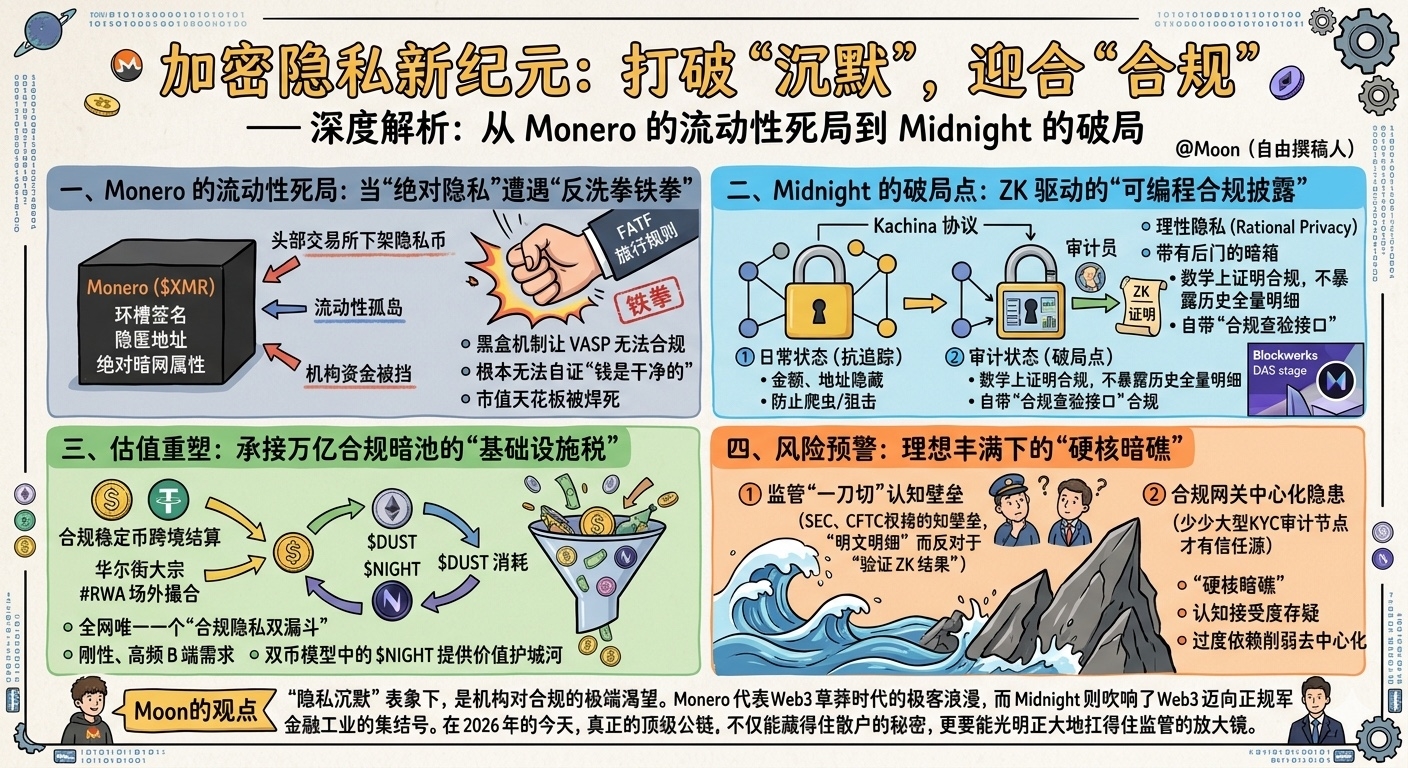
Recently, as major exchanges have delisted or withdrawn tokens with strong privacy attributes to comply with global regulatory standards, the entire cryptocurrency market has fallen into a strange state of 'privacy silence.'
On one hand, with the extreme advancement of on-chain data analysis tools (such as Arkham, Chainalysis), institutional large holders and smart money on fully transparent public chains are being stripped bare across the network; on the other hand, Monero (门罗币, c-104), once hailed as a beacon for geeks, has become a liquidity island due to its 'absolute dark web' attributes, and mainstream institutions avoid it like the plague.
Why, on the eve of the explosion of privacy demand, are capital markets silent about old privacy coins, instead focusing unprecedentedly on @MidnightNetwork , which is about to face a major test on its mainnet?
As a researcher and writer deeply rooted in the industry, today we set aside the old narratives commonly discussed in the market, and from a macro-financial perspective of 'FATF Travel Rule and Institutional Liquidity Restructuring', we deeply analyze this underlying narrative overhaul.
1. Monero's liquidity deadlock: When 'absolute privacy' encounters the 'iron fist of anti-money laundering'
The fall of the old generation of privacy coins is not due to technological backwardness, but because they have moved towards the absolute opposite of regulation in business logic.
Monero adopts ring signature and stealth address technology, creating a perfect black box. However, in the eyes of institutions in 2026, this is deadly poison. According to the Financial Action Task Force (FATF) 'Travel Rule', any regulated Virtual Asset Service Provider (VASP) must collect and transmit the real information of the sender and receiver during transactions.
Core pain points:
Monero's black box mechanism makes it impossible for exchanges and compliant OTC institutions to prove 'this money is clean'. If institutions cannot comply, they will not dare to enter the market. Without the liquidity injection from Wall Street and traditional old money, the market cap ceiling of the old generation of privacy coins has long been sealed.
2. Midnight's breakthrough point: ZK-driven 'programmable compliance disclosure'
It is precisely in the intense conflict between this 'privacy demand' and 'compliance red line' that Midnight's underlying architecture demonstrates a terrifying ability to reduce dimensions.
Midnight does not pursue the anarchist absolute black box of Monero but proposes an architecture with great commercial wisdom—Rational Privacy.
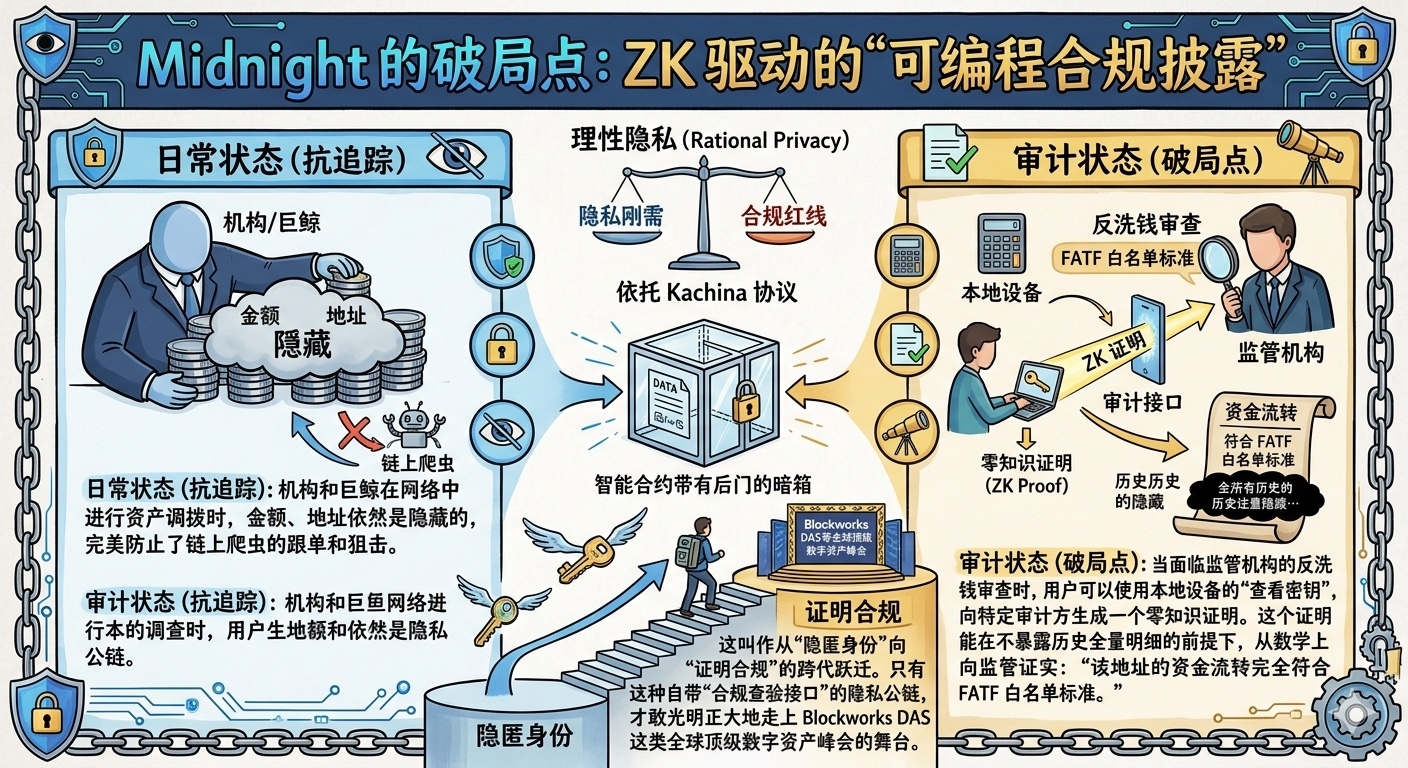
Relying on its core Kachina protocol, Midnight allows developers to set a 'black box with a backdoor' in smart contracts.
• Daily Status (Anti-tracking): When institutions and whales allocate assets within the network, the amounts and addresses remain hidden, perfectly preventing on-chain crawlers from following and sniping.
• Audit Status (breakthrough point): When facing anti-money laundering reviews from regulatory agencies, users can use a 'view key' from local devices to generate a zero-knowledge proof for specific auditors. This proof can mathematically confirm to regulators without exposing the entire historical details: 'The funds at this address fully comply with FATF whitelist standards.'
This is called the generational leap from 'stealth identity' to 'proving compliance'. Only privacy public chains that come with a 'compliance verification interface' dare to openly step onto the stage of global top digital asset summits like Blockworks DAS.
3. Valuation Restructuring: The 'infrastructure tax' for accommodating trillion-dollar compliant dark pools
From a professional research perspective, assessing the value of a chain depends on the level of assets it can absorb.
When transparent public chains (like Ethereum) expose institutions to the risk of 'leaking trade secrets', and Monero presents them with the risk of 'compliance delisting', Midnight has effectively become the only 'compliant privacy dual funnel' in the entire network.
Future compliant stablecoin cross-border settlements and Wall Street bulk #RWA (real assets) OTC matchmaking will likely migrate to networks that support programmable disclosure. Every time a 'compliant ZK proof' is generated in the network, it consumes a large amount of $DUST. This rigid, high-frequency B-end demand initiated by traditional financial institutions will provide an extremely solid value moat for $NIGHT in the dual-coin model.
4. Risk Warning: The 'hardcore reefs' beneath the ideal surface
Of course, for any new species, we must maintain an objective risk assessment:
1. The cognitive barrier of regulatory 'one-size-fits-all': Although ZK technology can mathematically prove its own innocence, traditional national regulatory agencies (such as the SEC and CFTC) still have doubts about the acceptance of 'cryptographic proof'. If regulators insist on 'obtaining underlying detailed information' instead of 'verifying ZK results', Midnight's business moat will face severe challenges.
2. Centralized risks of compliance gateways: Who will issue 'compliance qualifications'? If the Midnight network overly relies on a few traditional centralized KYC audit nodes as the trust source for ZK proof, this will weaken its decentralized narrative to some extent.
Moon's perspective
Beneath the appearance of 'privacy silence' lies the extreme desire of institutions for compliance. Monero represents the geek romance of the Web3 wilderness era, while Midnight sounds the rallying call for Web3 to march towards a regular financial industry. In today's 2026, a truly top public chain must not only be able to conceal the secrets of retail investors but also withstand the scrutiny of regulators openly.
Freelancer: Moon