
The more I consider Sign the less I see it as just another online signature platform. Calling it “just signing” feels far too small.
We’ve already had digital signatures. Platforms that let people click confirm and move on with business. Most worked well enough for daily needs. A contract gets signed. A record gets stored. Everyone hopes the host survives the servers remain intact and the legal framework cooperates when something goes wrong. Functional but far from inspiring.
Sign however is aiming much higher. It is not asking how do we sign faster? It is asking how do we make proof indestructible? And that is a far more serious goal.
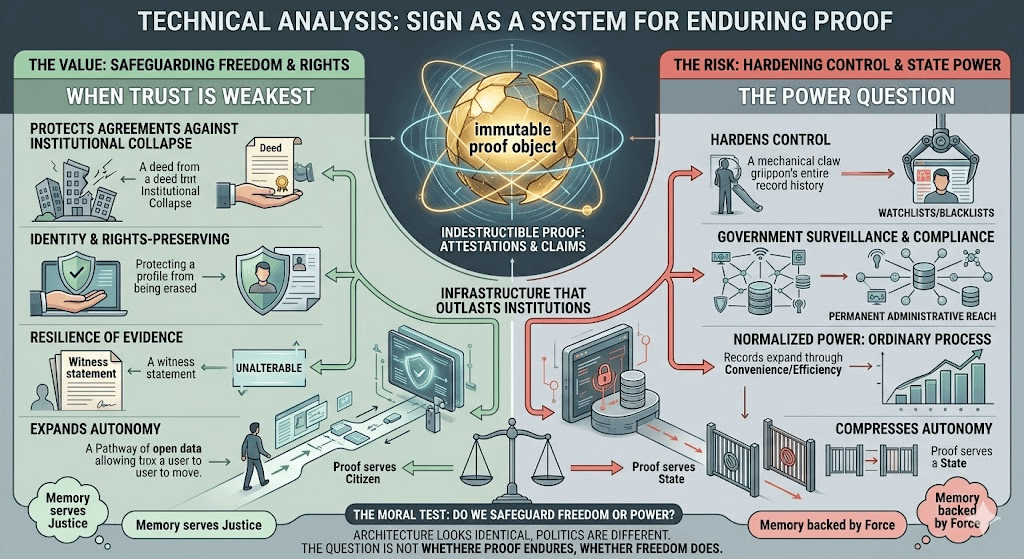
Honestly the appeal is immediate. Traditional e-signatures are fine until they fail. They depend on companies databases jurisdictions and all the fragile parts of modern digital life. If the platform fails, if records are disputed if institutions collapse into confusion and finger-pointing the “proof” suddenly feels far less permanent. So the idea of moving agreements claims rights and credentials onto infrastructure that is much harder to quietly alter or erase is not radical at all.
It might be one of the most compelling ideas I’ve encountered in this space. Because proof matters most when trust is weakest.
Beyond Documents Sign as a System for Enduring Evidence
This is where Sign begins to feel bigger than paperwork. Not just signatures, but attestations. Not just approvals but claims. Not just transactions but the logic behind rights access eligibility and recognition. Once proof becomes durable entire administrative systems start looking like they can be rebuilt on sturdier foundations.
Identity Token distributions Institutional records. Perhaps even state-level frameworks. And that’s when admiration mixes with caution. Because tools that protect rights can equally harden control.
The same system that preserves a contract against erasure can also make a person’s record harder to escape. The same framework that protects evidence against institutional collapse can preserve state power just as stubbornly. Once governments take interest the tone changes. What begins as tamper-resistant proof for fairness can become a permanent machine for surveillance, compliance and coercion. This is not a minor concern and it is central.
The Power Question at the Heart of Immutable Proof
We celebrate immutability when it safeguards the weak from the powerful. Less appealing when it gives the powerful a cleaner unalterable way to monitor track and enforce. A rights-preserving system can sound heroic until you remember governments also value durable records, especially when they help map behavior monitor identity and tighten administrative reach.
This is why Sign is not just a technology story. It is a story about power.
Permanence is never neutral. It is not inherently virtuous. It is useful. Sometimes beautifully useful. Sometimes dangerously so. Who holds the system who defines its boundaries and what options remain for individuals once their actions or identities are tied to infrastructure meant to outlast institutions all that decides whether permanence protects freedom or constrains it.
The Subtle Threat of Normalized Power
If proof survives institutional failure, great. But what if the institutions survive and grow more ambitious? What if durable infrastructure protects not only property or rights but also blacklists watchlists and permanent administrative suspicion?
Infrastructure often narrows freedom not through dramatic abuse, but through ordinary process. “Temporary” measures become permanent. Convenience drives normalization. Records expand simply because the system exists and is too useful not to use. Freedom erodes slowly through procedure efficiency and infrastructure that quietly grows indispensable.
Sign sits squarely in that tension.
Stronger proof. More durable evidence. Less reliance on fragile companies and legal systems. Greater confidence that agreements and claims survive institutional collapse. That is real value. Especially in a world where institutions fail all the time then act surprised.
But the question is not whether stronger proof is valuable. It is who benefits from that proof once the system becomes routine.
A proof system that serves citizens is one thing. One that prioritizes the state is something else entirely. The architecture may look identical but the politics could not be more different. One expands autonomy the other compresses it. One preserves rights under weak institutions the other preserves state power against resistance.
Memory Force and the Moral Test
Sign is no longer about signatures. It is about memory backed by force. Records that are harder to deny erase or escape. Sometimes that is exactly what justice requires. Sometimes it is exactly what control demands. And the same technical feature can serve either purpose depending on who wields it and what safeguards exist. Sign’s ambition is real. Its use case is far bigger than most first assume. It addresses a genuine weakness in digital proof today.
But once you build proof to endure institutional failure you must ask: What happens if institutions survive and grow stronger?
That is the real moral test.
Not whether proof endures.
Whether freedom does.
@SignOfficial #SignDigitalSovereignInfra $SIGN
