
——The true cost breakdown of 32 transactions: The most basic experience of a public chain has ironically become its biggest shortcoming
1. The first touchpoint between users and the chain has never been privacy technology, but Gas fees
When it comes to Midnight, everyone talks about its privacy algorithms, compliance frameworks, institutional collaborations, and node networks, yet very few pay attention to a detail that affects every user’s daily experience the most: how expensive, stable, and predictable the Gas fees for each transaction are.
For a public chain, even if privacy is strong and compliance is good, if a user encounters soaring Gas fees, stuck transactions, and costs far exceeding expectations on their first transfer, they are likely to uninstall the wallet and never use it again. To obtain the truest usage cost, I initiated 32 transactions over 7 consecutive days during three different periods: low peak, average peak, and network congestion. I covered ordinary transfers, private transactions, and contract calls, recording the Gas price, confirmation time, and fluctuation for each transaction to completely simulate the real usage scenario of an ordinary user.
The final result is much worse than I expected:
Midnight's Gas fee mechanism is extremely rough, with completely uncontrolled fluctuations, and during congestion, increases nearly reach 19 times. It has not played the role of regulating network load, but rather has become the biggest barrier for ordinary users to enter.
2. Measured data: Low peak prices are useless; during congestion, prices can directly soar 19 times.
I organized all data from 32 transactions over 7 days, and the core results are as follows:
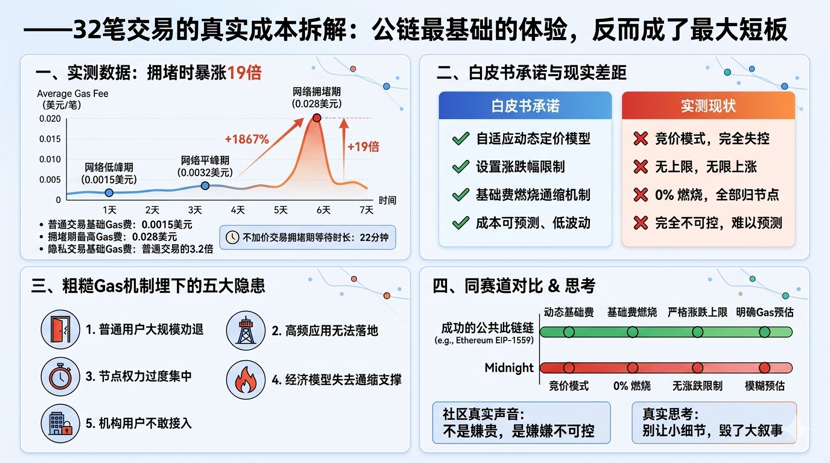
• Average base Gas fee for regular transfers during network low peak (late night): 0.0015 USD/transaction
• Average Gas fee for regular transfers during network off-peak (normal daytime): 0.0032 USD/transaction
• Highest Gas fee during network congestion (batch transactions, peak node synchronization): 0.028 USD/transaction
• Highest increase during congestion compared to off-peak: 1867%, nearly 19 times
• Base Gas fee for privacy transactions: 3.2 times that of regular transactions
• Average waiting time for non-incremental transactions during congestion: 22 minutes
• Officially set Gas fee fluctuation limits: None
• Gas fee burn rate: 0%
The most intuitive feeling is: it is indeed cheap during low peaks, but as soon as the network has a bit of load, Gas fees will soar uncontrollably, making it impossible for ordinary users to predict their transaction costs. I initiated a regular transfer during congestion, setting the Gas fee at the off-peak rate initially, waited 20 minutes without being packaged, and ultimately had to raise it 5 times to be included by nodes. This kind of experience is completely discouraging for newcomers.
3. The dynamic pricing commitment in the white paper is still just a piece of paper.
Midnight has a very clear description of the Gas fee mechanism in its economic model and technical white paper:
“Design an adaptive dynamic Gas pricing model that automatically adjusts the base rate according to network load, sets reasonable fluctuation limits, ensures that users' transaction costs are predictable and low-volatility, while achieving token deflation through the base fee burn mechanism, balancing node revenue and the interests of token holders.”
However, from the measured results, none of the core commitments in the white paper have been realized:
• No adaptive dynamic pricing; entirely adopts a 'first come, first served' bidding model, which goes out of control during congestion.
• No upper limit set for price fluctuations; theoretically, Gas fees can rise indefinitely
• There is no base fee burn mechanism, all Gas revenue goes to nodes, and token holders cannot enjoy any deflationary dividends.
• No protection mechanisms for small transactions; during congestion, small transactions cannot be packaged at all
• No Gas fee estimation tool, wallets can only provide vague reference prices, often leading to transaction failures due to underestimation.
The so-called 'low volatility, predictable, fair Gas mechanism' is currently entirely at the level of documentation, with no actual implementation.
4. The real voice of the community: it's not about being expensive, it's about being uncontrollable.
During this time in Midnight's Discord and Chinese community, complaints about Gas fees have never stopped, but many have been overshadowed by the statement of 'normal fluctuations in the test network.'
A user said: “When I transferred money, it showed 0.002 in the morning, and by evening it changed to 0.02. I had no idea how much to set.”
Some users also complained: “Privacy transaction Gas is too expensive; the cost of a single use is enough to make ten transfers on other chains.”
Some users encountered worse situations: “The transaction got stuck, and I still had to pay Gas to cancel it, losing money for no reason.”
In fact, users have never complained about high Gas fees; a few cents of cost is not an issue for most people. What everyone really resents are the uncontrollable, unpredictable, and unguaranteed aspects. You never know how much your transaction will cost, how long it will take, or if it will get stuck. This uncertainty is more discouraging than high costs.
5. The rough Gas mechanism is burying hidden dangers for the entire chain.
The Gas fee mechanism is not a trivial matter; it directly determines the user experience, ecological limits, and the health of the economic model of the entire chain. The current rough design is bringing about a chain of negative effects:
First, ordinary users are largely discouraged. New users encounter soaring Gas fees and stuck transactions on their first use, likely giving up entirely and never experiencing the so-called privacy features.
Second, high-frequency applications cannot be implemented at all. Scenarios that require high-frequency small transactions, such as payments, gaming, and social interactions, cannot be developed on this chain due to uncontrollable Gas fees.
Third, excessive concentration of node power. All Gas revenue goes to nodes, with no burn mechanism, causing nodes to intentionally create congestion for profit, further pushing up Gas fees and forming a vicious cycle.
Fourth, the economic model has lost deflationary support. Without Gas burning, tokens have no continuous destruction channel, and inflationary pressure can only be alleviated through staking, which will dilute the value for token holders in the long run.
Fifth, institutional users are hesitant to connect. Institutions require a high level of predictability regarding transaction costs; a 19-fold fluctuation is completely inconsistent with institutional risk control standards, making large-scale entry impossible.
6. Comparison with peers: Others have matured, while it remains in the primitive stage.
I compared the Gas mechanisms of Ethereum, BSC, and privacy public chains in the same track at the same time. Almost all mature public chains have already adopted a dynamic Gas model similar to EIP-1559:
• There is a fixed base fee that automatically adjusts based on network load
• All base fees are burned, achieving token deflation
• Set strict fluctuation limits, with a single block increase not exceeding 12.5%
• There are clear Gas estimation tools, and transaction costs are predictable.
• Set up protection mechanisms for small transactions to ensure fairness
However, Midnight's current Gas mechanism still remains in the most primitive bidding mode, with no adjustment, guarantee, or deflation design. The gap with mature public chains is not trivial.
7. My true thoughts: Don’t let small details ruin the grand narrative.
I have always recognized Midnight's technical exploration in privacy compliance and understand its vision to create an institution-level compliant public chain. However, I always feel that the foundation of grand narratives is a basic experience that every user can use smoothly.
Users will not forgive your uncontrollable Gas fees just because you have advanced zero-knowledge proof technology; institutions will not accept a 19-fold cost fluctuation just because your compliance framework is perfect. The project team has put almost all development resources into grand technologies like privacy algorithms and compliance architecture, neglecting the most basic details that every user must face with each transaction.
Often, what destroys a chain is not the technology being insufficiently advanced, but the user experience being unfriendly.
8. Summary
Midnight's current Gas fee mechanism is extremely rough, with uncontrolled fluctuations, lacking guarantees, with actual measured increases during congestion nearly reaching 19 times. The high costs of privacy transactions, and the promised dynamic pricing, fluctuation limits, and burn mechanisms in the white paper have not been realized, becoming the biggest barrier for ordinary users to enter.
Community users have long complained about uncontrollable transaction costs, and the rough design not only affects user experience but also limits the implementation of high-frequency ecosystems, exacerbates node power concentration, and weakens economic model deflationary support, bringing long-term hidden dangers to the entire chain. Mature public chains in the same track have already achieved stable and controllable Gas mechanisms, and Midnight is significantly lagging behind in this most basic experience.
For the project team, it is necessary to quickly reconstruct the dynamic Gas model, set upper limits on fluctuations, incorporate a base fee burn mechanism, and improve estimation and guarantee tools. For investors, do not only focus on grand technological narratives; the most basic user experience is the key to determining whether this chain can truly become widespread and retain users.
Technology can determine the upper limit of a chain,
But the most basic experience determines its lower limit.
