
I used to trust what I saw on chain.
Wallet activity. Volume. Participation. Engagement.
It all looked like signal.
Until I realized how easy it is to fake.
A few months ago, I followed a wallet that looked “smart.” It was early into a few projects, had consistent activity, and seemed like it knew what it was doing. I started tracking it more closely.
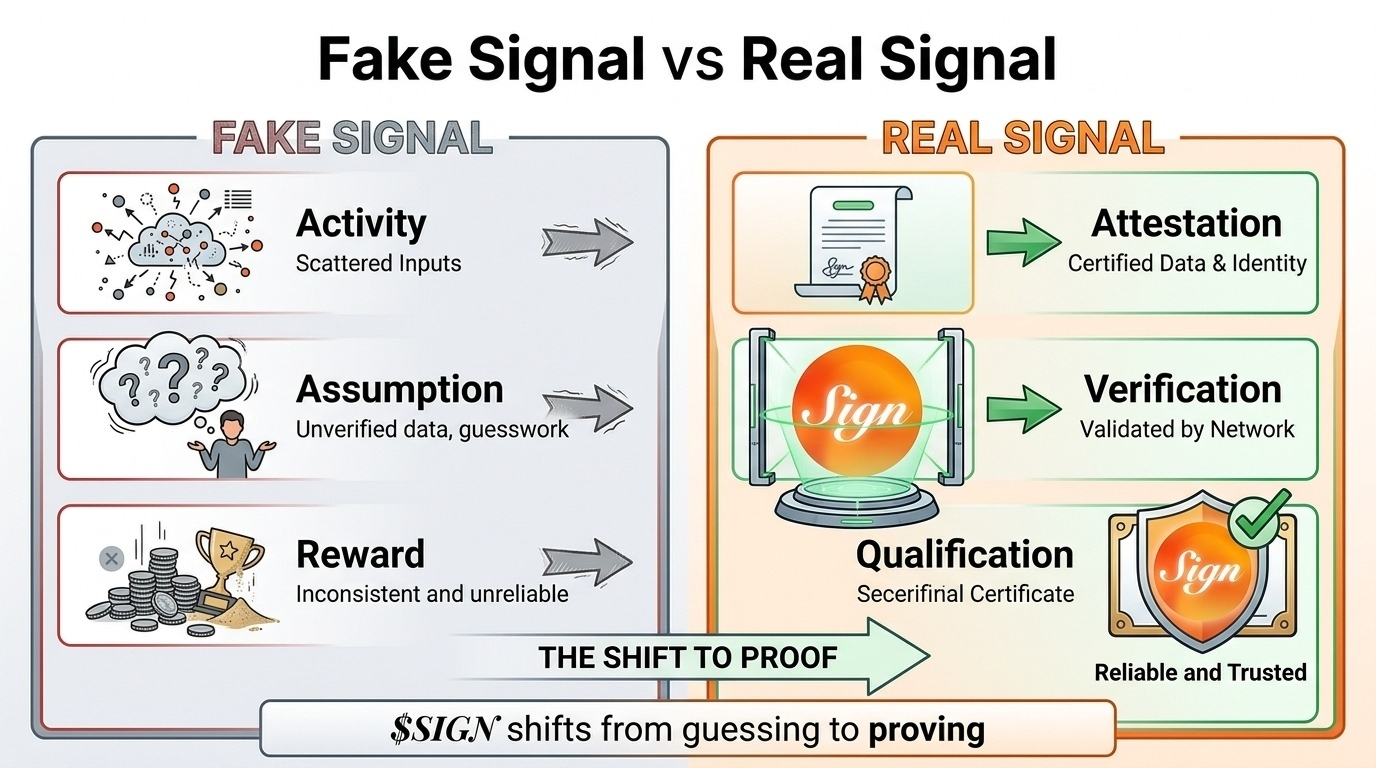
Then I noticed something strange.
A lot of its activity was just… noise.
Repeated interactions. Low-effort farming. Moving between projects with no real conviction. It looked active, but it wasn’t meaningful. It was optimized to look like signal without actually being signal.
That’s when it clicked.
Crypto is full of reputation that isn’t real.
And that’s a problem.
Because most systems still rely on weak indicators. Wallet activity, transaction count, interaction history. Things that look useful on the surface but are incredibly easy to manipulate once people understand the rules.
That’s the environment where $SIGN starts to make more sense.
Sign Protocol doesn’t try to guess reputation from behavior. It focuses on verifiable claims. Instead of assuming someone is valuable because they interacted a lot, it allows systems to define what actually matters and record that properly.
That’s a completely different approach.
Because the problem is not lack of data.
It’s lack of meaningful data.
The more I think about it, the more I see how broken current reputation models are. They reward visibility, not contribution. They reward activity, not quality. And once people understand how to game the system, the signals degrade fast.
That’s why a lot of “onchain reputation” feels fake.
It’s not anchored to anything solid.
What Sign Protocol introduces is a way to anchor claims. If a user contributed, that can be recorded. If a wallet qualified under specific criteria, that can be verified. If an action mattered, it can be attested.
That changes the game.
Because now reputation is not inferred.
It’s proven.
And proven reputation is harder to fake.
I think this becomes more important as crypto grows. The more money flows through systems, the more incentives exist to manipulate signals. And once that happens, weak metrics collapse.
You see it everywhere already.
Airdrops farmed by bots. Communities filled with low-quality engagement. Metrics inflated but meaningless. Syst

ems trying to reward “users” but struggling to define what a real user actually is.
That’s not a small issue.
That’s a structural problem.
And it doesn’t get fixed by better dashboards.
It gets fixed by better definitions of truth.
That’s what $$SIGN s trying to provide.
Not perfect reputation.
But verifiable reputation.
And I think that distinction matters more than most people realize.
Because in a system where everything can be faked, the only thing that holds value is what can be proven.
@SignOfficial $SIGN
