
In-depth analysis of $SIGN: Why is it the hardest 'digital currency' in the midst of the chaos in the Middle East?

Brothers, have you been following the news these days? Reuters revealed that the outflow risk of deposits in the Gulf region could be as high as 3070 billion dollars. What does this indicate? It indicates that the traditional financial trust system is collapsing. At this time, if the assets you hold still rely on the old system, then you are swimming naked. That's why I not only didn't run away, but instead exchanged most of my positions for $SIGN at the bottom.
Many people don't understand and think that $SIGN is just a verification tool that increases slowly, not as stimulating as the local dogs. But what I see is its ambition as 'sovereign-level digital infrastructure'. It is no longer just an electronic signature for small vendors, but is helping countries build a digital defense.
Highlight 1: It accurately addresses the most painful 'trust gap' in the Middle East.
The chaos in the Middle East is fundamentally a collapse of trust. When banking channels are cut off and international settlements are hindered, you need a verification system that does not require the endorsement of any intermediaries. $SIGN does exactly this, replacing verbal commitments with mathematics and code. Its founder even stated on Saudi television that the geopolitical crisis is just beginning, and $SIGN is prepared for it. This is strategic support; its existence is not for speculation but to serve those nations that truly need digital sovereignty.
Highlight 2: The implementation capability exceeds imagination, not just PPT.
I particularly appreciate its schema + attestation framework. Simply put, developers can customize data templates, and after signing on-chain, anyone can verify authenticity at any time without exposing original information. This is crucial in conflict zones! Refugee identities and property ownership can be quickly transferred without being bogged down by bureaucracy. The UAE is moving from the blockchain experimentation phase to large-scale execution, with digital identity already serving 11 million users. And as infrastructure, $SIGN is set to capture the largest piece of this cake.
Highlight 3: The token's value is directly linked to real consumption.
$SIGN is not vaporware. Whether it is developers accessing APIs or enterprises distributing digital certificates, it must be consumed. This logic of 'consumption equals demand' means that the more people use the protocol, the stronger the intrinsic demand for the token becomes. As more and more countries begin to use its system for CBDC distribution and subsidy issuance, $SIGN becomes the oil of the digital world.
Regarding community sentiment and security guarantees.
To be honest, in the ten years of the crypto world, I have seen too many bubbles burst. But $SIGN feels different to me; the discussions in the community focus more on technical implementation and ecological expansion rather than mere speculation. The team has a solid foundation in cryptography, with a dual-chain architecture and Arma sharded BFT consensus, achieving TPS exceeding 200,000, and even providing a pause switch for central banks. This security measure designed for extreme situations allows me to sleep soundly.
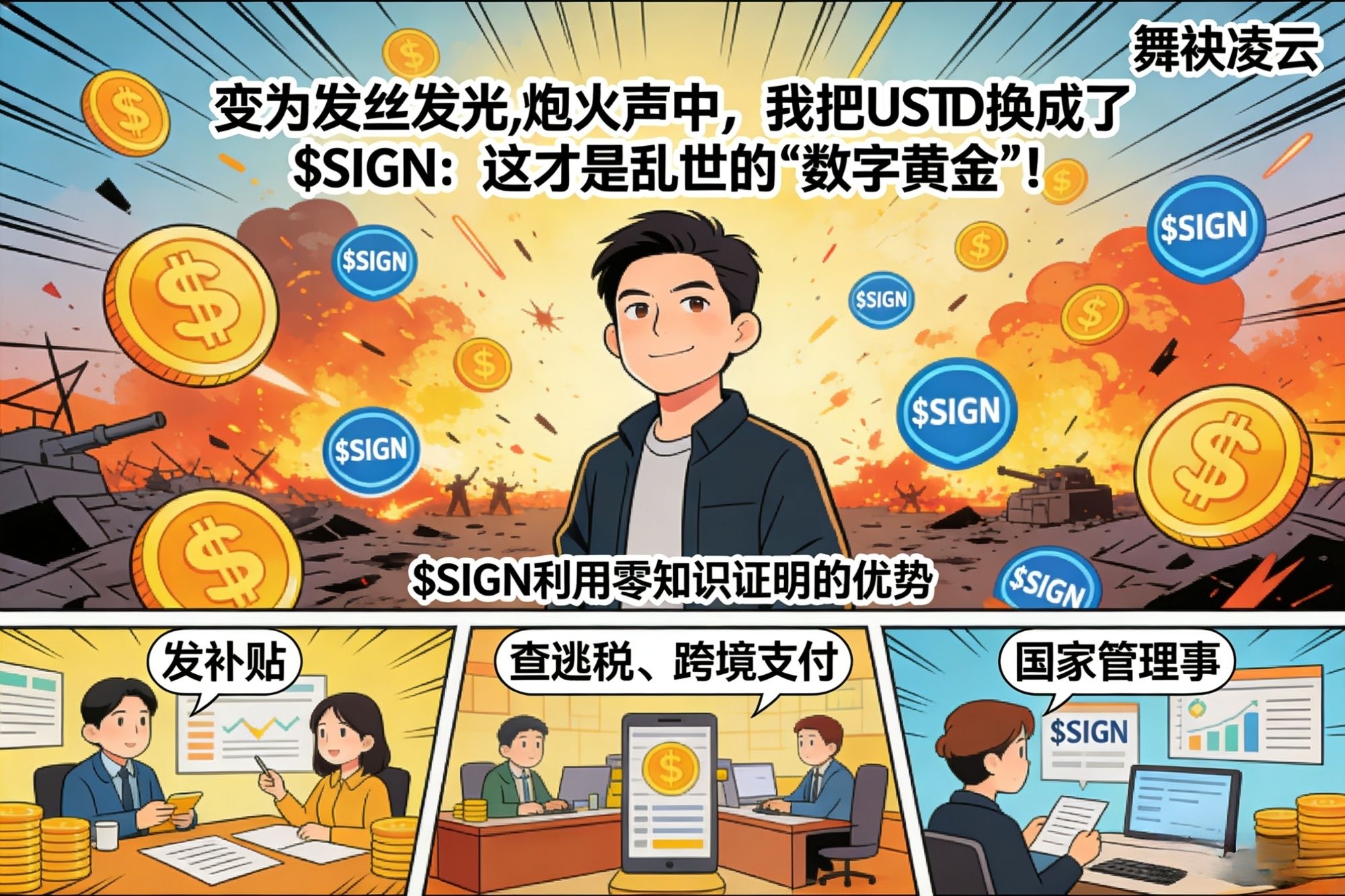
In short, I am heavily invested in $SIGN, not because of short-term price manipulation, but because it is becoming that 'certainty in a fractured era.' If you agree with this logic, feel free to chat.
\u003ct-31/\u003e