The crypto ecosystem has just undergone its deepest transformation since the birth of Bitcoin. The narrative of a state bureaucracy unable to keep up with technology collapsed on March 17. In an unprecedented coordinated move, the SEC and CFTC demonstrated that 'historical clarity' did not depend on new laws but on political will.
The End of the Era of Uncertainty: Digital Commodities
By issuing a joint 68-page interpretation, regulators have classified Ether (ETH), Solana (SOL), XRP, and 13 other assets as digital commodities. This milestone provides the market with the certainty that Congress has dodged for years, freeing these assets from the stigma of being considered "securities."
Under the supervision of the CFTC, these assets now operate in spot markets without the burden of endless litigation. The technical logic behind this decision is irrefutable:
Programmatic Value: The value of ETH and similar assets emanates from the operation of a functional system, validation, and smart contracts.
Goodbye to Howey: It is recognized that the success of these protocols does not depend on the "managerial efforts of third parties," finally overcoming the archaic Howey test.
Domino Effect: As Paul S. Atkins, chairman of the SEC, pointed out, the regulator's role is to "draw clear lines." This activates bank custody and opens the door for pension funds and large managers to inject unprecedented institutional liquidity.
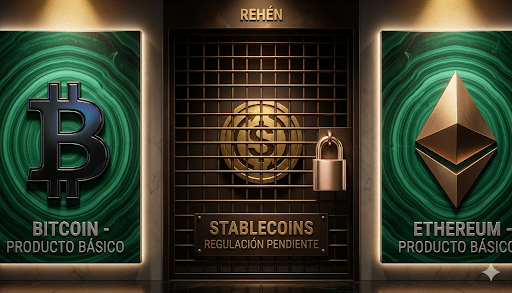
The "Hostage" of the Ecosystem: Stablecoins and the Banking Wall
However, this victory has a bitter face. While volatile assets gain ground and legitimacy, stablecoins — especially those that offer returns — remain in a regulatory limbo that seems anything but accidental.
The deliberate omission of stablecoins in this framework of "clarity" responds to a war of economic interests:
Margin Protection: Stablecoins compete directly with traditional savings and investment products. If the user can efficiently earn returns in digital dollars, the business model of commercial banking is shaken.
The Banking Lobby: Fierce defenses have been activated under the argument of "financial stability." In reality, it is a market shield to protect the profits of the banking sector against a technology that renders them obsolete.
Liquidity Control: By keeping stablecoins under constant regulatory pressure, banks ensure that the bridge between fiat money and the crypto world continues to pass through their hands, charging tolls and limiting user autonomy.
"Decentralization has won the battle for the asset narrative, but banks still control the exit doors of stable liquidity."
Conclusion: Half Freedom?
We are facing a bittersweet scenario. On one hand, the massive institutionalization of $BTC , $ETH , and $SOL is a reality that guarantees the survival and long-term growth of the industry. On the other hand, the fight for stablecoins will be the next great trench.
The market has shown that it can function programmatically and decentralized. Now it remains to be seen if the banking lobby can hold its walls for long against a technology that, as we saw on March 17, only needs "clear lines" to transform the financial world.
Do you think stablecoins will manage to free themselves from banking control this year or will they continue to be the weak point of regulation? Share your opinion in the comments.👇
#Notice #bitcoin #Information #StablecoinRevolution #ETH