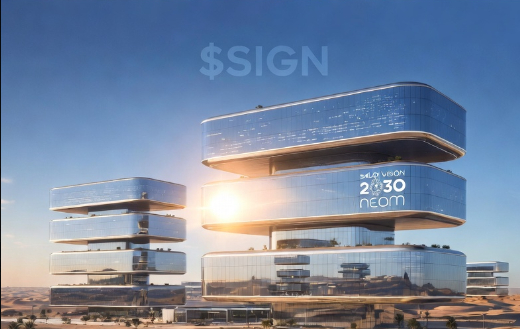
Recently, the overall cryptocurrency market has shown signs of a rebound, with Bitcoin fluctuating between $70,000 and $90,000. The Ethereum ecosystem's Layer 2 and AI narratives continue to evolve, while geopolitical factors in the Middle East, combined with changes in the global macro environment, are becoming one of the important variables affecting market sentiment. Countries like Saudi Arabia and the UAE are accelerating their economic diversification strategies under the dual pressures of oil price fluctuations and energy transition, with national-level plans such as Vision 2030 and the Dubai Blockchain Strategy continuously releasing funding and policy dividends. Digital assets and blockchain infrastructure are receiving unprecedented strategic attention in this context.@SignOfficial The launched $SIGN token, as a native token focused on sovereign-level digital infrastructure, is at the core intersection of this macro trend. The Sign Protocol, with omni-chain attestation as its core technology, combines TokenTable, verifiable credentials, and zero-knowledge proof body 9 series to construct a blockchain solution that balances national data sovereignty and global liquidity. The core value of this system lies in its ability to meet the rigid demands of governments for data control, audit rights, and privacy protection while seamlessly connecting to global application scenarios such as DeFi, cross-border payments, and CBDC, thus achieving a balance between 'controllable digitalization' and 'open innovation.' This value is particularly prominent in the current geopolitical and economic environment of the Middle East. Disruptions in the Red Sea shipping routes, drastic fluctuations in oil prices, and intensified competition among regional powers have led to continuous increases in the efficiency and trust costs of traditional financial systems. At the same time, countries like Saudi Arabia and the UAE are pushing with great determination to increase the proportion of non-oil economies: the Saudi Public Investment Fund (PIF) continues to tilt towards technology and digital fields, and the UAE has incorporated blockchain into its national strategic planning, attracting a large number of institutions and talents. The tools provided by $SIGN precisely meet these countries' core demands—achieving efficient cross-border settlement, digital identity management, precise subsidy distribution, on-chain sovereign fund management, and CBDC pilot projects while retaining the ultimate control of data and assets by the state. The Sign Protocol has already established real government-level cooperation scenarios in places like Abu Dhabi, proving that its technology is not just in the conceptual stage. The project has received backing from top institutions such as Sequoia Capital and Binance Labs, further validating its credibility at the institutional and governmental levels. In terms of the token economic model, with a total supply of 10 billion tokens, a relatively reasonable deflationary path has been designed through community incentives, ecological buybacks, and destruction mechanisms. As the digital economy in the Middle East continues to expand, $SIGN, as the underlying connecting layer, is expected to gradually evolve from a regional infrastructure into a key bridge connecting geopolitical stability and global blockchain liquidity. In the current market environment, the narrative around crypto assets is shifting from mere price speculation to real scenario implementation and institutional adoption. The Middle East, as an important hub for global energy and capital, will bring significant incremental demand for related projects as it undergoes digital transformation. $SIGN's unique positioning in this track—'sovereign-level controllable blockchain infrastructure'—gives it strong defensiveness and growth elasticity amid chaos. In the long run, as more government-level cooperation is established and regional CBDC and digital identity projects advance, the value anchor of $SIGN is expected to gradually shift from speculative sentiment to actual adoption and network effects. The complexity and uncertainty of the Middle Eastern situation are precisely catalysts accelerating its digital transformation. At this historical turning point, what $SIGN represents is not just a technological solution but also the underlying infrastructure of emerging digital sovereignty under geopolitical changes. Investors focusing on the Middle East, sovereign blockchain, and controllable digitalization may consider continuously tracking the progress of the Sign Protocol.#sign地缘政治基建 $SIGN @SignOfficial