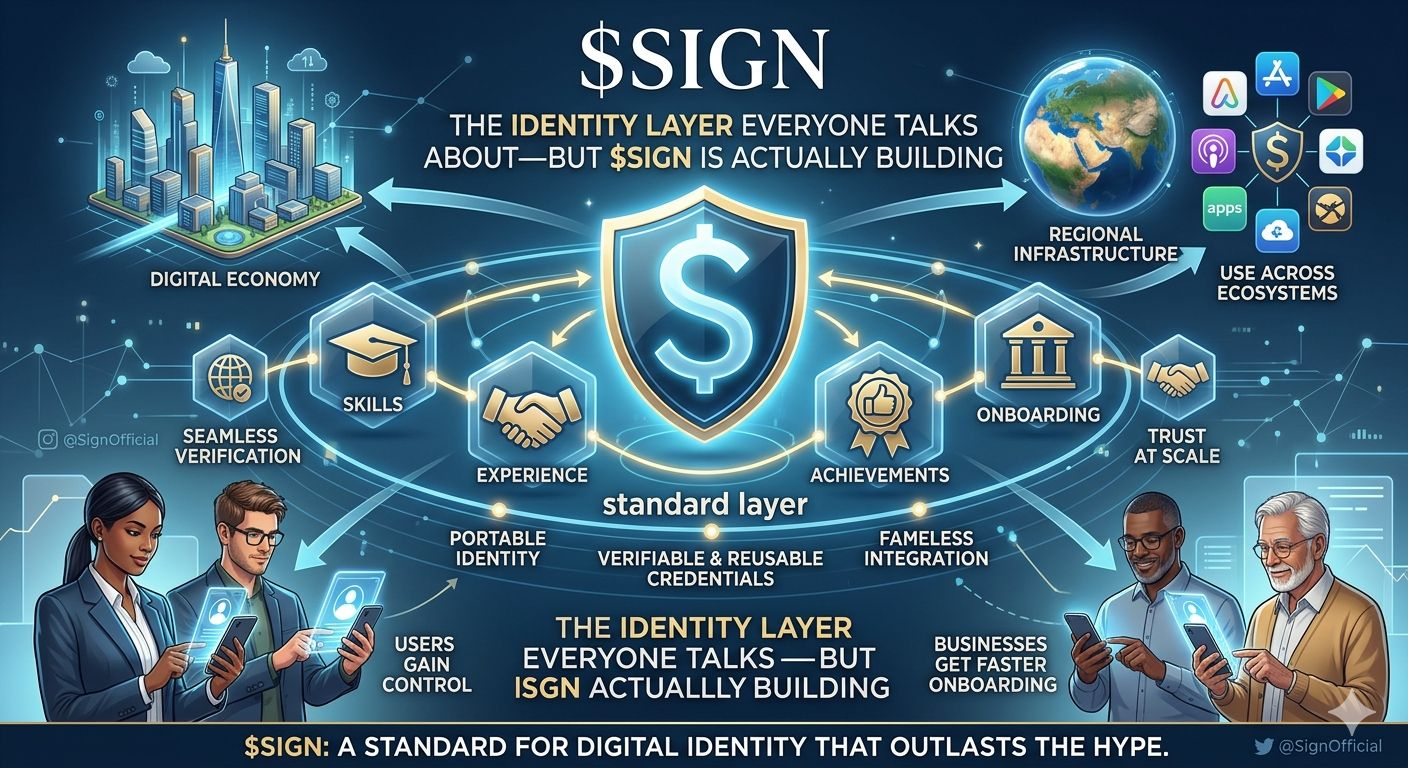
The Identity Layer Everyone Talks About—But $SIGN Is Actually Building
For years, crypto has promised one thing over and over again: you will own your identity.
But in reality, most users are still stuck in the same loop—platforms hold the data, verification is slow, and trust is fragmented.
That’s where $SIGN starts to feel different.
Instead of treating identity as static data, Sign turns it into something verifiable and reusable. Your credentials—skills, experience, achievements—can be issued once and then proven anywhere without exposing everything behind them.
That shift is bigger than it sounds.
Because the internet doesn’t just need identity—it needs trust at scale.
Right now, every system rebuilds trust from scratch. Every platform asks you to prove yourself again. It’s inefficient, slow, and full of friction. SIGN compresses that process into a single layer where verification becomes seamless.
And this is where it gets interesting…
As digital economies expand—especially in regions like the Middle East—portable identity isn’t optional anymore. It’s becoming core infrastructure. Businesses need faster onboarding. Users need control. Systems need reliability.
SIGN sits right at that intersection.
It’s not just about “owning your data.”
It’s about using your identity across ecosystems without losing control of it.
Of course, none of this matters without adoption.
If developers don’t build, if users don’t engage, it stays a concept.
But if they do…
Then SIGN doesn’t remain just another project.
It becomes a standard layer for digital identity.
And in crypto, the projects that become standards don’t chase hype—
they outlast it.