Last year, at a closed industry summit, everyone was discussing the TPS of Layer 2 while shaking their wine glasses, talking about which meme had made them rich again. I happened to be sitting across from a core member of the @SignOfficial team, and I asked him: Now that everyone is going after retail traffic, aren't you tired of running to Abu Dhabi and Kyrgyzstan every day? He smiled and pointed outside, saying: If blockchain can only be used for speculation and leverage, it will never enter mainstream civilization. What we want to do is to truly have a country's currency and identity running on the chain.
At that moment, I realized that what they were targeting was not the limited supply of the cryptocurrency world, but the uncharted territory of sovereign infrastructure.
From EthSign to digital sovereignty: a long-planned evolution.
Many people's impression of them is still based on EthSign, that easy-to-use decentralized signature tool. But take a look at the current sign.global official website, and you'll find that the landscape has completely changed. What they are doing is called S.I.G.N.
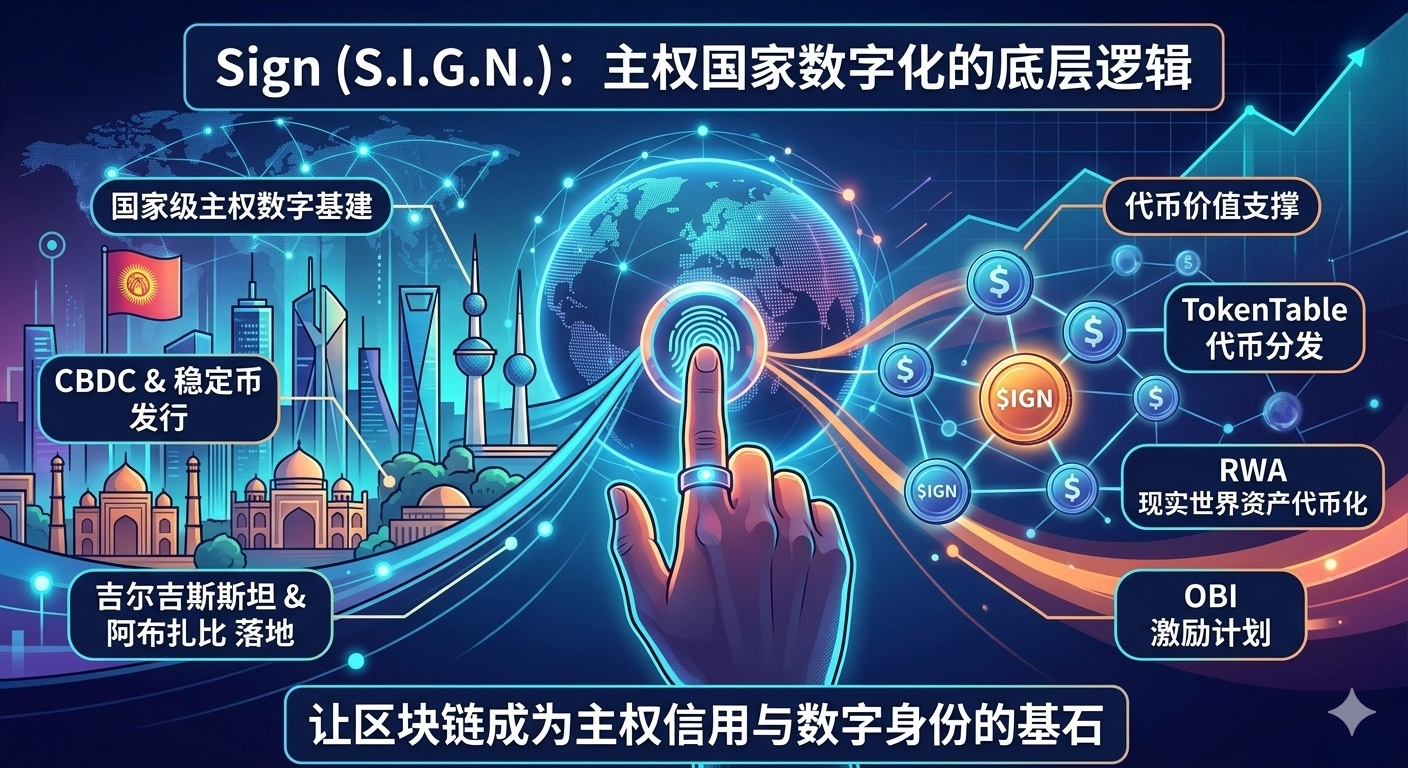
This is not a fantasy on a PPT. From Kyrgyzstan's digital som, to Sierra Leone's digital identity system, to Abu Dhabi's strategic endorsement, Sign has quietly penetrated the defenses of sovereign nations. In the context of today's geopolitical turmoil, where countries want to break free from centralized financial dependence, such neutral and autonomous infrastructure is an absolute necessity.
Core value support: not just tokens, but also credit certificates.
When talking about the most concerning $SIGN , its logic is completely different from ordinary governance tokens. In the Sign ecosystem, tokens carry multidimensional value:
1. The link of distribution and incentives: Coupled with their TokenTable, they have handled over 3 billion dollars in token distribution, which means that $SIGN is inherently endowed with a deep compliance distribution gene.
2. The lubricant of infrastructure: With the implementation of various countries' CBDC and RWA projects, tokens play a role in underlying settlement or collateral in identity verification, cross-border clearing, and asset custody.
3. Top-notch endorsement guarantees: The support from Sequoia and Circle places this token in the first tier regarding compliance and institutional recognition.
Hard infrastructure in chaotic times.
The current market lacks not good protocols, but implementable ones. While most projects are entangled over fractions of interest, Sign has already planted its flag in the banks of sovereign nations.
I have been observing their OBI incentive program and the on-chain repurchase dynamics recently. The team's execution displayed in early 2026 shows that they are not just writing code but are also conducting a global experiment on trust.
In summary: If you believe that Web3 should carry something more substantial, then the $SIGN , which is tied to national security anxiety and digital sovereignty, is definitely the most worthy anomaly to keep an eye on in this cycle.