
Midnight Network doesn’t arrive with the usual noise you expect in crypto. There’s no over-the-top promise, no dramatic claim that everything is about to change overnight. Instead, it feels quieter, almost careful. And honestly, that’s probably why it catches attention in a different way.
If you’ve been in this space for a while, you’ve likely seen how privacy has been handled. At first, transparency was the big win. Everything on-chain, everything visible, everything verifiable. It felt like a breakthrough. But over time, that same transparency started to feel a bit uncomfortable. Wallets became traceable. Patterns became predictable. And suddenly, something that was supposed to empower users began exposing them in ways most didn’t even realize at the start.
The truth is, people don’t actually want full transparency in their everyday lives. Not individuals, not businesses, not even institutions. There’s always a line between what should be visible and what should remain private. The problem is, most blockchain systems never really figured out how to draw that line properly.
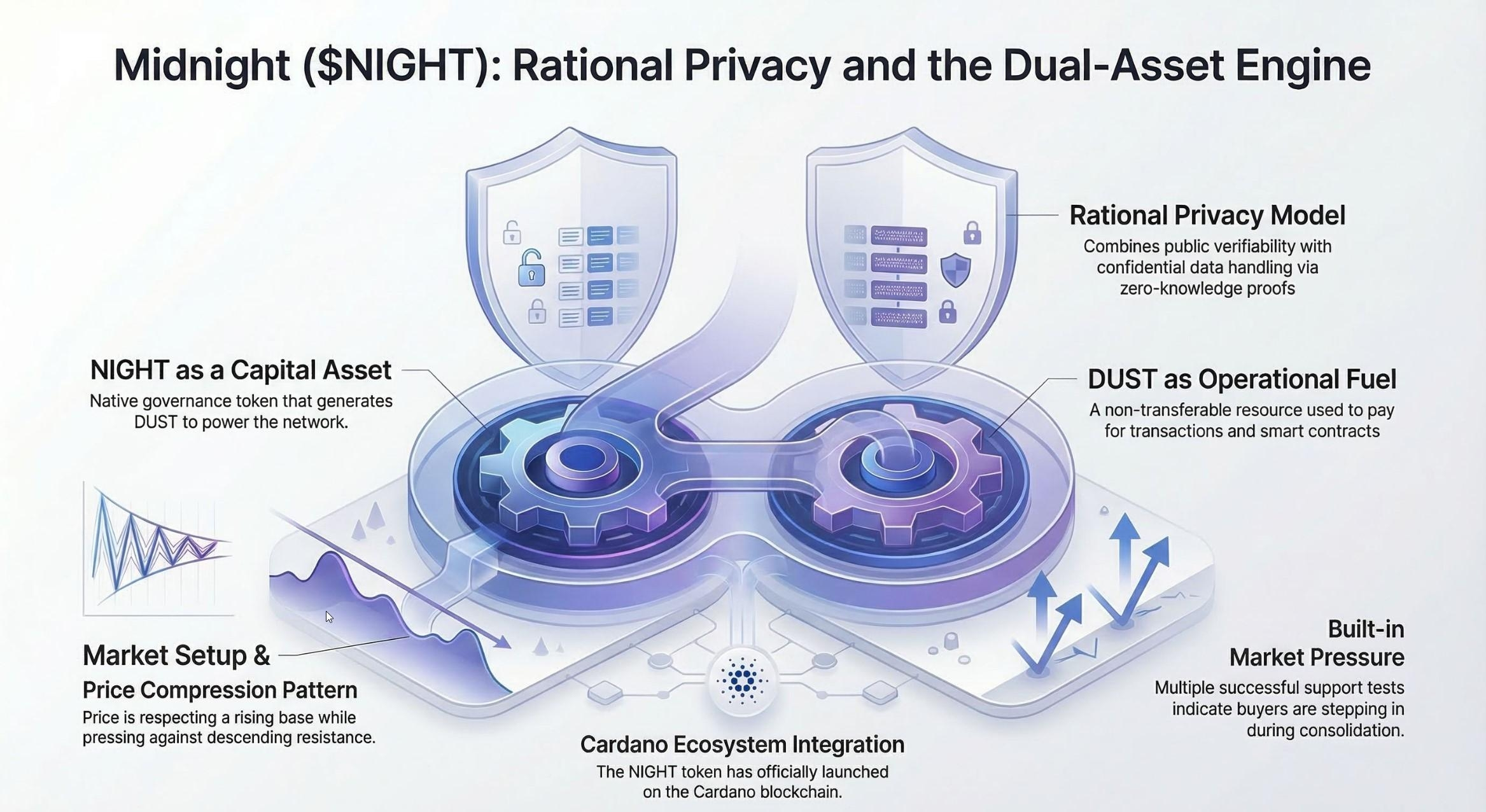
That’s where Midnight Network tries to approach things differently. It’s not trying to hide everything, and it’s not trying to turn privacy into some extreme concept. Instead, it leans into a more practical idea—control. The ability to prove something is true without revealing everything behind it. That might sound simple, but it changes how you think about privacy entirely.
Imagine being able to confirm your eligibility for a service without handing over your full identity. Or validating a transaction without exposing every detail tied to it. It’s not about disappearing. It’s about sharing only what’s necessary, nothing more. That kind of approach feels closer to how privacy works in the real world, where people constantly choose what to reveal and what to keep to themselves.
What makes this interesting is that it doesn’t try to fight the system. A lot of past privacy projects went all-in on anonymity, almost as if the goal was to stay outside any kind of structure. But that rarely works long term. Regulators push back, businesses hesitate, and users get confused. Eventually, the excitement fades because the model can’t hold up under real-world pressure.
Midnight seems to recognize that reality. It doesn’t reject rules outright, and it doesn’t pretend regulation doesn’t exist. Instead, it tries to work around those constraints in a smarter way. That’s why the idea of selective disclosure stands out. It creates space for privacy without completely breaking compatibility with how the world already operates.
Still, it’s hard to ignore the skepticism. And honestly, that skepticism is earned. The space is full of projects that sounded promising at the beginning but struggled once things moved beyond theory. So naturally, people are cautious. They want to see if this can actually be used by normal people, not just understood by developers. They wonder if it can scale, if it can stay secure, and if anyone outside a small circle will truly adopt it.
Because at the end of the day, none of this matters if it doesn’t get used.
There are a few areas where something like this could genuinely make a difference. Digital identity is an obvious one. Right now, proving who you are online often means oversharing. Documents, personal details, sensitive information—all handed over just to pass a simple check. A system where you can prove something without exposing everything could make that process feel lighter and safer.
Businesses could benefit too. Most companies are interested in blockchain for its efficiency and transparency, but they’re not comfortable with having their internal activity visible to everyone. A model that allows verification without full exposure could open doors that were previously closed.
And then there’s decentralized finance, which has always lived in a kind of tension with regulation. Too much openness invites scrutiny. Too many restrictions remove the point of decentralization. A middle ground, where compliance can exist without full transparency, might actually make things more sustainable.
But even with all that potential, the biggest challenge isn’t technical. It’s human.
Most users aren’t thinking about cryptography or how proofs work behind the scenes. They care about how something feels. Whether it’s easy. Whether it makes sense. Whether they trust it without needing to understand every detail. If Midnight becomes too complicated, it risks losing the very people it’s trying to help.
That’s something the industry has learned the hard way. Good technology doesn’t automatically lead to adoption. If privacy is optional, most people won’t bother. If something feels complex, they’ll avoid it. And if it doesn’t fit naturally into their behavior, it simply won’t stick.
What’s interesting about Midnight is that it doesn’t come across as trying to reinvent everything. It feels more like an adjustment, a refinement of ideas that were already there but never fully worked in practice. And sometimes, that kind of approach has a better chance of succeeding than something overly ambitious.
Still, there’s a gap between a good idea and a working system. That gap is where most projects struggle. It’s where real users come in, where edge cases appear, where pressure builds. That’s the part no whitepaper can fully prepare for.
Right now, Midnight Network sits somewhere in that in-between space. The concept makes sense. The direction feels grounded. But it hasn’t fully proven itself yet. And until it does, the skepticism will remain—not as a negative thing, but as a kind of necessary filter.
Because in this space, belief isn’t enough anymore. People want to see things work.
If Midnight manages to make privacy feel natural instead of complicated, if it allows control without creating confusion, and if it quietly fits into how people already interact with technology, then it might actually matter.
Not in a loud, revolutionary way. But in a way that sticks.
@MidnightNetwork #night $NIGHT #Night
