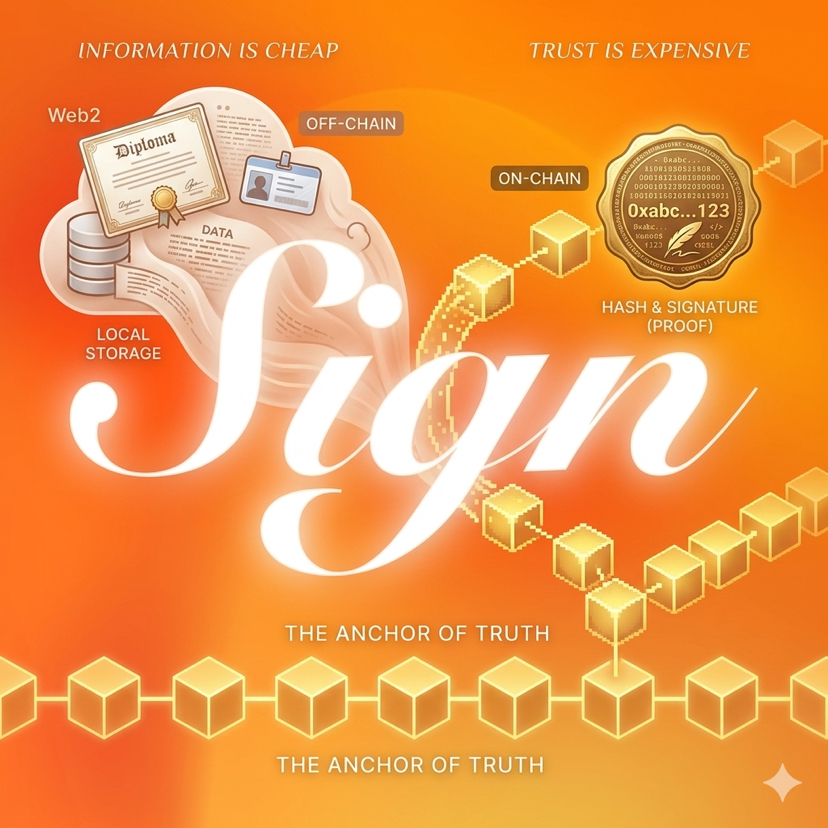
“Information is cheap, but trust is expensive” — a quote from George Gilder that I read a long time ago, but it wasn't until I sat down to study with @SignOfficial that I truly felt its significance.
That night, I intended to skim through the documents just to get an idea. But the more I read, the more I got stuck on a very basic question: If Sign does not store data on-chain, then what exactly is being stored?
Then I suddenly remembered George Gilder's quote, and I thought, it turns out I had asked the wrong question. The issue is not where to store it?, but what is truly worthy of occupying a space on the blockchain?
There has always been a paradox of "putting everything on the chain".
For example: A DAO certifies User A for contributing 100 hours to the project. User A wants to use it to apply for a job.
If following the original Web3 style of storing all certificate content on-chain for transparency, sooner or later you will face the following issues:
*Mistakes cannot be corrected: Just mistyping a letter means it is there forever.
*Loss of privacy: Sensitive information is exposed to the world.
*Poor due to Gas fees: Storing millions of such certificates, where is the money to pay for it all?
On-chain storage was not actually created to hold contextual or frequently changing items.
But Sign has chosen a rather wise and controversial path: Separating Content and Proof.
Physical part (Data): Push everything off-chain (IPFS, Arweave, or a private server). Here you can save anything you want, heavy or light, public or private as you wish.
Spiritual part (Proof): Only store Hash and Signature on-chain. This is where immutability speaks.
At this point, I began to see Blockchain differently: It is no longer a warehouse of truth but rather an anchor of truth.
But this model leads to quite an awkward situation. Suppose a university issues a diploma through Sign, with the content stored on IPFS, but 5 years later no one maintains (pins) that file anymore. The result is that the On-chain still has the fancy Hash, but the original content has vanished. You are holding proof of something that no longer exists.
This made me realize a somewhat harsh truth: Sign does not promise that your data will exist forever; they only swear that the data once existed and has not been altered by anyone.
Thus, the battle between Integrity and Availability begins:
Data Integrity: Is the data fake? (Sign handles this very well).
Data Availability: Is the data still readable? (Sign pushes this responsibility onto you).
Initially, I saw this as a weakness. But upon reflection, perhaps this is a calculated trade-off. If everything demands to be readily available on-chain, then the cost (in terms of both expense and flexibility) will be extremely high.
Sometimes I wonder: Is Sign making everything more complicated?
Compared to just dumping everything on the chain and claiming "absolute transparency", Sign's method requires users to understand Hash, about the layers of storage; it is no longer a simple click. The biggest risk here is not in the technology but in the mismatch: Users think they are "safely storing on the blockchain", but in reality, they are holding a link that could break at any time.
Web2 data is in the hands of the "big server giants", while Blockchain data is too expensive for mass storage. While waiting for a perfect solution, Sign chooses a gray area in between: Verifiable data – data that can be verified, but not necessarily on-chain.
It sounds like a compromise, but looking at it broadly, it's a very positive step. Instead of trying to turn Blockchain into a universal hard drive, let's use it as a filter for trust.
After all, I don't think Sign has solved the storage problem. They still leave the issue of lost data open, making the system more complex and placing the burden on the user.
But in return, they force us to reconsider: Do we really need Blockchain to store everything, or do we just need to save enough for us to trust the rest?
Perhaps the future does not lie in our attempts to store data on the blockchain, but in our ability to prove data. Sign is not just a tool; it is also a way to redefine trust amidst a sea of cheap information out there.
This is a small perspective of mine; everyone can express their views in the comments!
$SIGN #SignDigitalSovereignInfra