On February 25th, I came across a message that MoneyGram announced joining the Midnight Network. To be honest, I was taken aback for a moment—how did this long-established player in cross-border payments, with a presence in over 200 countries, suddenly team up with a ZK privacy chain that hasn't even launched its mainnet yet?
Looking back, this is quite interesting.
In recent years, the attitude of traditional finance toward blockchain can basically be summarized in four words: both love and fear. They love the settlement efficiency and transparency, but fear—well, you know—all transactions being laid bare on the ledger for everyone to see. If banks put customer remittance records on a public chain, the compliance department would probably have to resign en masse.
So you see, most public chains appear to institutions as a 'technology that can’t be dressed up for the occasion.' What impressed MoneyGram this time about @MidnightNetwork is not how flashy the ZK technology is, but rather a very practical point: selective disclosure.
What does it mean? It means you can prove 'this transaction complies with anti-money laundering regulations' without having to disclose the counterparty and amount. A bank can tell regulators, 'See, I’m compliant,' while telling clients, 'Your privacy is protected.' This is not a compromise; it stands firm on both sides.
MoneyGram is neither the first nor the last. Charles Hoskinson just tweeted last week, and the list of partners includes Worldpay, Google Cloud, and Bullish. Worldpay is a payment giant, Google Cloud is the infrastructure layer, and Bullish is a compliance exchange—together, these three essentially cover several key aspects of institutional entry.
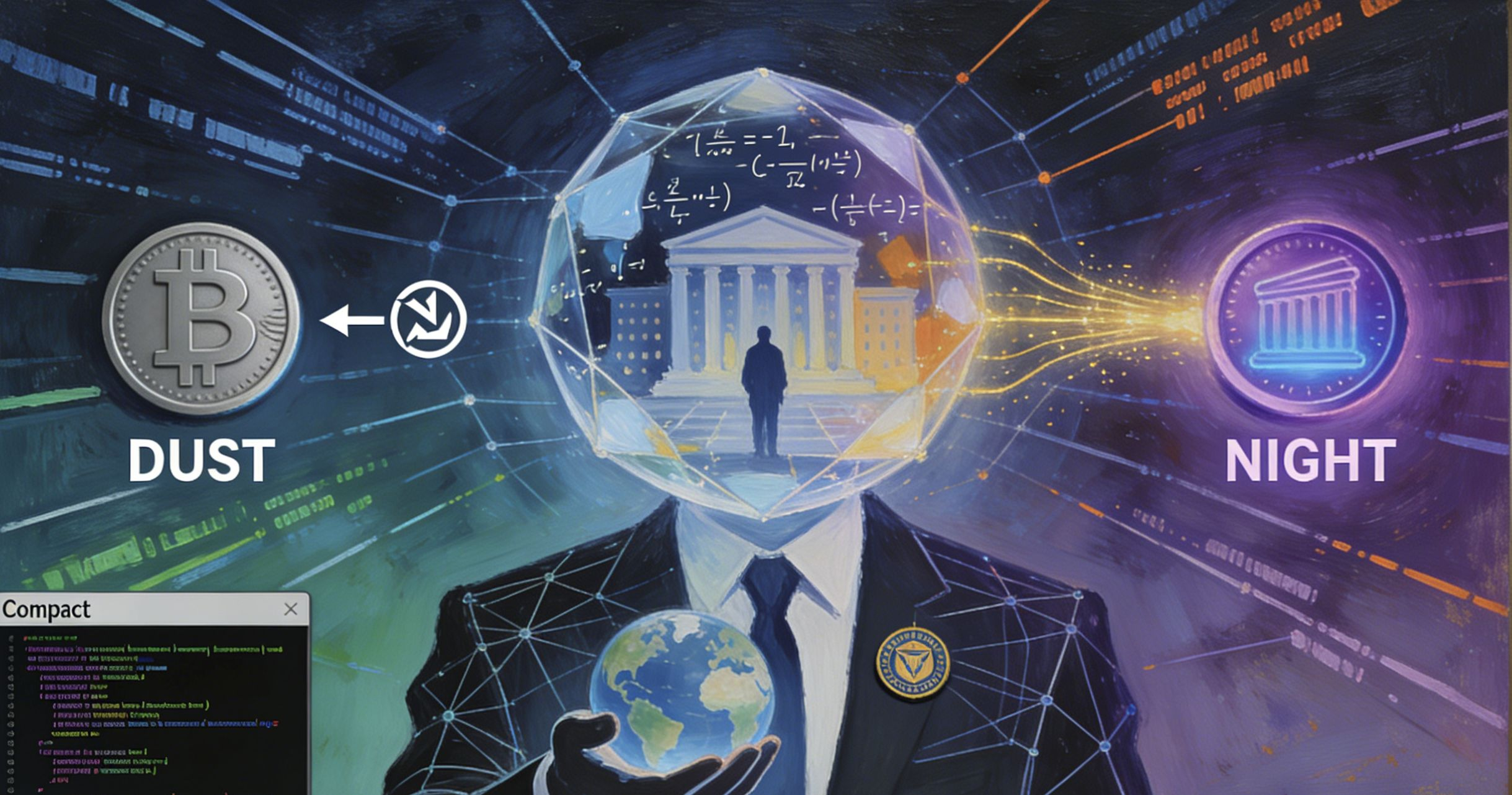
But what I really want to talk about is the easily overlooked design of Midnight: DUST.
Many people understand the dual-token model as 'one for speculation and one for use,' which is too simplistic. The white paper clearly states that DUST is non-transferable and will decay after detaching from the generated $NIGHT . Consider this design carefully—transaction fuel cannot be hoarded, speculated on, or used as a privacy coin.
What does this mean?
It means that the real cost of using the network will not be hijacked by skyrocketing NIGHT prices. Every bull market in Ethereum sees someone shout, 'Gas is too expensive to afford,' but this won't happen in Midnight's logic. You hold onto NIGHT, DUST grows on its own, and what grows can be used; what can't be used will disappear.
This mechanism is very friendly to institutions. Compliance departments don’t have to explain 'why we hold a tradable privacy token' because DUST is not one at all. And as a governance asset, NIGHT captures all the value it should.
I think what this batch of traditional players at MoneyGram is interested in is likely this kind of 'privacy solution dressed up for the occasion.' It can provide the transparency that regulators want while maintaining the privacy that businesses need, with stable and predictable costs.
Now we just have to see how it performs after the mainnet launch at the end of March. Having an impressive partner list is one thing; whether it runs smoothly is another. The concurrent processing capability of the Kachina protocol and the developer experience of the Compact language—these are the hard indicators that will determine if people can be retained.
However, one thing is certain: when traditional payment giants begin to seriously consider ZK privacy chains, this field is no longer just a game for geeks. #night