Last month, I was looking through the annual report of the Central Bank of Kyrgyzstan and was stunned by a passage for a long time.
They are collaborating with a Web3 project to develop the national digital currency Digital SOM. It’s not a proof of concept, it’s not a memorandum, but a real system integration. My first reaction was: are these people crazy? A former Soviet republic handing over its financial infrastructure to a crypto project?
Later, I found more information and discovered it’s not just Kyrgyzstan. Sierra Leone is working on digital identity and stablecoin payments with the same system, and Abu Dhabi's blockchain center is also using this framework for public sector digital record management. These countries are spread across Central Asia, West Africa, and the Middle East, with different political systems and economic levels, but they have made the same choice—to anchor their digital sovereignty on the Sign Protocol.
You might think I'm exaggerating. How could a project doing on-chain credential verification be related to sovereignty?
But have you ever thought about a question: if a country's digital identity system, payment clearing network, and government data storage all run on servers of foreign enterprises, what is the essential difference from handing over your lifeline to others? Normally it’s fine, but once the geopolitical winds change, if the other party cuts off the service or adjusts a parameter, you won’t even have a place to appeal.
This state of 'digital vassalage' is more covert than military alliances and harder to break free from.
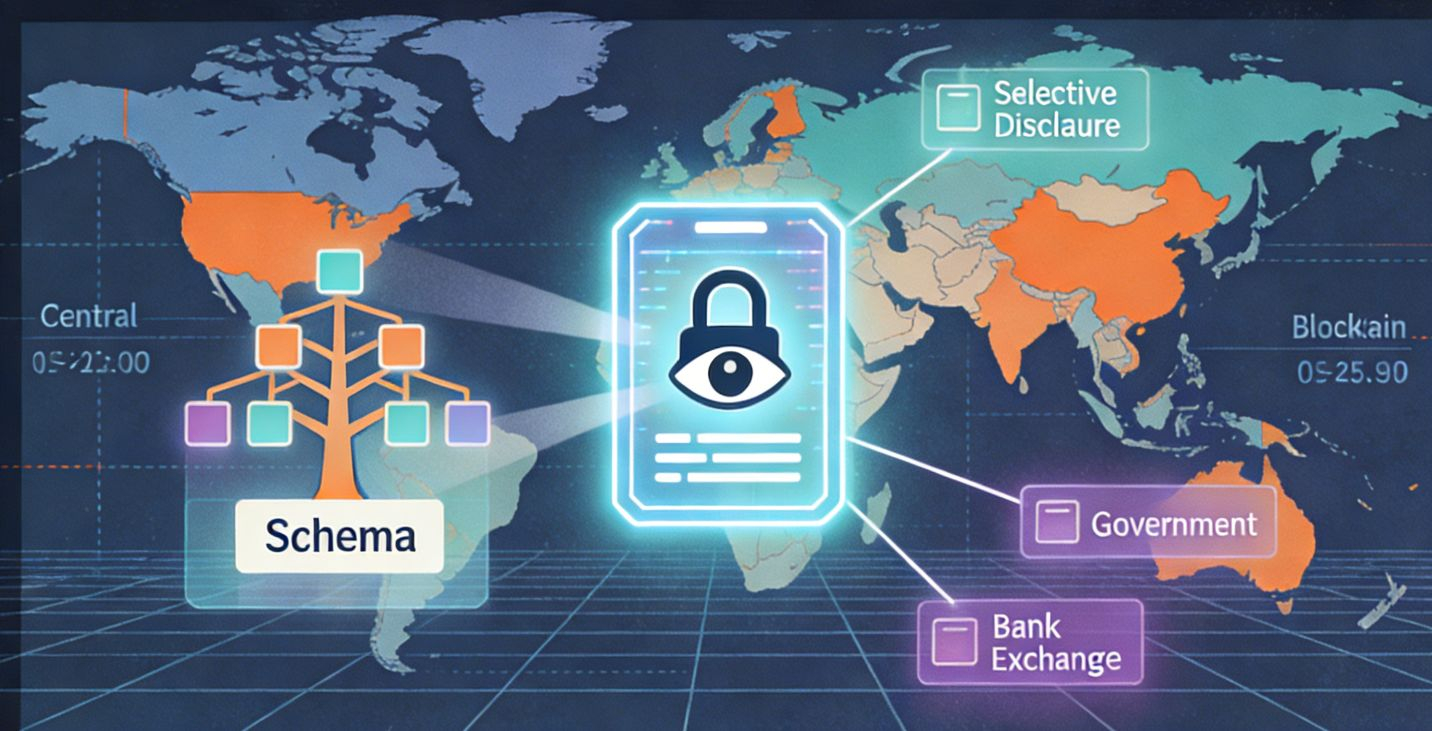
@SignOfficial What it does is not to provide a better 'track', but to give these countries an autonomous 'track-laying capability'. Its technical architecture is interesting: you define a data template on the chain, which is what they call a Schema, structuring things like identity, qualifications, and compliance status. Then you generate a verifiable credential—Attestation, accompanied by the issuer, timestamp, rule version, and revocation status. These credentials can be read and verified across systems, institutions, and jurisdictions without having to prove everything again every time you enter a new place.
More importantly, it supports selective disclosure. You only need to prove 'I meet this qualification' without having to disclose all underlying data. This is critical for compliance scenarios because often what holds you back is not insufficient data, but rather too much data triggering another barrier for privacy compliance.
These technical details sound dry, but if you think a layer deeper, you will understand: if this system works, it means that for the first time, a country's citizenship, asset ownership, and compliance records have a foundation that does not rely on any single country's or company's infrastructure to carry. Data sovereignty has, for the first time, the possibility of technical implementation.
This is why those small and medium-sized countries are at the forefront. They are not trying out new technologies; they are buying a one-way ticket to escape 'digital vassalage'.
The window period is very short. Once several key nodes are connected into a new network using similar systems, the rules will take shape. Latercomers will either comply or be isolated from the mainstream digital ecology. This is no longer a matter of choice, but a silent race for digital survival rights.
Of course, the biggest resistance to this narrative currently lies not in technology, but in whether various institutions are willing to accept the same set of standards. Banks, regulatory agencies, and exchanges each have their own vested interests and historical systems. It will take a long time for them to switch certification frameworks.
Moreover, the token itself also faces structural pressures. $SIGN The total supply is 10 billion tokens, and the current circulation ratio is not high. The subsequent unlocking rhythm will indeed continue to create selling pressure. This objective fact cannot be avoided.
But speaking of compliance costs, this is not a minor issue for any industry. It is a wall that everyone will inevitably hit in the process of global digital economic expansion.
I still remember the year I first entered the circle; I missed a later successful opportunity because I couldn't understand a fully English event page. It wasn’t because my English was poor, but that friction cost of 'forget it, too troublesome' made me back out -7. Later I reflected and found that this is essentially the same problem these countries are facing now—too high a threshold to prove that one meets the conditions.
What Sign is doing is systematically lowering the cost of proving that you meet the qualifications. So that those who are genuinely qualified won’t be kept out due to friction costs.
As for whether this demand is large enough or real enough, I think the answer no longer needs me to say.
By the way, they just launched a plan called 'Orange Basic Income', with a budget of 100 million $SIGN, abandoning the traditional staking model, and directly rewarding based on on-chain balance and holding duration. What is the underlying implication of this design? It is that the project party wants to push the chips from centralized exchanges to self-custody wallets, allowing those who genuinely care about this ecosystem, rather than short-term speculators, to become the mainstay of the network.
How to calculate this bill is up to you.#Sign地缘政治基建