
In the current community, many people are curious, or in other words, puzzled about one thing.
Is it illegal for me to trade cryptocurrencies after working so hard?
Today Saul, I will explain it to you clearly in one breath!
In the general public's perception, there is often a misunderstanding that 'individuals playing with virtual currency is illegal.' However, from the perspective of our current effective regulatory rules, the regulatory authorities have never outright banned all personal activities related to virtual currency. The core regulation targets illegal financial activities related to virtual currency that involve businesses and the public. The act of individuals merely holding and taking risks with their investments does not necessarily constitute an illegal act.
This article will outline the core regulatory documents in the field of virtual currencies in our country chronologically, clarifying the legal boundaries of individual related behaviors.
1. Timeline of core regulatory documents for virtual currencies in our country
1. December 5, 2013: Notice from the People's Bank of China and five ministries (on preventing risks of Bitcoin) (Yin Fa [2013] No. 289)
This is the first formal regulatory document in our country targeting virtual currencies, laying the foundational tone for the regulation of virtual currencies in our country.
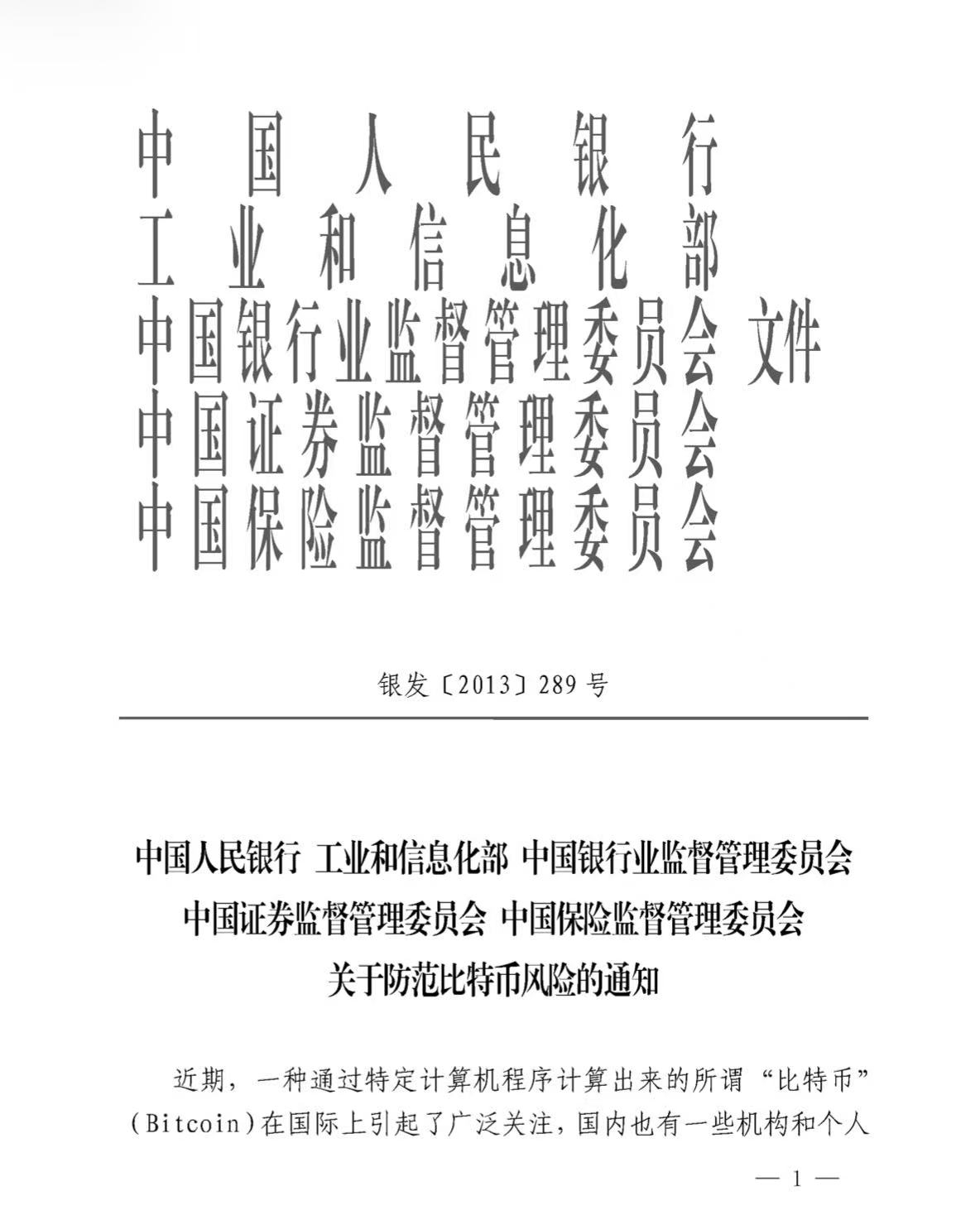
• Core Qualification: It is clear that Bitcoin is not legal tender, does not have the legal status equivalent to currency, and cannot and should not circulate as currency in the market; its nature is that of "specific virtual goods."
• Prohibited Scope: Only applies to financial institutions and payment institutions, clearly prohibiting the aforementioned institutions from engaging in Bitcoin-related exchange, custody, mortgage, settlement, and other businesses.
• Attitude towards individuals: The document clearly acknowledges that "ordinary people have the freedom to participate in Bitcoin trading at their own risk," and does not impose any prohibitive regulations on individuals holding or trading virtual currencies, nor does it classify individuals' related behaviors as illegal.
2. September 4, 2017: Notice from the People's Bank of China and seven ministries (on preventing risks of token issuance financing) (commonly known as '94 Notice')
This document was issued in response to the rampant ICO (token issuance financing) phenomenon at that time and marked an important turning point in the regulation of virtual currencies in our country.
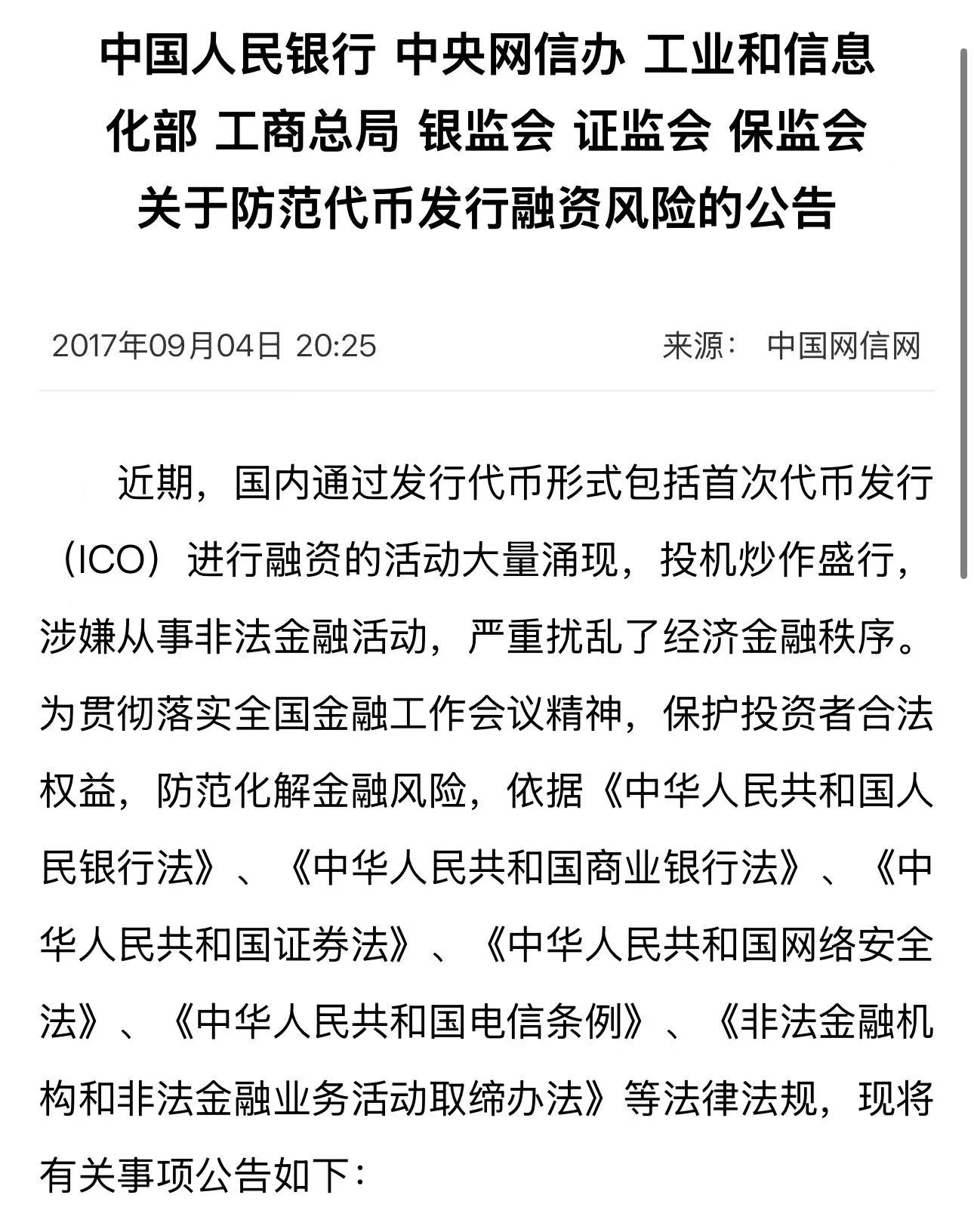
• Core Qualification: It is clear that the nature of token issuance financing is an act of unauthorized illegal public financing, suspected of illegal sale of token vouchers, illegal issuance of securities, as well as illegal fundraising, financial fraud, pyramid schemes, and other illegal criminal activities, and any token issuance financing activities are strictly prohibited.
• Prohibited Scope: The core regulation covers two categories of behaviors: one is public token issuance financing activities, and the other is the operational services of virtual currency trading platforms, including prohibiting platforms from engaging in the exchange, transaction matching, pricing, information intermediary, and other businesses involving legal currency and virtual currency.
• Attitude towards individuals: The document does not prohibit individuals from holding virtual currencies, nor does it prohibit one-on-one, non-business transfers of virtual currencies between individuals; the core regulation remains focused on crowd financing behaviors and operational activities of platforms, without infringing on individuals' rights to hold and privately transfer.
3. September 24, 2021: Notice from the People's Bank of China and ten ministries (on further preventing and dealing with the risks of virtual currency trading speculation) (Yin Fa [2021] No. 237)
This is currently the highest-level and most stringent core document in the field of virtual currency regulation in our country, and it is also the document most misunderstood by the public.
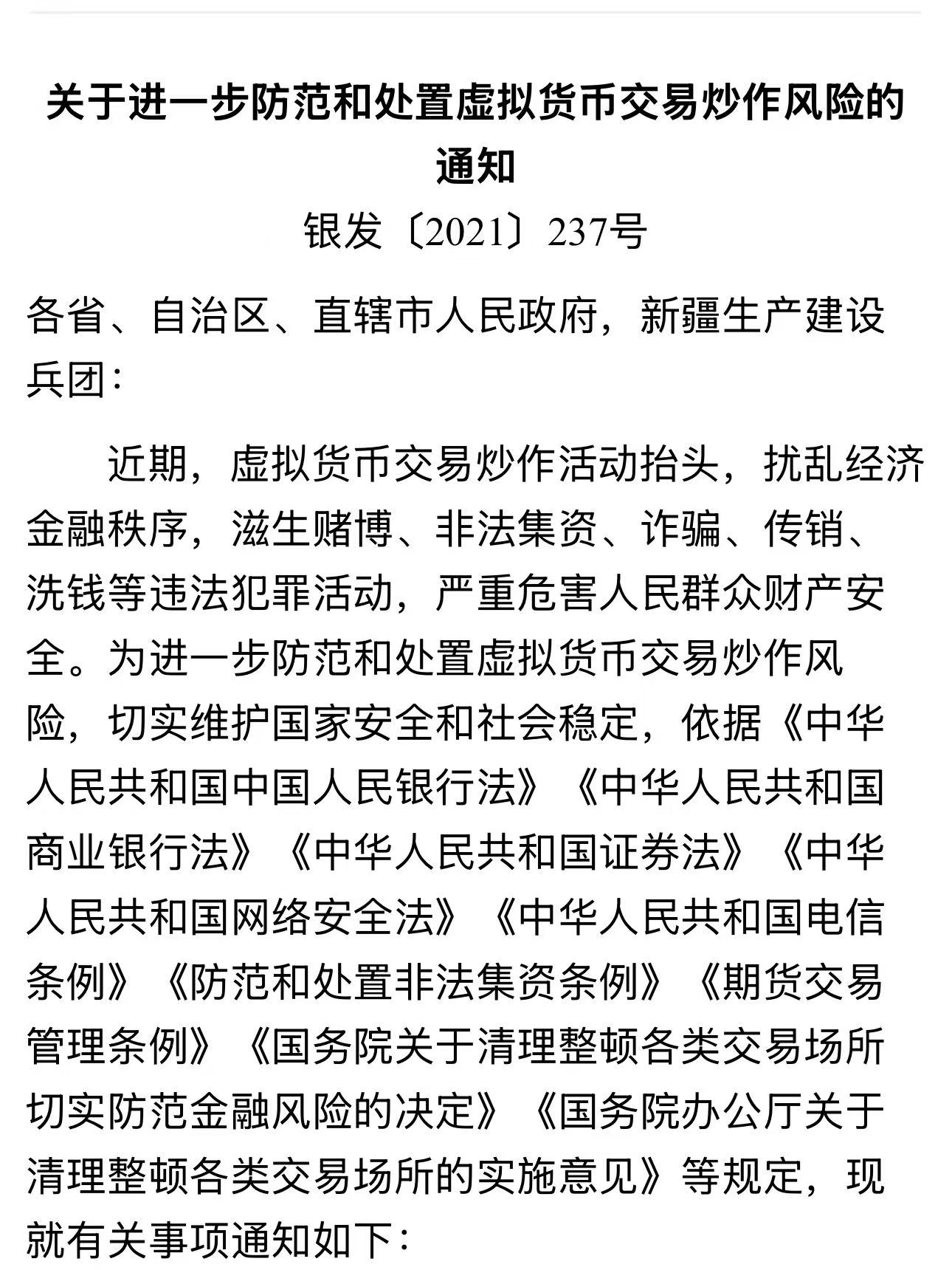
• Core Qualification: It is clear that "activities related to virtual currencies constitute illegal financial activities," defining the specific scope of illegal financial activities, including: virtual currency exchange, virtual currency transaction matching, token issuance financing, virtual currency derivatives trading, providing information intermediary and pricing services for virtual currency trading, etc.; it also clarifies that overseas virtual currency exchanges providing services to residents in our country through the internet also constitute illegal financial activities.
• Attitude towards individuals: The document only imposes civil-level constraints, stating that "natural persons' investment in virtual currencies and related derivatives, which violate public order and good customs, renders the relevant civil legal actions invalid, and any resulting losses shall be borne by themselves," and does not classify individuals' holding and investing in virtual currencies as administrative illegal behavior, let alone directly classify it as criminal behavior.
In simple terms, the act of individuals investing in virtual currencies is not protected by law on a civil level, and losses cannot be sought through litigation for legal relief, but regulatory authorities will not impose administrative penalties on individuals merely for holding or investing in virtual currencies, as this behavior itself does not constitute illegality.
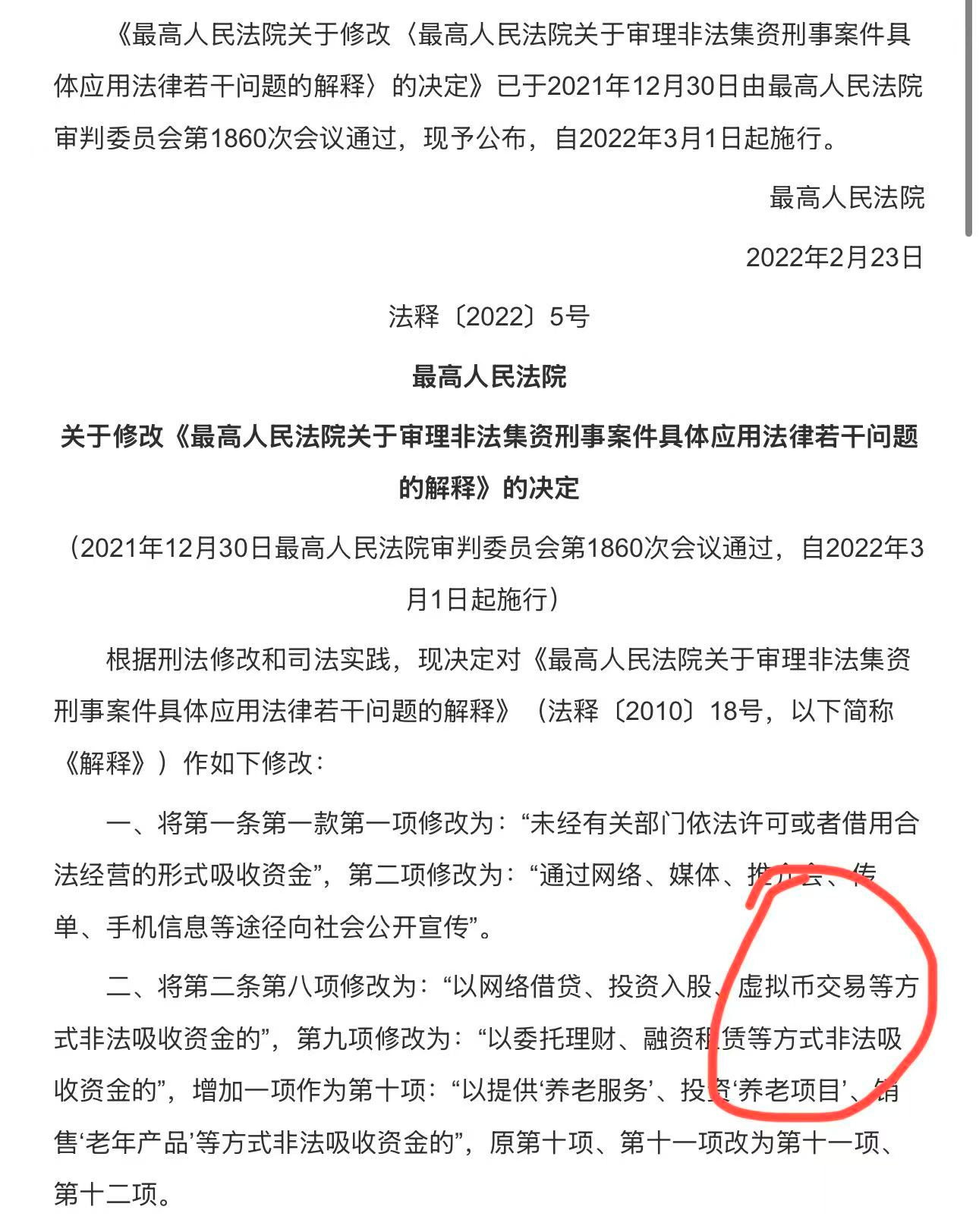
4. March 1, 2022: The Supreme People's Court revised (on several issues concerning the specific application of laws in handling criminal cases of illegal fundraising)
This judicial interpretation is the criminal supporting rules for virtual currency regulation, clearly listing "illegally absorbing funds through virtual currency transactions" as a situation for identifying the crime of illegally absorbing public deposits, but its core regulation still targets non-specific public operational and crowd financing behaviors, rather than individuals' simple investment and holding behaviors, further clarifying the boundaries of criminal accountability.
2. Clarification of the legal boundaries of personal virtual currency-related behaviors
Based on the above regulatory documents, we can clearly delineate the legal and illegal boundaries of individual related behaviors:
1. Personal behaviors that do not constitute illegal crimes
• Individuals may simply hold virtual currencies at their own risk;
• One-on-one transfers and gifts of virtual currencies between individuals that are not for business purposes;
• Individuals can obtain virtual currencies through mining without violating local energy consumption control regulations (merely holding the virtual currencies obtained through mining is not illegal).
2. Personal behaviors that are illegal or even criminal
• Engaging in virtual currency exchange, trading intermediaries, custody, settlement, etc., for business purposes aimed at unspecified public, constitutes illegal financial activities, and if the circumstances are serious, may constitute the crime of illegal business operations;
• Engaging in illegal fundraising, pyramid schemes, fraud, and other activities using virtual currencies will constitute corresponding criminal offenses;
• Using virtual currencies to launder money for upstream crimes and transfer funds constitutes money laundering and aiding information network criminal activities;
• Engaging in activities such as capital flight and illegal buying and selling of foreign exchange through virtual currencies violates the (Foreign Exchange Administration Regulations) and may face administrative penalties; if the circumstances are serious, it may constitute the crime of capital flight;
• Engaging in virtual currency mining activities in violation of local prohibitions may face administrative penalties.
3. Final Conclusion
The current regulatory system for virtual currencies in our country has a core logic of "prohibiting illegal financial activities, not prohibiting individuals from bearing risks in holding and investing," and has never categorically defined "individuals playing with virtual currencies as illegal."
The regulatory red line remains clear: crowd-related, operational virtual currency-related businesses are all illegal financial activities and are strictly prohibited; while individuals' simple, risk-bearing holding and investing behaviors do not constitute illegal crimes, but are not protected by law on a civil level, and related losses are borne by individuals themselves.
Lastly, it must be seriously reminded: Virtual currency trading speculation activities severely disrupt the economic and financial order, breed gambling, illegal fundraising, fraud, pyramid schemes, money laundering, and other illegal criminal activities, and pose extremely high property and legal risks.
Even if the act of simply holding or investing by individuals does not constitute illegality, it is not encouraged by law, and it is strongly advised to stay away from virtual currency trading speculation activities to protect one's property safety and legitimate rights and interests.#BTC #法律诉讼