Now I look at whether a project can really take off, and I'm not paying much attention to how well the founder can speak.
I'll first think of a scene.
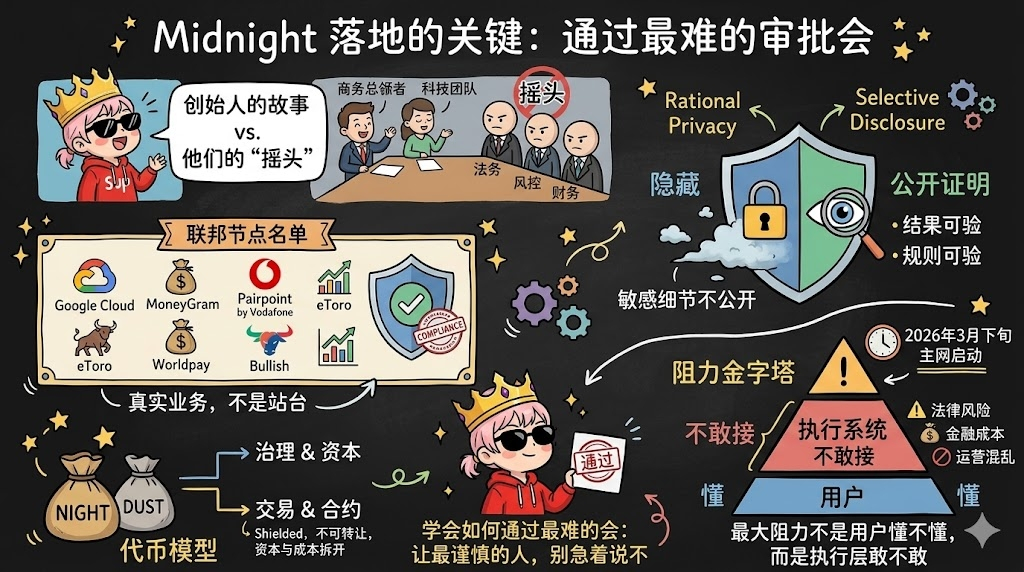
In large companies, during meetings, the business leader is very excited, the tech team nods, but the real decision makers who determine whether this can move forward are often those few people sitting nearby who haven't said much: legal, risk control, finance.
As soon as they shake their heads, the story ends.
@MidnightNetwork This is where I started to look seriously.
It's not like many projects that try to persuade the most passionate group right from the start.
It's more like doing something harder in reverse, first calming down the people who are most likely to vote against.
The recently disclosed list of federal nodes by the officials can actually illustrate the issues very well.
Earlier, there were Google Cloud, MoneyGram, Pairpoint by Vodafone, and eToro, and on March 17, Worldpay and Bullish were added. This combination, when placed together, feels less like 'who is willing to help endorse' and more like 'who is willing to try to integrate real business in'.
Why are these people going first?
Because what they face every day isn’t traffic; it’s responsibility.
Payment companies fear that transaction relationships will be exposed, market makers and trading platforms fear that strategy paths will be laid bare, and cloud and infrastructure teams fear adopting a system that's only suitable for storytelling but not for compliance and auditing.
The rational privacy and selective disclosure that Midnight has been talking about become less abstract here.
It’s not about hiding everything, but about separating the 'parts that need to be proven' and the 'parts that don’t need to be public'.
Results can be verified, rules can be verified, and sensitive details do not need to be handed over casually.
I increasingly feel that for blockchain to enter the real world, the biggest resistance has never been that users don’t understand, but that the intermediate execution systems are afraid to take it on.
The legal department fears risks, the finance department fears fluctuating costs, and the operations team fears losing control once processes are on the chain.
Midnight even models its tokens as if in response to this matter.
$NIGHT is placed at the governance and capital level, while DUST is used for running transactions and contract execution.
The officials have explained this design very clearly; DUST is a shielded, non-transferable resource, emphasizing the separation of capital properties and operational costs, making the system more predictable to use.
This point is something few people would notice at first glance, but in real organizations, it is actually very important.
Because a system doesn’t just run for one day; the budget needs to work, and the process needs to be manageable. It can't be that every time there are more activities on the chain, costs and exposure spike together.
Plus, the timing has also come.
The official confirmation in February stated that the Midnight mainnet will launch in late March 2026. During this time, many are focused on whether there is still any sentiment before the launch, but I am more concerned about why those willing to step forward first seem more like people who truly have approval processes, compliance requirements, and existing business.
So when I look at Midnight now, what comes to mind is not the three words 'privacy chain'.
What I think of is that a chain has finally started to learn how to pass the most difficult test.
It’s not about pleasing the most excited people first.
Instead, let the most cautious people be willing to not rush to say no.
@MidnightNetwork $NIGHT #night