
SIGN Protocol is addressing a problem that the crypto community is so accustomed to that almost no one questions it: the repetitive verification of the same thing.
If you have participated in several airdrops, you will see this very clearly. The same wallet, but it has to go through many verification steps on different platforms. The eligibility list is gathered from many sources, processed through a spreadsheet, and then uploaded to the contract.
It still works. So no one is in a hurry to fix it.
I used to think this was just a matter of 'a bit inconvenient', until I started to look more closely. The more intermediary steps, the higher the chance of discrepancies. The Optimism airdrop in 2022 is an example, where users received incorrect allocations and had to adjust afterward. It's not a contract error. The issue lies in how the data was assembled beforehand.
SIGN Protocol goes straight into this layer. Instead of each project defining its own verification data, SIGN creates an attestation system, which can be simply understood as verifiable proofs on the blockchain. A wallet that has been KYC'd, a user who has contributed, or an address eligible for an airdrop can all be recorded in this way.

At first, I thought: okay, so you just need to verify once, used in many places.
But reading more closely, it's not as simple as that.
SIGN does not just store data, but also standardizes it with schemas, meaning a common definition so that other systems can read and understand it in the same way. This is more important than I initially thought, because most of the problem is not a lack of data, but rather that the data is incompatible.
SIGN is also heading towards an omni-chain approach. This means that an attestation can be used across different chains. Combined with ZK-cryptography, users can prove something is true without revealing all the information behind it.
Sounds fine. But I don't see it happening in real life as easily as that.
An attestation is only valuable when another system accepts it. And the reality is that many projects will not want to rely on an external data source. Not because they don't trust the technology, but because they don't want to lose control.
I've noticed that almost every project I've ever participated in maintains its own verification system, even when better solutions are available. It's not that they don't know, but rather that they have no motivation to change.
And from there everything began to deviate.
Developers cannot abandon the old verification system. But if they want to use SIGN, they must add a new layer. Two systems coexist. One for internal control. One for interaction with the outside.
I don't think many people realize this right from the start, because at a small scale, everything still seems fine. But as the number of users grows, the two data sources start to have the potential to deviate from each other.
And at that point, the consequences are no longer small. A user may qualify under the internal system but be excluded on the attestation side, or vice versa. They may receive the wrong allocation or be denied a claim without any source considered 'absolutely correct' for comparison.
SIGN in this case does not eliminate repetition. It just changes the way repetition occurs.
TokenTable is where I see SIGN solving a very specific part. This is a tool in the SIGN ecosystem used to distribute tokens based on verifiable conditions. Instead of sending tokens according to a static list, the distribution is directly tied to the attestation.
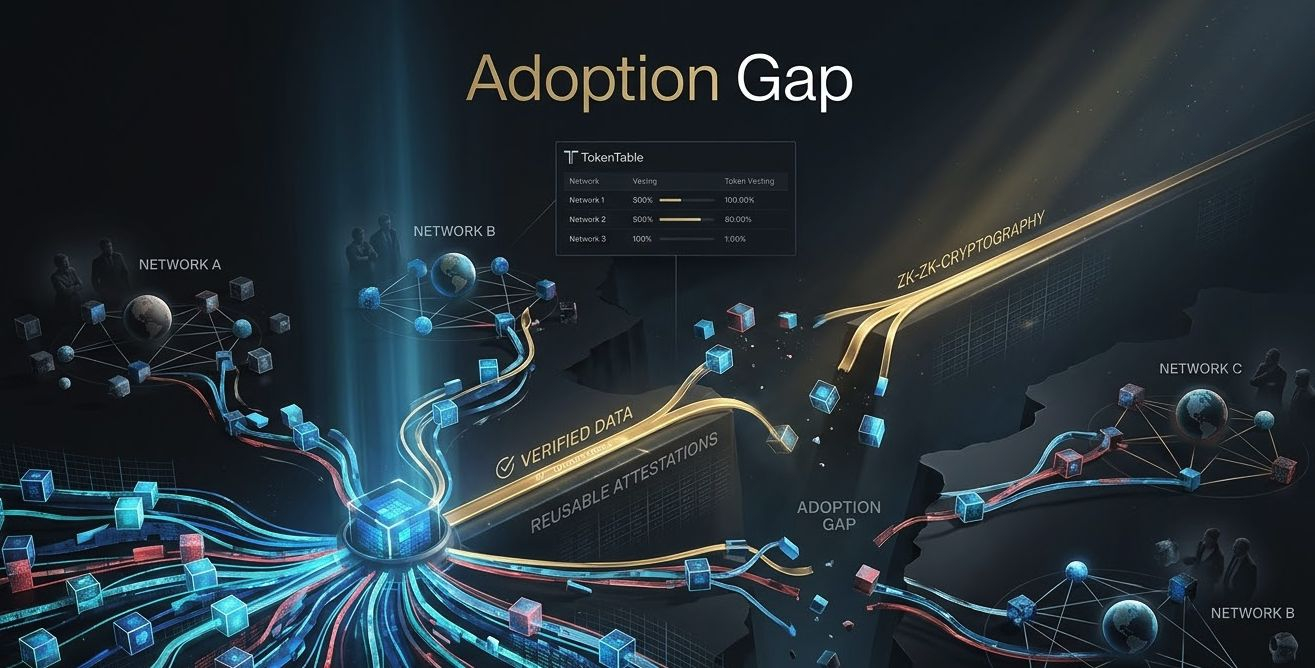
Such systems have handled distribution amounts reaching billions of USD, so clearly the model is not just theoretical.
But when looking at the TokenTable, a part of the Sign ecosystem, I see something somewhat contrary.
It works well because of the clear scope of control. Meanwhile, the attestation part that SIGN wants to expand across the entire ecosystem depends on whether other parties accept it or not.
That is, the easy part is running well. The hard part is not necessarily so.
SIGN is aiming to make attestation a common data layer for the entire ecosystem. But for that to happen, projects must agree on a standard. And for them to accept it, that standard must prove its value beforehand.
I have not seen this loop have a clear solution.
If that does not happen, SIGN's attestation still exists but is not widely used. And at that point, SIGN does not replace the old system.
It stands next to it.
For me, the question is no longer whether SIGN solves the problem correctly. But whether, if it does not become a common standard, SIGN is helping to simplify the system, or pushing developers into a state where they must operate two verification systems in parallel?
@SignOfficial $SIGN #SignDigitalSovereignInfra