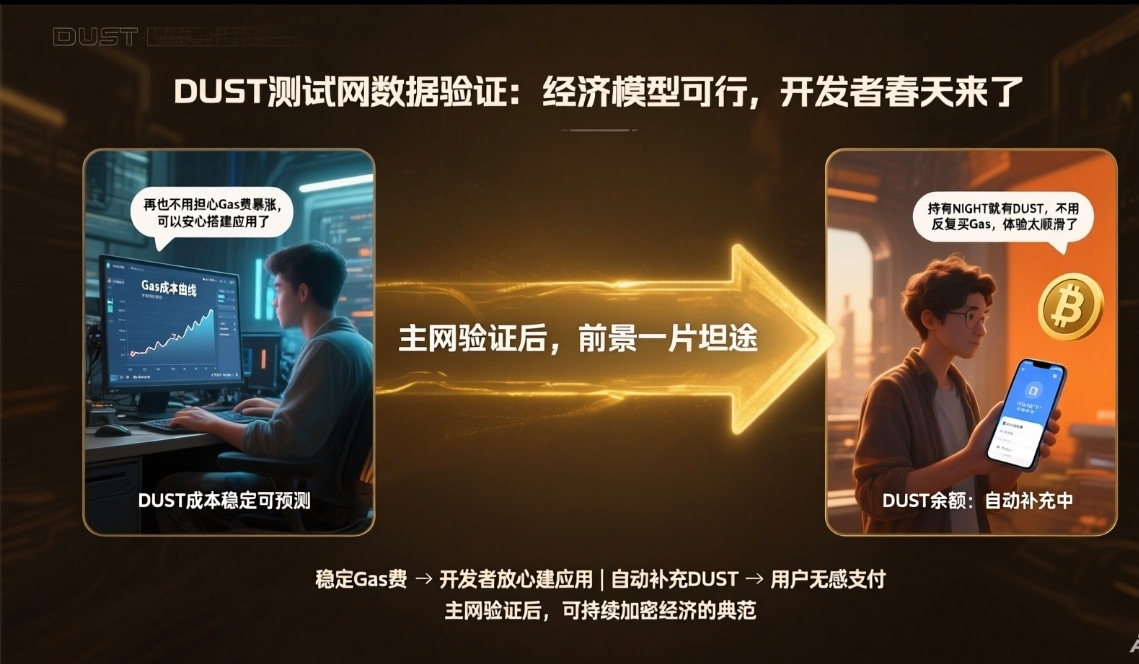
Recently, I have focused on the #NIGHT and DUST dual-generation mechanism, and their respective roles. Because they are highly important in the project, I have been closely monitoring @MidnightNetwork and the operational data on the Midnight testnet. Today, I have specifically organized the generation and consumption of DUST to share with everyone. I believe this mechanism of holding $NIGHT to generate power has already shown a clear outline on the testnet, and large-scale promotion is just a matter of time.$NIGHT
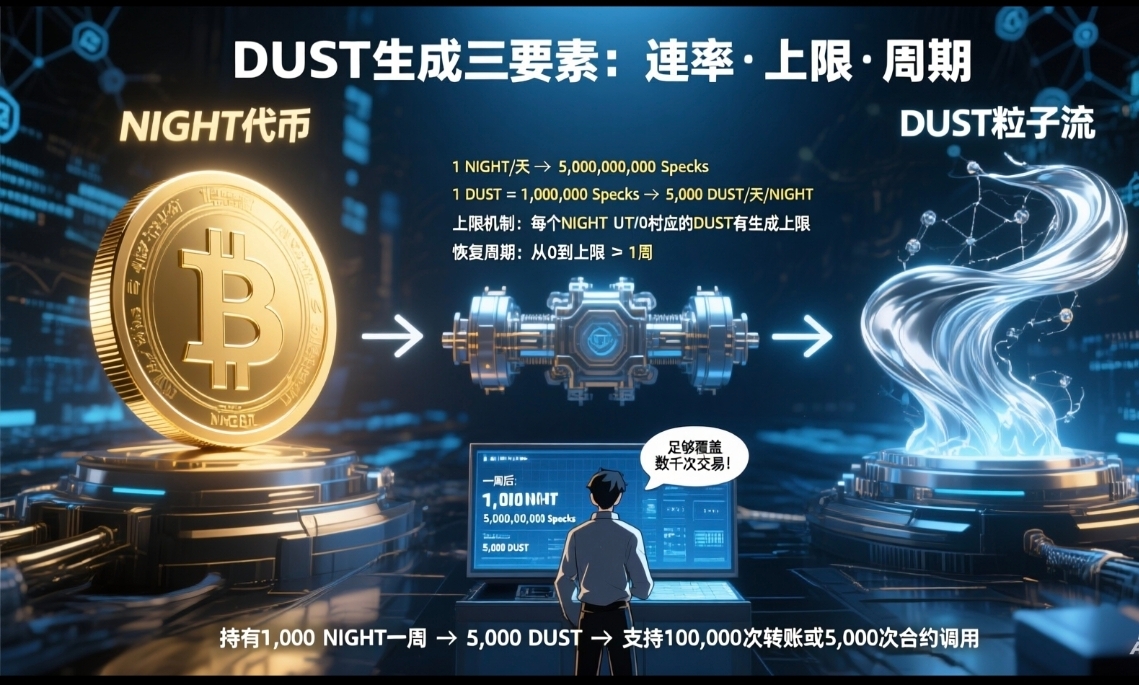
First, let me explain how DUST is generated.
According to the official Midnight documentation, the generation of DUST has a set of precise mathematical parameters.
1, its generation rate: each NIGHT can generate about 5,000,000,000 Specks per day (the smallest unit of DUST).
2, its upper limit mechanism: each NIGHT UTXO corresponds to a DUST generation upper limit, and growth stops when the limit is reached.
3, its recovery cycle: it takes about 1 week to reach the limit from 0, and I think the recovery cycle is quite short.
Everyone can understand it so easily. If you hold 1,000 NIGHT tokens, after a week, your DUST account will grow to about 5,000,000,000 Specks, which is equivalent to 5000 DUST (I converted it based on 1 DUST = 1000000 Specks). To put this number directly, many people might feel confused. Let me put it this way, this amount is completely enough to cover the thousands of ordinary transactions everyone usually makes.
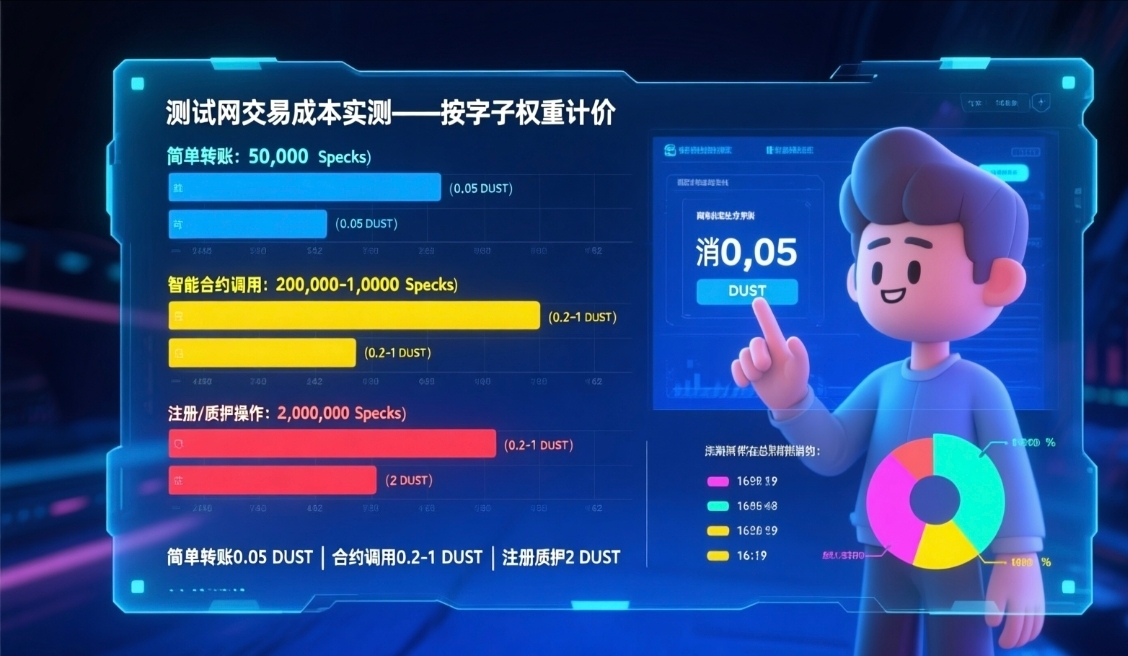
Second, let me discuss the actual consumption data on the testnet.
I checked the information, and the transaction fees on the testnet are priced in DUST, calculated based on everyone's transaction byte weight. I looked at the feedback from the developer community online.
1, for simple transfers, the consumption is about 50000 Specks per transaction (approximately 0.05 DUST).
2, for smart contracts, depending on the specific complexity of the contracts, consumption is between 200000-1000000 Specks, roughly 0.2-1 DUST.
3, during registration and staking operations, the consumption is relatively high, about 2,000000 Specks, roughly 2 DUST.
What does everyone think this means? Let me do the math for you. Holding 1000 NIGHT tokens generates enough DUST in a week to support about 100,000 simple transfers, or approximately 5000 complex contract calls. Personally, I believe this amount is sufficient to support the normal daily testing needs for developers and high-frequency users.
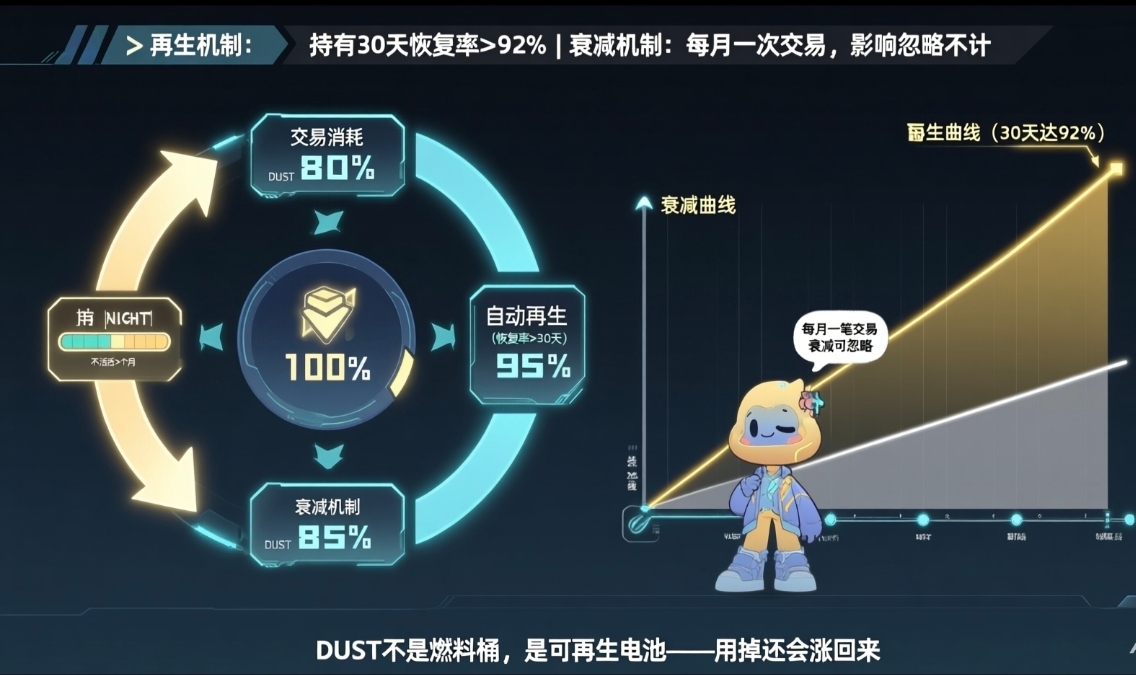
Third, let me talk about the regeneration and decay of DUST.
According to the information I found, the testnet has also verified two key mechanisms of DUST.
First, the regeneration mechanism. After users consume DUST, they only need to continue holding NIGHT, and the corresponding DUST will regenerate until it reaches the generation limit. According to the actual test data I found, as long as users hold $NIGHT tokens for more than 30 days, the recovery rate of the DUST balance is basically stable at over 92%.
Secondly, the decay mechanism. If users do not use the network for a long time, the DUST in their accounts will gradually decay. According to the testnet data I found, as long as everyone maintains at least one transaction per month, this rate of decay can basically be ignored. A single transaction per month is basically negligible for everyone.

Fourth, let me talk about the ways to obtain the project's testnet.
According to the information I found, testnet users can receive tNIGHT from the faucet, about 1000 tNIGHT can be received each time. This is used to generate tDUST for testing. Of course, this faucet is also limited in flow protection, and the same address needs to wait several hours before receiving again, as it is only in the testing phase.
According to the data, the average block time on the testnet is about 6 seconds, and the final confirmation of transactions is usually completed within 1-2 blocks (the time I found is about 18 seconds). This performance indicator is basically consistent with what was expected for the mainnet, which means that the overall functionality of the testnet basically meets the design requirements.
Fifth, let me discuss the significance of this for developers and users.
It is clear that I believe the testnet data of DUST verifies the feasibility of this economic model. For most developers, the cost of DUST is stable and predictable, so everyone can confidently build applications without worrying about sudden spikes in Gas fees like on Ethereum. In simple terms, since this project emerged, I believe the spring for developers has arrived as well. After all, where can you find such stable Gas, right?
For users, as long as everyone holds NIGHT, DUST will automatically replenish, and there is no need to spend money to repeatedly purchase Gas. The user experience is quite powerful.
When this set of data from the testnet is verified by the mainnet, I feel that this should be the simplest interpretation of Midnight's sustainable crypto economy, which also means that the project's future development prospects are absolutely bright.
#night $NIGHT @MidnightNetwork