
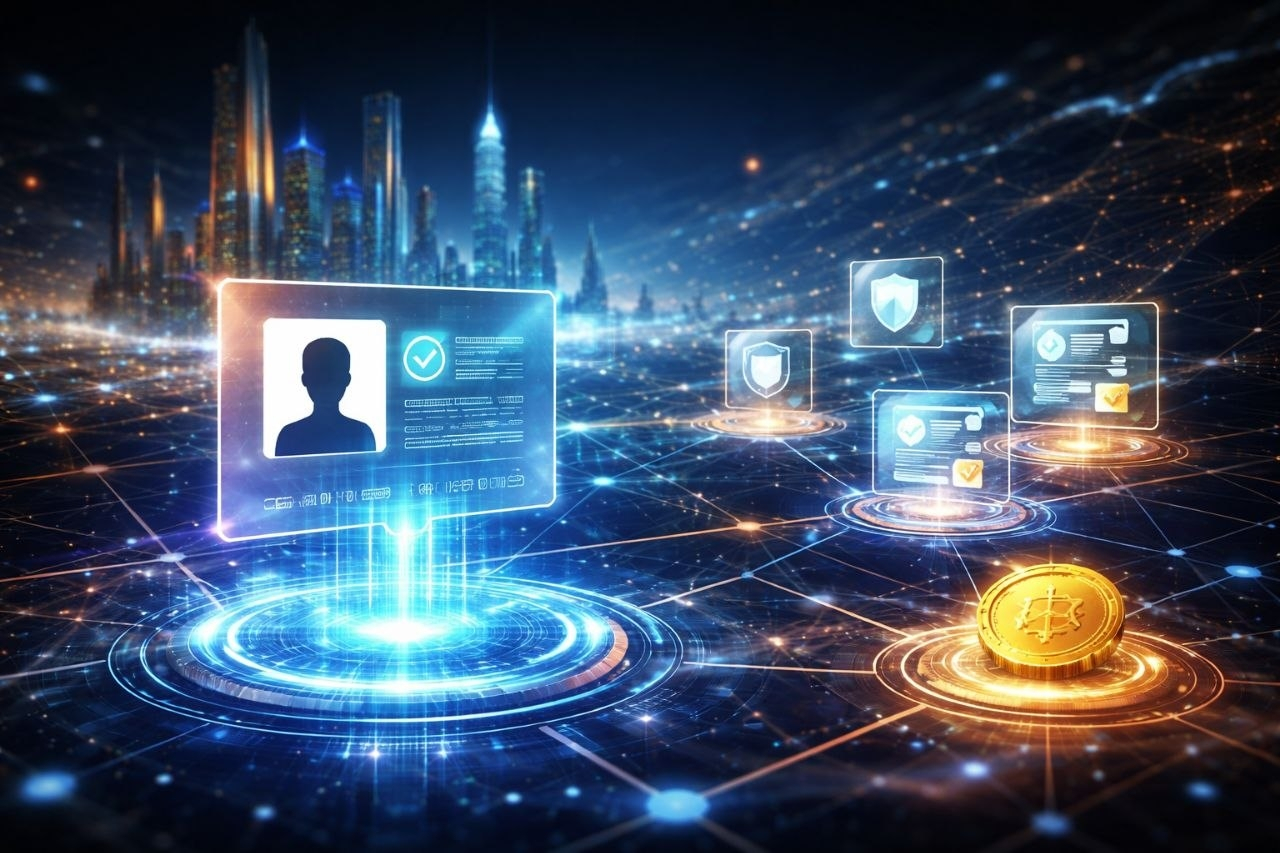
For a long time, we have treated digital identity as merely an identification layer: who you are, where you belong, and what you can prove. But as systems based on Bitcoin and Ethereum evolved, it became clear that the problem wasn't in 'proving identity' itself... but in what happens next.
You can prove your identity.
You can document your data.
But you cannot operate this identity within the economy in a continuous and scalable way.
And here the real question appears:
Is identity just a record… or is it an infrastructure that can move within economic systems?
From identity as definition… to identity as movement
Most digital systems have failed at this specific point.
It created identities… but did not make them 'alive'.
Static identities, used once, then the process is repeated:
Registration
Verification
Storage
Re-request
A closed loop that consumes trust instead of producing it.
But what started to attract attention in Sign Protocol is not that it is a new verification system… but that it redefines the function of identity itself.
The question is no longer:
Can I prove this information?
But it has become:
How does this information move within the economy after being proven?
⚙️ Redefining 'trust' as an operational layer
At its core, Sign does not deal with identity as data, but as 'trusted flows'.
Through the model of attestations:
Digitally signed proofs are issued cryptographically
Stored in a verifiable manner without revealing the full data
Applications can read, use, and build upon them
In other words: trust is no longer a moment of verification… but has become a continuous state within the system.
And here the fundamental transformation occurs:
From 'verification on demand'
To 'trust as a layer that always operates in the background'
🌍 The Middle East: where the idea becomes a necessity
In environments like the Middle East, this transformation is not a technical luxury… but a strategic necessity.
The region is going through a phase:
Acceleration in digital transformation
Expansion in financial and technical services
A clear desire for technological independence
But the biggest challenge was not in the infrastructure… but in managing trust across different systems.
Here the need intersects with what Sign offers:
Instead of:
Separate verification systems
Closed databases
Reliance on third parties
We move to:
A shared verification layer
Data usable across systems
Local control over who issues and consumes trust
The question is no longer:
Do we use technology?
But:
Do we own its operational logic?
🤝 From theory to real economy
The real value of any system is not measured by what it promises… but by what is actually used.
And here the true test of Sign appears:
Are attestations issued continuously?
Are they consumed within real applications?
Do they become part of daily operations (financial, organizational, commercial)?
If the answer is yes, we are facing:
A living infrastructure that grows with each use
But if it remains:
Isolated events
Or activity tied only to incentives
Then the system turns into a static record… not a moving economy.
🪙 The economic dimension: when trust becomes an asset
What distinguishes this model is that it does not separate technology from the economy.
The token here is not just a trading tool,
But a means of coordination and motivation within the trust network.
Every verification…
Every proof…
Every use…
Adds a new layer of value.
And this leads to a deeper idea:
Trust is no longer consumed… but produced and distributed within the system.
🚀 Why is this transformation extraordinary?
Because what is happening is not a gradual improvement…
But a redefinition of three fundamental concepts:
Identity → from data to operational structure
Trust → from service to asset
User → from recipient to participant in the system
And this kind of transformation does not just change applications…
But reshapes how digital economies themselves are built.
✨ Conclusion: What were we really missing?
Everything mentioned leads to a simple answer… but a critical one:
The problem was not that we did not have a digital identity.
But that we did not have a way to use it continuously and reliably within the economy.
And here exactly comes the role of Sign:
Not as a technical solution… but as an answer to a question we had not formulated clearly.
Towards a sovereign infrastructure… towards driven partnerships in the Middle East.
#SignDigitalSovereignInfra @SignOfficial $SIGN
