

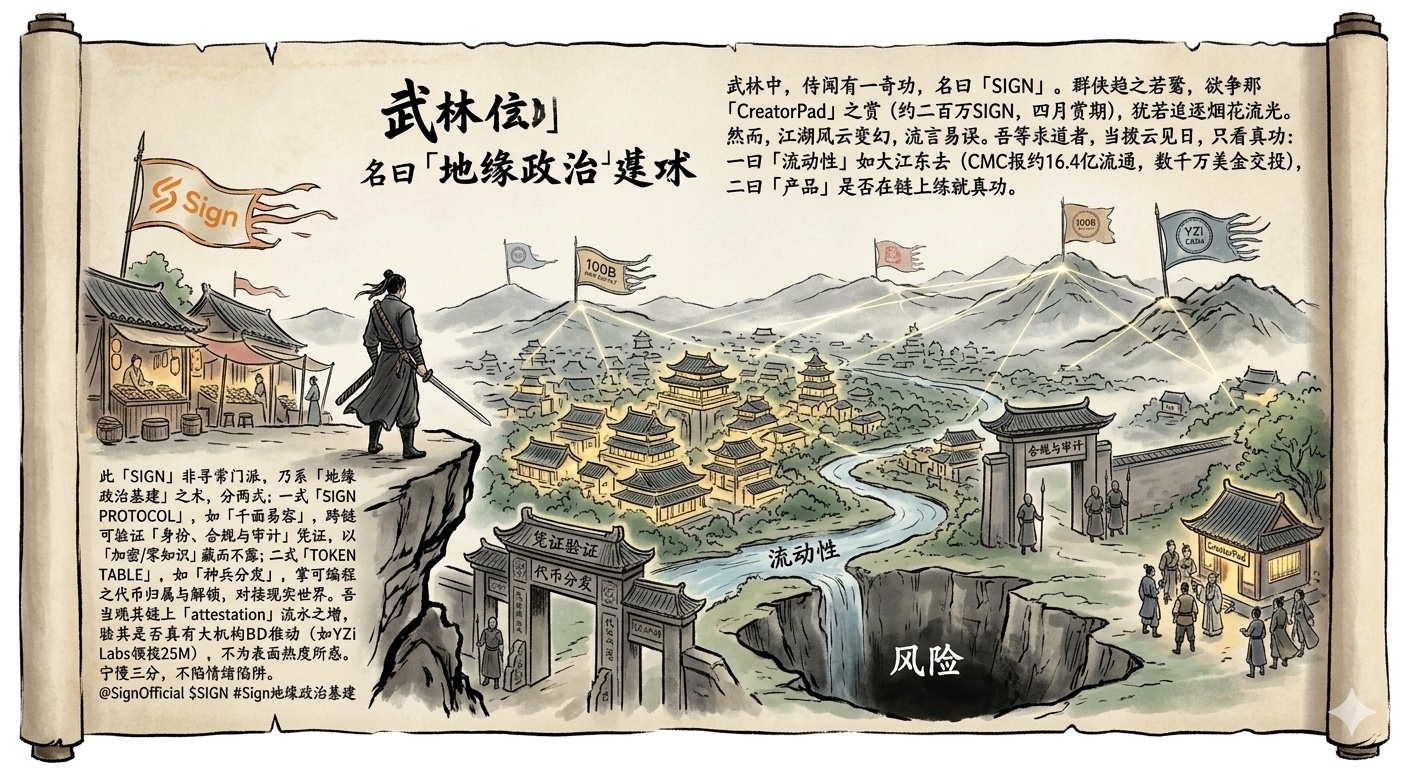
 In the past few days, Binance Square has been filled with tutorials and even blatant "Go for it!" marketing articles about CreatorPad's SIGN event. From 09:30 on March 19, 2026 (UTC) to 23:59 on April 2, 2026 (UTC), the 1,968,000 SIGN rewards (token vouchers) in the reward pool certainly acted as a short-term traffic accelerator, but for a rational Web3 investment researcher, this is merely superficial hype.
[Account Settlement]: SIGN's Fundamentals from the Perspective of Liquidity and Supply Structure
Let's start with the actual data to avoid speculative arguments: As of the time of writing, according to data from Binance and CMC, the price of $SIGN is fluctuating between $0.04x and $0.05x, with 24-hour trading volume remaining in the tens of millions of US dollars. The circulating supply is approximately 1.64 billion, while the maximum supply is as high as 10 billion.
This set of data means two things to me:
First, it is at least not a "small, illiquid trading platform"; it has a certain degree of market consensus and liquidity support.
Second, it is far from a "market capitalization steady state." The maximum supply is more than six times the current circulating supply, meaning the "supply story" is far from over. This presents a crucial long-term supply management issue that any long-term holder considering participation must address. The current market capitalization is just the tip of the iceberg, and volatility driven by market sentiment will be very pronounced.
Therefore, we must look beyond the surface to see if it has enough robust products to support this grand supply-demand race model.
[Product Disassembly]: In-depth exploration of the core logic of "geopolitical infrastructure"
The Sign protocol describes itself as a "global infrastructure for credential verification and token distribution." The task cards precisely anchor the suggested discussion topic on "the development value and future growth potential within the context of the Middle East situation." This is a highly effective entry point for "de-homogenization," elevating the narrative from a simple "signature" to a deeper level of "trust and collaboration."
In the complex geopolitical and business environment of the Middle East, what is the biggest source of friction?
It's not just about the speed of capital flows, but also the low level of mutual trust among multipolar powers, the extreme complexity of compliance and auditing, and the trust barriers faced by the digitization of Real-World Assets (RWA). For example, how can unified compliance standards be established among multiple countries and institutions? How can the authenticity of credentials in cross-border supply chains be ensured without relying on a single centralized entity? How can verifiable privacy proofs be achieved in sensitive commercial and political matters?
This is precisely where the core products of the Sign Protocol—Sign Protocol (credential verification protocol) and TokenTable (programmable token distribution)—can function as “infrastructure.”
1. Sign Protocol: Cross-chain verifiable credentials (Omni-chain Attestation)
Typical marketing materials simply tout "decentralization," while Sign addresses real-world needs in a revolutionary way. It's not just a "signature," but a cryptographic and verifiable "claim" or "credential." In the context of the Middle East situation, it can transform government-issued business licenses, institutional audit reports, and even personal identification documents into verifiable and traceable on-chain proof.
More importantly, the official Academy mentions "encryption/zero-knowledge methods." By introducing zero-knowledge proofs (ZK), the Sign protocol allows organizations to prove their compliance with specific requirements without exposing unnecessary trade secrets or customer details. This is an irreplaceable core requirement in highly sensitive political and business collaborations.
2. TokenTable: Regulated Issuance & Distribution
TokenTable is more than just token issuance; it's a programmable, regulated distribution workflow. In the Middle East, regulatory environments vary widely. A Real-World Asset (RWA) project targeting governments or large institutions requires extremely stringent unlocking conditions, compliance whitelists, and audit trails. TokenTable seamlessly integrates compliance verification (KYC/KYB/accredited investor verification) generated by the Sign Protocol into the distribution logic.
This is the perfect combination of the two: first, Attestation is used to "certify qualifications," and then TokenTable is used for "compliant distribution." This is a perfect closed loop of compliance process, and also a technical interface that the real world is willing to use and that regulators can also connect to.
[Value Support]: Financing Background and Actual Operational Evidence
I don't want to pretend I know everything, so I'll just go with the publicly available information. Around October 21, 2025, Sign secured $25 million in funding led by YZi Labs. This isn't just a guaranteed return; it's a strategic resource. For projects deeply rooted in "geopolitical infrastructure," business development capabilities and institutional trust are crucial. This funding means it's easier for the market to price it based on a "grand narrative," but conversely, if the outcome falls short of expectations, the pullback will be more swift—something I'm personally more cautious about.
As an investment researcher, I will continue to monitor the attestation flow on the Sign Scan. That's where the project's "core code" lies. I'll focus on what kind of schema was created and what kind of entities are using it—it's not just a PowerPoint presentation. Furthermore, the FAQ documentation is written in a more "engineering-oriented" style, directly mentioning verification, authorization proofs, and audit trails. This kind of phrasing aligns with the keywords "geopolitical infrastructure." It's more like they're creating an interface that the real world would be willing to use and that regulators could also interface with.
[Sober Reflection]: I focused on SIGN's three "local standards" and risk warnings.
Finally, I want to offer a sober summary to avoid accusations of me advocating for something. I acknowledge the long-term value of the SIGN (Signature Indicator Group) sector, but I'm also wary of it being pushed into a position where grand narratives and event traffic don't match its speed of implementation. I'll be monitoring it myself using a rather simplistic but reliable standard:
First, is the usage of on-chain Attestations continuously increasing (not just a sudden surge during the activity period followed by a drop to zero)?
Second, has TokenTable, as a distribution tool, been adopted as the default solution by more projects/organizations?
Third, at the market level, I only look at two lines: whether the trading volume can be maintained in a healthy range after the event, and whether the price always fluctuates according to the task node.
These three points aren't cool, but they can save your life.
In the short term, you see the hype and rewards; in the long term, you need to see "who is using it, why they can't live without it, and whether it can create a network effect." I will continue to monitor the on-chain traces and the pace of implementation, preferring to be slower rather than letting my emotions dictate my actions.
@SignOfficial $SIGN #Sign地缘政治基建
