
To be honest, staring at the big pie's sideways movement lately is quite exhausting, but that doesn't stop me from flipping through the fundamentals of the Middle East in the middle of the night. I've seen quite a few people praising c-50/ as the 'new darling of geopolitics,' and my first reaction is still that old saying: don't look at the advertisement, look at the efficacy. As someone who has been cut numerous times in this circle, I now have a physiological vigilance towards any projects waving the 'sovereignty' flag. However, after deeply analyzing the fundamentals of Sign lately, I feel a bit like I can't spit it out. The things this project is doing are really not the 'fast-moving consumer goods' that ordinary retail investors can understand. Let's talk about the Middle East; the rich folks are not short on money, what they lack is a 'sense of security.'
They found that if their banking system, government data, and even citizen identity information all run on others' centralized servers, it's not much different from having their lifeline in someone else's hands. This is the main reason why Sign, as a decentralized verification protocol, can be deeply bound to core areas like Abu Dhabi. This is not a simple Web3 narrative; it is a solid 'digital sovereignty' defense war.
1. What exactly is the so-called 'digital sovereignty infrastructure'?
In simpler terms, what Sign is doing is establishing a 'truth template' for the world. The cost of trust is extremely high now. You have to prove you are you, you have to prove that this money is yours, and you need to run around getting a pile of proofs. The logic of Sign is: the government or authoritative institution issues you an electronic certificate, and you keep it in your wallet. When you go to do something, you only need to present a 'zero-knowledge proof', and the other party can verify its authenticity, with the original data still in your hands. The Middle East is currently desperately working on economic transformation, wanting to shift from 'selling oil' to 'developing technology'. This transformation requires extremely high digital administrative efficiency. If this infrastructure runs smoothly, then Sign will not just be a simple protocol; it will be the 'bus' for digital economic growth in the Middle East over the next decade. Its value lies in its irreplaceability—you can issue a thousand MEME coins, but it's very difficult to create a trust consensus layer on-chain that is recognized by sovereign nations.
2. Why is its market always 'dragging its feet'?
This needs some criticism. Infrastructure projects have a nasty habit: they are boring and extremely dry. $SIGN The current downward trend or fluctuations actually reflect a very realistic problem—who has the patience to wait for a 'government agreement' to slowly materialize in an environment where everyone wants to get rich overnight during a bull market? Its logic is too cold, unlike those AI or blockchain gaming projects that can paint a picture that excites people's blood. But conversely, this 'coldness' is its moat. I verified several data points; the asset distribution system before Sign processed over a hundred million dollars in transactions, indicating real blood-making ability. Middle Eastern projects rely on contracts, not Twitter. The conclusion for this target is not absolute.
 It's like the utility pole downstairs; it's annoying when there's no power, but it's a lifesaver during a blackout. In fact, many people don't understand it; it's not just a signature, but it aims to create an attestation proof ecology, dealing with on-chain diplomas or trade certificates. Behind it are top-tier investors, placing bets on a certain future. Although the explosion of this underlying protocol is slow, once a standard is formed, it becomes a winner-takes-all situation.
3. Growth Space: Is it the sea of stars or a dead end?
Pulling the framework to geopolitical issues, the ceiling is indeed high. In the trend of global multipolarity, neutral countries need a set of identity and asset verification systems not controlled by a single power. This is not just a business for the Middle East; it may be a pressing need for all emerging market countries. But here's a cold splash of water: the growth cycle of infrastructure is measured in 'years'. If you're expecting to double your investment by next week, I advise you to quickly buy a local dog. Sign is configured for those who believe in the 'decentralized backbone'. It is currently undervalued, but this undervaluation may continue for a long time.
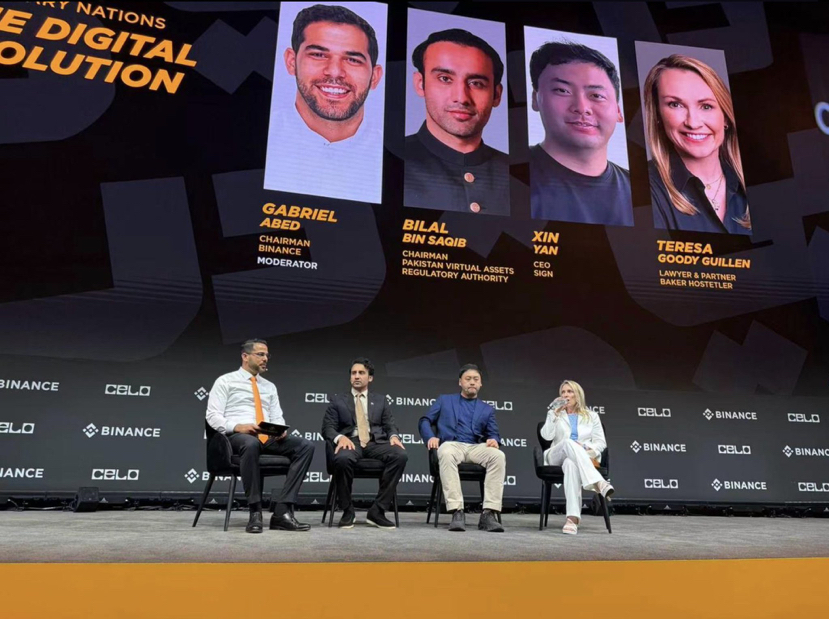
To summarize my homework: First, it addresses the pain points in the Middle East; second, the technical architecture is hardcore; third, don't have illusions. In this noisy industry, finding a project willing to do hard and tiring work is quite rare. First, ensure survival, and leave the rest to time. Everyone should observe and cherish, layout rationally without going all in, do more homework and shout less. In this unpredictable era, understanding trends is much more important than rushing forward.