
Imagine this: you stay up late for several weeks, completing tasks and accumulating points, just waiting for that long-awaited airdrop. When the list is announced — a guy used 200 accounts to take 40% of the tokens, while you and countless ordinary players can only share a pitiful few scraps.
This isn't just bad luck; it's Sybil attack at play. It has stealthily destroyed the fairness of Web3 for several years like a ghost.
But what if there was a way that didn't require you to upload your ID or expose any privacy, and the system could instantly recognize 'this is a real person'?
This is the game rule that SIGN is quietly changing.
We used to naively believe: blockchain is inherently fair, and as long as the wallet is connected, everyone is equal.
So what’s the result? One person can easily pretend to be a thousand people.
'Decentralization' suddenly sounds like a casino manipulated behind the scenes.
The real turning point has come—fairness is never achieved through anonymity but through verifiable 'uniqueness.'
You only need to prove 'I am me, a real person,' without telling the whole world who you are. SIGN has made this dream a reality.
Sybil attacks are actually terrifyingly simple: one person creates hundreds or thousands of fake identities to manipulate voting, airdrops, DAO governance, and even social feeds.
What about traditional solutions? None of them work.
Proof-of-Stake empowers the big players; KYC directly scares away regular users; CAPTCHA and IP checks? It's 2026 now, and any script can bypass them.
The result is: the project side does not trust users, and users feel that rewards are diluted, making the entire ecosystem increasingly unfair.
What we need is not just 'trust me' or 'send your ID to the server,' but truly smart and privacy-respecting methods.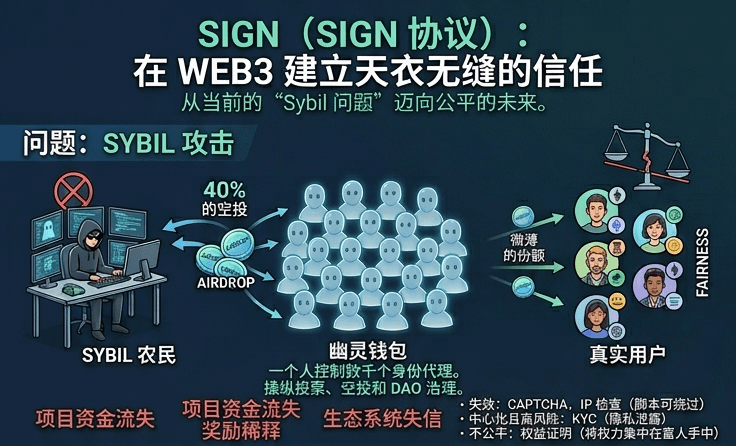
This method is SIGN (Sign Protocol).
It is not another chain, but a full-link 'proof layer'—like a decentralized notary office built on Ethereum, Solana, TON, and all other chains.
Anyone (individuals, projects, or even countries) can use it to issue immutable 'proofs.'
Their goal is to help 300 million people use this technology by 2028, even national-level digital systems are using it.
The core principle is actually quite elegant: Attestation (proof).
You or the project side first set a template, such as 'this wallet belongs to a real person who has completed the task and has not claimed before.' Then use the private key to sign, and this proof is put on-chain (or anchored off-chain).
Anyone can verify at any time, yet cannot see your true identity.
The most impressive part is:
- Using zero-knowledge proofs + selective disclosure, you can prove you are a real person without revealing your name, photo, or address.
- It is compatible with W3C verifiable credentials and DID, and proofs can be taken across chains, even used offline with QR codes or NFC.
- In their TokenTable distribution engine, proof is directly tied to 'uniqueness,' so a real person can only claim once—those farmed small accounts are instantly revealed.
- Bad proofs can be revoked at any time, but it won't drag everyone down.
SIGN does not ask 'who are you,' but rather 'are you the real person who has already proven once before.'
Just this one sentence has cut off the Sybil attack at its root.
In early 2025, a major DeFi project was being crazily exploited by Sybil farmers, and the national treasury was about to be emptied.
They urgently connected SIGN proof + TokenTable. What was the result? 98% of the tokens were distributed to real unique users.
Those farmers changing wallets, using VPNs, or even buying old accounts, are all caught by the proof system in an instant.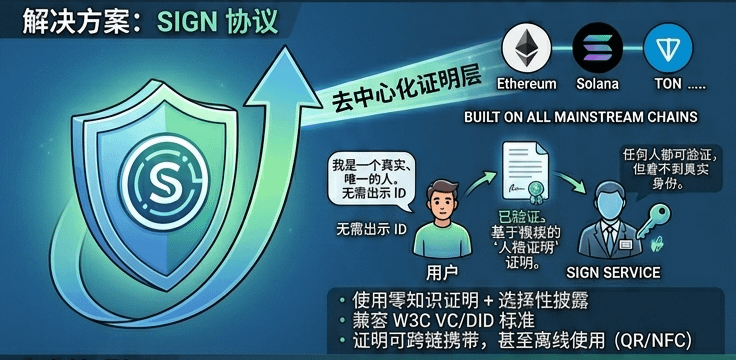
Cooler still, it is already being used at the national level.
A certain country quietly piloted using SIGN for subsidies: citizens use private proofs to receive assistance, eliminating 'ghost beneficiaries' stealing money.
Real people are receiving real help, and the system is completely auditable.
This is no longer a PPT; it is a real story that is happening.
Now airdrop farming has become an industry, with reported losses of billions of dollars each year.
Project teams urgently need fair distribution tools, and SIGN happens to be in the sweetest spot:
No need to change wallets, no need for new chains, support for all major public chains, and can scale to tens of millions of users.
From gaming guilds battling bots to institutions doing RWA, even CBDC pilots, all are quietly using it.
TokenTable has already helped many projects achieve large-scale compliant distribution that traditional tools cannot.
It can be said that SIGN is transitioning from a 'tool' to the underlying infrastructure of Web3.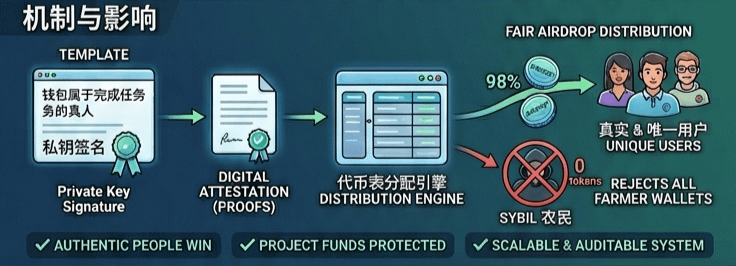
Of course, any technology carries risks.
If the issuer of the proof is unreliable, bad proofs may slip in; privacy is protected by zero-knowledge, but users still need to trust the original template designer.
However, SIGN uses open standards (W3C VC/DID) that can seamlessly integrate with other systems, and the hybrid on-chain and off-chain model has proven it can run steadily and quickly at the national level.
SIGN is not just combating Sybil; it is actually rebuilding trust from the ground up.
In this era of AI robots and deepfakes, 'one real person, one voice' is no longer a technical issue but a philosophical necessity.
It allows nations and projects to maintain digital sovereignty without bowing to big tech companies or surveillance states.
Every proof leaves cryptographic traces, which can verify and protect privacy—this is the perfect bridge between 'trustless' and 'trustworthy.'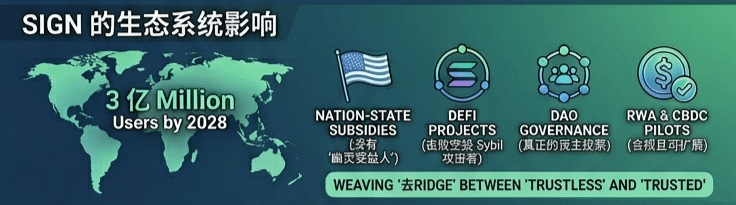
Next time you see an airdrop or governance vote that feels particularly fair and comfortable,
It is highly likely that SIGN is silently guarding behind the scenes.
It issues one proof at a time, transforming Web3 from 'pretending to be fair' to 'truly fair.'
Let real people finally win.
This is not just a technological advancement.
This is the future we have always wanted.