
The mainnet launch is in the final countdown, @MidnightNetwork answering a question that has troubled the blockchain industry for ten years: how to allow everything to be verifiable while protecting privacy?
This is not a technical detail, but the final hurdle for blockchain to go mainstream.
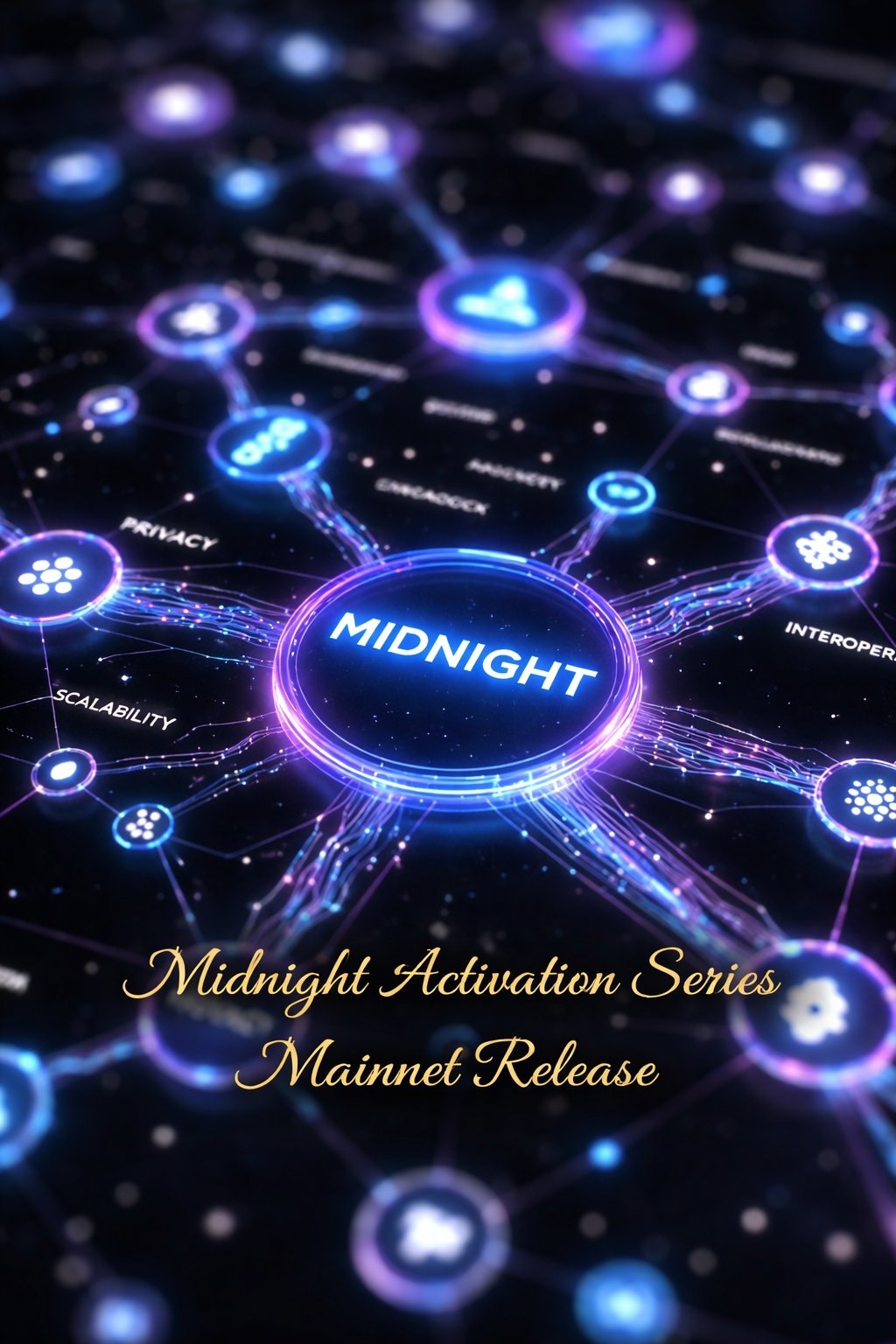
The deadlock between transparency and privacy has been resolved by Midnight.
The logic of traditional blockchains is very simple: all data is public, and everyone can verify it. This logic has enabled Bitcoin and Ethereum, but it has also kept enterprises at bay. Who is willing to lay out vendor information, funding flows, and business strategies under the sun?
Another path is privacy coins, which hide data tightly. As a result, regulation cannot enter, compliance cannot pass, and ultimately, they are delisted by exchanges, left to struggle in dark corners of the web.
Midnight's founding team - from Input Output Global, trained under Cardano - realized one thing: transparency and privacy are not enemies, but require a new set of tools to separate them.
This set of tools is zero-knowledge proof.
Zero-knowledge proof: verify without exposing, the core cryptography of Midnight.
The technical core of Midnight can be summarized in one sentence: the system can verify the authenticity of information without looking at the data.
What does this mean? Let's take a simple example.
Suppose you need to prove to the bank that you have 1,000,000 in savings, but you don't want them to see exactly which money came from where. Traditional solutions can't do it - either you show them your account or you have no evidence.
But on Midnight, you can generate a zero-knowledge proof: proving your total assets ≥ 1,000,000, without revealing the details of any single transaction. Banks can verify that this proof is authentic, but cannot see anything they shouldn't see.
Translated into Midnight's official statement: rules can be followed, transactions can be effective, and conditions can be met. All evidence has been verified without leaking private information that facilitated the results.
This is the magic of Midnight - comprehensive verification without worrying about being monitored.
Selective disclosure: returns the right of 'who sees what' back to the user.
Zero-knowledge proof addresses 'can we verify,' while Midnight's other core design - selective disclosure - addresses 'who sees what.'
Midnight divides data access into three levels:
Public layer: Anyone can see, just like a regular blockchain.
· Audit layer: Only auditing institutions or certified third parties can view.
· Regulatory layer: Only regulatory agencies can access.
You can prove compliance to regulators without letting competitors know who your customers are. You can let auditors verify financial status without laying out the details of every transaction.
This is what Midnight calls 'programmable privacy' - it's not all or nothing, but you can programmatically define: who can see what under what conditions.
Federated nodes: What is Midnight verifying in the real world?
The list of Midnight's federated nodes has assembled an all-star lineup from the real-world economy.
Every case is validating Midnight's core proposition: proving that important information is true without disclosing sensitive data.
Western Union does not need to disclose all transaction records to prove to regulators that it is not money laundering. Worldpay does not need to expose the merchant's settlement details to prove that the payment process is compliant. Bullish does not need to publicly disclose wallet addresses to prove that the exchange has sufficient solvency.
This is the key to what Midnight can truly facilitate in practical applications - providing a reason for businesses that were afraid to go on-chain due to 'data exposure' to finally do so.
NIGHT: Provides the economic foundation for verifiable privacy.
No matter how lively Midnight's ecosystem is, it ultimately relies on$NIGHT this native token to operate.
NIGHT plays two roles. The first is governance. Holders of NIGHT can vote on which federated nodes enter or exit, how the protocol upgrades, and how fee parameters are adjusted. The second is resources. Every operation on Midnight requires consuming DUST, which can only be generated by staking NIGHT.
The three special attributes of DUST - non-transferable, will decay, and will run out - ensure that resources are not hoarded. Large holders cannot accumulate resources for years and release them all at once when needed, and small holders will not be turned away for not being able to afford NIGHT.
This is what Midnight has figured out: ownership and usage rights must be separated. You can hold NIGHT for a lifetime, representing your stake in the ecosystem. But if you want to use the network, you must consume DUST - this fuel generated by NIGHT, which disappears once used.
From theory to reality: What is Midnight changing?
In the past, privacy chains were perceived as 'hiding things.' Midnight redefined this - it is not about hiding, but completing verification without leaking information.
Midnight is pushing 'privacy-first blockchain' from theory to reality. After the mainnet goes live, everything will change - because there will finally be a chain that allows users to protect data while enabling the system to verify everything that needs to be verified.
Comprehensive verification without worrying about being monitored.
This is the real possibility.#night