The Invisible Theft Happening to Every Internet User
Every day, billions of people prove who they are online. They log into bank accounts, sign documents, verify credentials, authenticate purchases, and confirm identities across dozens of platforms and services.
And every single time, they surrender a piece of themselves.
Your identity data — your name, birthdate, address, financial history, employment records, educational credentials, biometric signatures — doesn't live in your wallet or on your device. It lives on corporate servers. Servers owned by banks, governments, social media platforms, healthcare providers, and hundreds of other institutions that collected your information under the pretense of "verification" and then stored it indefinitely for their own purposes.
You didn't sell this data. You didn't consciously give it away. It was extracted as the invisible cost of participating in modern digital life. And once extracted, you have virtually zero control over how it's used, who it's shared with, or whether it's protected.
Data breaches expose billions of records annually. Identity theft costs consumers over $50 billion per year globally. Companies monetize personal data through advertising, analytics, and data brokerage — industries built entirely on selling information that people never consciously agreed to commoditize.
This isn't just a privacy problem. It's an ownership problem. And it's the problem that @SignOfficial was built from the ground up to solve.
What Is Sign?
Sign is a decentralized attestation protocol that fundamentally restructures how digital identity, credentials, and verification work — shifting ownership and control from institutions back to individuals.
At its core, Sign provides infrastructure for creating, managing, and verifying attestations — cryptographic statements that prove specific claims about a person, organization, or entity without requiring trust in a centralized authority.
But reducing Sign to "just an attestation protocol" would be like reducing Ethereum to "just a database." The implications of what decentralized attestation enables are vast, touching virtually every industry and every digital interaction where trust and verification currently depend on centralized intermediaries.
Here's what makes @SignOfficial architecturally significant:
🔑 Self-Sovereign Attestations — Users own their attestations completely. Your university degree, your professional certification, your credit score verification, your age confirmation — each exists as a cryptographic attestation that you control. You decide who sees it, when they see it, and for how long. No institution can revoke your access to your own credentials or hold your identity hostage.
🔑 Omni-Chain Architecture — Sign operates across multiple blockchains rather than being locked into a single ecosystem. Attestations created on one chain can be verified on another, ensuring that your digital identity isn't fragmented across incompatible networks. One identity. Every chain. Seamless verification.
🔑 Permissionless Attestation Creation — Anyone can create attestation schemas on Sign — not just established institutions. A small business can create employee credential attestations. A community organization can issue membership verifications. A DAO can attest to contributor roles and achievements. This democratization of attestation creation breaks the monopoly that large institutions currently hold over credential issuance.
🔑 Composable Trust — Attestations on Sign can reference other attestations, creating chains of trust that build increasingly robust identity profiles without requiring any single attestation to reveal excessive information. Your employer attests that you work there. Your bank attests that you have an active account. Your university attests that you hold a degree. Combined, these create a rich identity profile — but each attestation reveals only what's necessary, and each is independently verifiable.
🔑 Privacy by Design — Sign integrates privacy-preserving mechanisms that allow attestation verification without exposing underlying data. Prove you're over 21 without revealing your birthdate. Prove you're a licensed professional without revealing your license number. Prove you're a resident of a specific country without revealing your address. The verification is cryptographic and absolute. The data exposure is minimal and controlled.
The Attestation Economy: Why This Is Bigger Than Identity
Most people hear "digital identity" and think of logging into websites. That's a tiny fraction of what decentralized attestation actually enables.
Think about every moment in life where someone or something needs to verify a claim:
📄 "This document was signed by this person on this date" — Document attestation
📄 "This product originated from this manufacturer and passed these quality checks" — Supply chain attestation
📄 "This person completed this course and earned this certification" — Educational attestation
📄 "This organization is registered, compliant, and in good standing" — Regulatory attestation
📄 "This piece of content was created by this artist and has not been modified" — Creative attestation
📄 "This financial transaction was authorized by these parties under these terms" — Financial attestation
📄 "This vote was cast by an eligible voter and counted correctly" — Governance attestation
📄 "This AI model was trained on this dataset using these parameters" — AI provenance attestation
📄 "This carbon offset represents genuine emissions reduction verified by these auditors" — Environmental attestation
Every single one of these verification moments currently relies on centralized authorities — notaries, auditors, registrars, certification bodies, government agencies — that charge fees, introduce delays, create bottlenecks, and represent single points of failure and corruption.
@SignOfficial provides the infrastructure to decentralize all of them. Not through a single application, but through a protocol that any developer, organization, or individual can build upon to create attestation-powered solutions for their specific domain.
The total addressable market isn't "digital identity." It's every trust verification event in the global economy. That's not a niche. That's the foundation of how civilization functions.
How Sign Transforms Specific Industries
Let's examine how Sign's attestation infrastructure reshapes specific sectors:
🎓 Education and Professional Credentials
The Problem: Credential fraud costs the global economy billions annually. Verifying degrees and certifications requires contacting individual institutions — a process that takes days or weeks and often involves fees. Credentials earned in one country are frequently unrecognized in another due to incompatible verification systems.
Sign's Solution: Educational institutions issue degree attestations on Sign. Employers verify credentials in seconds through cryptographic verification — no phone calls, no emails, no waiting. Credentials are globally portable, immune to institutional closure (your degree attestation persists even if your university shuts down), and impossible to forge.
🏦 Financial Services and KYC
The Problem: Every financial institution requires independent Know Your Customer verification. A person opening accounts at three banks submits the same identity documents three times, creating three separate copies of sensitive personal data — each representing a potential breach target. The redundancy is wasteful, the risk is cumulative, and the user experience is miserable.
Sign's Solution: A user completes KYC verification once, receiving an attestation that proves compliance without exposing raw documents. When opening a new account, they present the attestation. The institution verifies it cryptographically in milliseconds. No document resubmission. No additional data copies. No incremental breach risk. One verification, infinite reusability.
⚖️ Legal and Contractual
The Problem: Document signing and notarization remain surprisingly analog. Physical signatures are easily forged. Digital signing services are centralized platforms that store copies of every signed document. Notarization requires in-person visits and government-licensed intermediaries.
Sign's Solution: Documents signed through Sign generate on-chain attestations proving that specific parties signed specific documents at specific times. The attestation is immutable, independently verifiable, and doesn't require trusting any platform to maintain records. Notarization becomes a cryptographic function rather than a human ceremony.
🗳️ Governance and Voting
The Problem: Both on-chain DAO governance and traditional electoral systems struggle with the tension between voter verification and ballot privacy. Most systems sacrifice one for the other — either votes are transparent but privacy is compromised, or privacy is preserved but vote legitimacy can't be independently confirmed.
Sign's Solution: Voter eligibility attestations confirm that a participant has the right to vote without revealing their identity. Vote attestations confirm that a valid vote was cast without revealing its content. The election is verifiably fair and completely private simultaneously — a combination that current systems cannot achieve.
🏥 Healthcare
The Problem: Patient medical records are fragmented across dozens of providers, each maintaining separate databases with inconsistent formats and incompatible systems. Patients transferring between providers face delays, repeated tests, and privacy risks as records are transmitted through insecure channels.
Sign's Solution: Medical providers issue attestations for diagnoses, test results, prescriptions, and treatment histories. Patients control their complete medical attestation portfolio, sharing specific attestations with new providers instantly. Records are portable, verifiable, patient-controlled, and permanently available regardless of provider changes.
Understanding $SIGN
The economic engine powering Sign's entire attestation ecosystem is SIGN — the native token that aligns incentives across every participant in the network.
Within the Sign Protocol, SIGN Serves essential functions that bind the ecosystem together:
💫 Protocol Fees — Creating, storing, and verifying attestations on the Sign network involves minimal protocol fees denominated in $SIGN. These fees prevent spam, fund ongoing development, and create baseline demand that scales directly with network usage.
💫 Staking and Security — Network participants stake SIGN support protocol operations and earn rewards for honest participation. This staking mechanism secures the attestation infrastructure while providing token holders with sustainable yield tied to real network activity.
💫 Governance — SIGN ders shape the protocol's future through decentralized governance — voting on parameter adjustments, feature priorities, fee structures, and strategic direction. This ensures that no single entity controls the evolution of identity infrastructure that potentially affects billions of users.
💫 Incentive Alignment — Developers building on Sign, institutions issuing attestations, and users managing their identities are all economically aligned through $SIGN. Growth in any segment benefits all participants, creating a cooperative ecosystem where individual incentives and collective health reinforce each other.
💫 Access and Premium Services — Advanced attestation features — complex conditional verifications, high-volume enterprise issuance, cross-chain attestation bridging — utilize SIGN he access mechanism, creating utility-driven demand beyond basic speculation.
As the number of attestations created, verified, and managed on Sign grows, the fundamental demand for SIGN proportionally — creating an economic model where token value reflects genuine protocol adoption rather than narrative momentum alone.
The Sovereignty Thesis
Here's the philosophical underpinning that makes @SignOfficial more than just a technology project — it's a sovereignty movement.
For the past three decades, the internet has operated on an extractive model. Users create value — content, data, identity, attention — and platforms capture that value. The user gets a "free" service. The platform gets an asset worth billions.
Blockchain began reversing this model for financial assets — giving people direct ownership of their money without institutional intermediaries. DeFi, self-custody wallets, and peer-to-peer transactions returned financial sovereignty to individuals.
Sign extends this revolution to identity assets — arguably even more fundamental than financial ones. Your money can be replaced. Your identity cannot. Your credentials represent years of effort. Your reputation represents a lifetime of behavior. Your attestations represent trust relationships built over decades.
These assets are more valuable than any token balance. And until Sign, they had no infrastructure for self-sovereign ownership.
@SignOfficial is building the infrastructure that treats identity with the same sovereignty principles that Bitcoin applied to money. Your attestations. Your credentials. Your identity. Your property. Not rented from platforms. Not stored on corporate servers. Not accessible to advertisers and data brokers. Yours.
That's not a feature. That's a paradigm shift. And SIGN economic foundation making it sustainable, scalable, and permanent.
Why Now?
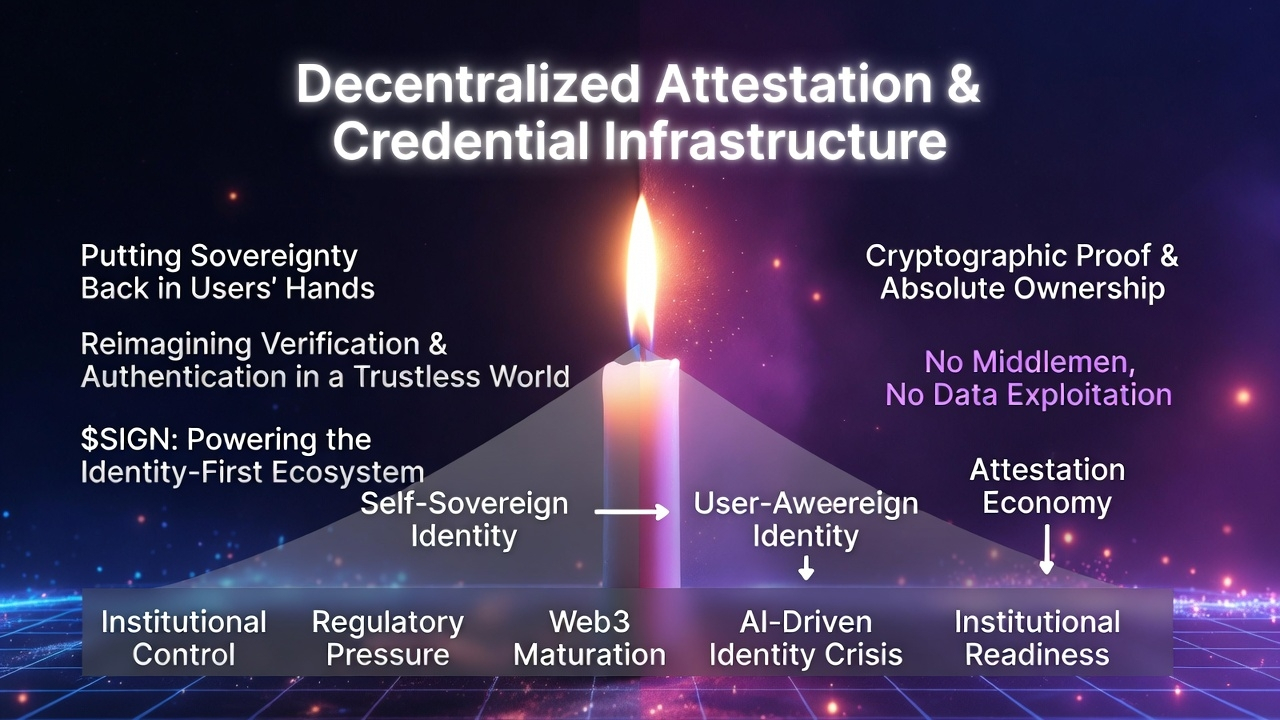
Several converging forces make this the optimal moment for Sign's emergence:
🌍 Regulatory Pressure — Governments worldwide are mandating data sovereignty through legislation like GDPR, CCPA, and emerging digital identity frameworks. Organizations need solutions that comply with these regulations by design rather than through costly retrofitting.
🌍 Web3 Maturation — The blockchain ecosystem has evolved beyond simple token transfers to support complex applications. The infrastructure for decentralized attestation — fast chains, affordable storage, cross-chain bridges, ZK proofs — now exists at production quality.
🌍 AI-Driven Identity Crisis — Deepfakes, AI-generated content, and synthetic identities are making traditional verification methods obsolete. Cryptographic attestation is one of the few verification approaches that remains robust against AI-powered fraud.
🌍 Institutional Readiness — Banks, universities, governments, and enterprises are actively exploring blockchain-based identity and credential systems. They need a protocol to build on — not another proprietary platform that recreates the same centralization problems.
🌍 User Awareness — Years of data breaches, privacy scandals, and platform exploitation have created widespread consumer demand for alternatives. Users are ready for solutions that genuinely protect their data rather than just promising to.
Looking Ahead
The transition from institutionally-controlled identity to self-sovereign identity won't happen overnight. It will happen gradually — one attestation type at a time, one industry at a time, one regulation at a time — until the accumulated momentum makes the old model untenable.
@SignOfficial is positioned at the epicenter of this transition. Not as a single application solving a single use case, but as foundational protocol infrastructure that enables an unlimited number of applications across an unlimited number of industries to implement decentralized attestation in whatever way their specific context demands.
That's the power of building at the protocol layer rather than the application layer. Sign doesn't need to predict which specific use case will achieve mainstream adoption first. It needs to ensure that whichever use case wins, it runs on Sign.
The attestation economy is emerging. Digital sovereignty is transitioning from philosophy to infrastructure. And $SIGN tioned as the economic heartbeat of a protocol that could fundamentally reshape how trust, verification, and identity function in the digital age.
DYOR. Explore the protocol. Understand attestation infrastructure. And ask yourself a simple question: in a world drowning in deepfakes, data breaches, and identity fraud — what's more valuable than a system that lets you prove who you are without giving yourself away?
🖊️🔐🌐
#SignDigitalSovereignInfra | @SignOfficial $SIGN