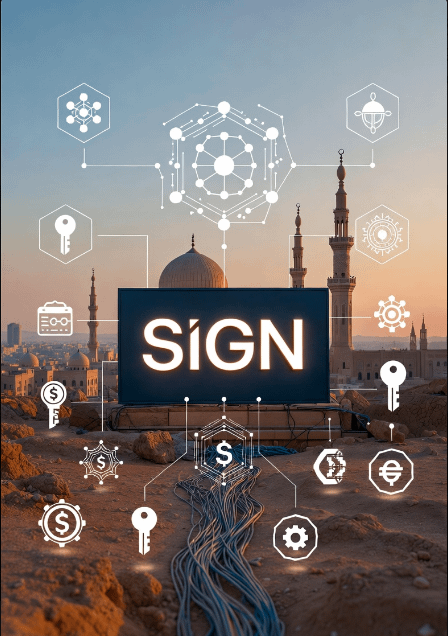
The current issue in the Middle East appears to be an escalation of conflict, but fundamentally it is something else: the old order is beginning to fail.
When military power frequently competes, energy channels could be cut off at any time, and traditional financial settlements face sanctions and interruption risks, the real impact is not on a specific country, but on the entire region's 'trust system' that it relies on. SWIFT can be restricted, banks can be frozen, and assets can be blocked at the push of a button by regulators - this means that the previous 'centralized trust' is becoming unreliable.
So the key to this round of changes is not war, but: who will replace trust.
More and more countries are beginning to realize that relying solely on external systems essentially hands over control. Once the situation changes, payments, identities, and asset flows could all be stalled. This is also why the cryptocurrency adoption rate in the Middle East has suddenly exploded—not because of speculation, but because they need an underlying system that does not depend on a single power center.
But the question arises: public chains ≠ usable by nations.
The open chain addresses 'decentralization' but does not solve 'sovereign control.' What countries need is not a completely anonymous and uncontrollable system, but an infrastructure that can be independently managed while also possessing global interoperability.
This is precisely where Sign fits in.
The Sign Protocol is essentially not a simple on-chain tool, but a layer of 'verifiable trust network.' It unifies information such as identity, assets, and data that are originally dispersed across different systems through attestation, achieving on-chain verifiability and cross-chain usability.
In other words, what it is doing is not financial applications, but the reconstruction of trust standards.
When Abu Dhabi began to promote digital identity, CBDC, and RWA systems, the choice was not a single public chain, but rather a structure that balances sovereignty and openness. TokenTable addresses large-scale asset issuance and distribution, SignScan is responsible for auditing and transparency, while $SIGN becomes the fuel for the entire system operation—every verification, every call, generates real demand.
This is different from past projects that were purely narrative-driven.
Its growth logic is not whether the market is willing to speculate, but whether countries are using it.
When a region validates the feasibility of a 'sovereign-level blockchain' in a highly uncertain environment, it is difficult for other countries facing financial constraints and geopolitical pressures not to follow suit. Countries like Saudi Arabia, Qatar, and even broader emerging markets have similar needs.
This means that the core of future competition will no longer be whose TPS is higher, but who can become the trust interface standard across nations.
If the past cryptocurrency industry was focused on decentralized finance, the next stage, the real battleground is actually:
digital sovereign infrastructure.
In this track, Sign represents a more realistic path—
not to subvert nations, but to become a new 'connection layer' between nations.
Therefore, rather than viewing it as a short-term asset with astonishing gains, it is better to see it as an infrastructure being validated by geopolitical factors.