
The growth of Web3 has unlocked new opportunities for decentralization, ownership, and transparency. However, one fundamental issue continues to slow down mass adoption — trust.
In traditional systems, trust is maintained by @SignOfficial centralized authorities such as banks, governments, and institutions. Web3 aims to remove these intermediaries, but the question remains: how do we establish trust in a decentralized world?
This is where SIGN comes into the picture.
What is $SIGN?
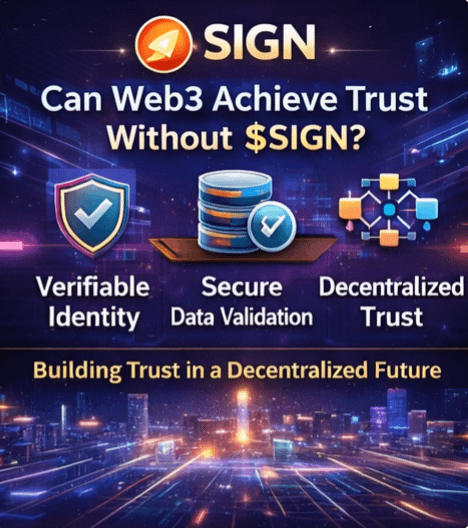
SIGN is designed to act as a trust infrastructure layer for Web3. Instead of relying on centralized entities, it provides tools that allow users, platforms, and applications to verify information in a secure and decentralized way.
Its core focus revolves around three pillars:
Verifiable Identity
Users can prove who they are without exposing unnecessary personal data.
Secure Data Validation
Information can be verified on-chain, reducing the risk of fraud or manipulation.
Decentralized Trust
Trust is distributed across the network instead of being controlled by a single authority.
Why It Matters
As Web3 continues to grow, more industries are starting to explore blockchain technology — including finance, gaming, social media, and digital identity systems.
However, without a reliable trust mechanism, these systems face serious limitations:
Fake identities
Data manipulation
Lack of accountability
$SIGN aims to solve these problems by introducing a system where trust is programmable and verifiable.
Early Stage Opportunity
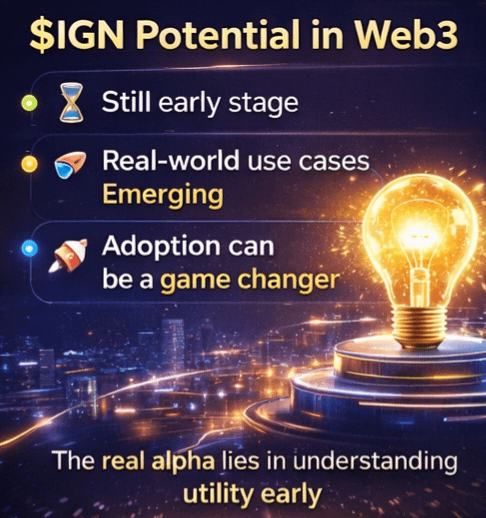
One of the most interesting aspects of SIGN is that it is still in its early stages. Historically, early adoption of strong infrastructure projects has often led to significant long-term value.
But it’s important to understand that:
Adoption takes time
Utility develops gradually
Market sentiment can fluctuate
The real advantage lies in identifying projects that solve real problems, not just trending narratives.
Future Potential
Looking ahead, $SIGN could play a major role in:
Decentralized identity systems
On-chain reputation
Secure Web3 interactions
Cross-platform trust verification
Final Thoughts
The future of Web3 isn’t just about decentralization — it’s about trust without intermediaries.
SIGN is positioning itself as a key player in this space by focusing on real-world utility rather than short-term hype.
As adoption grows, projects like this could define the next phase of the internet.
The question is — are you early, or are you waiting for confirmation? 👀
#SignDigitalSovereignInfra $SIGN #TrumpConsidersEndingIranConflict