

On March 17, 2026, the U.S. SEC (Securities and Exchange Commission) and CFTC (Commodity Futures Trading Commission) jointly released a significant historic document, officially declaring the end of the decade-long era of 'regulation as enforcement.'
Bitcoin (BTC), Ethereum (ETH), SOL, XRP, and 16 other mainstream cryptocurrencies have been officially recognized as digital commodities rather than securities; core activities in mining, staking, airdrops, and other industries simultaneously gained legal status. The U.S. crypto market bids farewell to ambiguous regulation and enters a new phase with clear rules and guidelines, marking a critical turning point for the entire industry. After reading this article, you will clearly understand the official identity of the tokens in your hands and their future compliance direction.
On March 17, 2026, the SEC and CFTC jointly issued the official explanatory document numbered 33-11412, totaling 68 pages, which formally ended the 'substituting law enforcement for regulation' model, classifying BTC, ETH, SOL, XRP, and 16 other mainstream cryptocurrencies as 'digital bulk commodities', explicitly excluding securities attributes, while also confirming the legitimacy of the three core behaviors of mining, staking, and airdrops. U.S. crypto regulation has officially entered a standardized and systematic era. Below are the core points of the document and an analysis of its deep impact on the industry:
1. Core content of historical documents
1. Significant turning point in regulatory models
Bid farewell to the vague control model of 'substituting law enforcement for regulation' over the past decade, and shift towards a regulatory system centered on 'Project Crypto' that is structured and collaborative. The SEC and CFTC have clarified their regulatory divisions, significantly reducing jurisdictional conflicts between institutions and clearing institutional barriers for industry development.
2. Clear classification of five major asset types
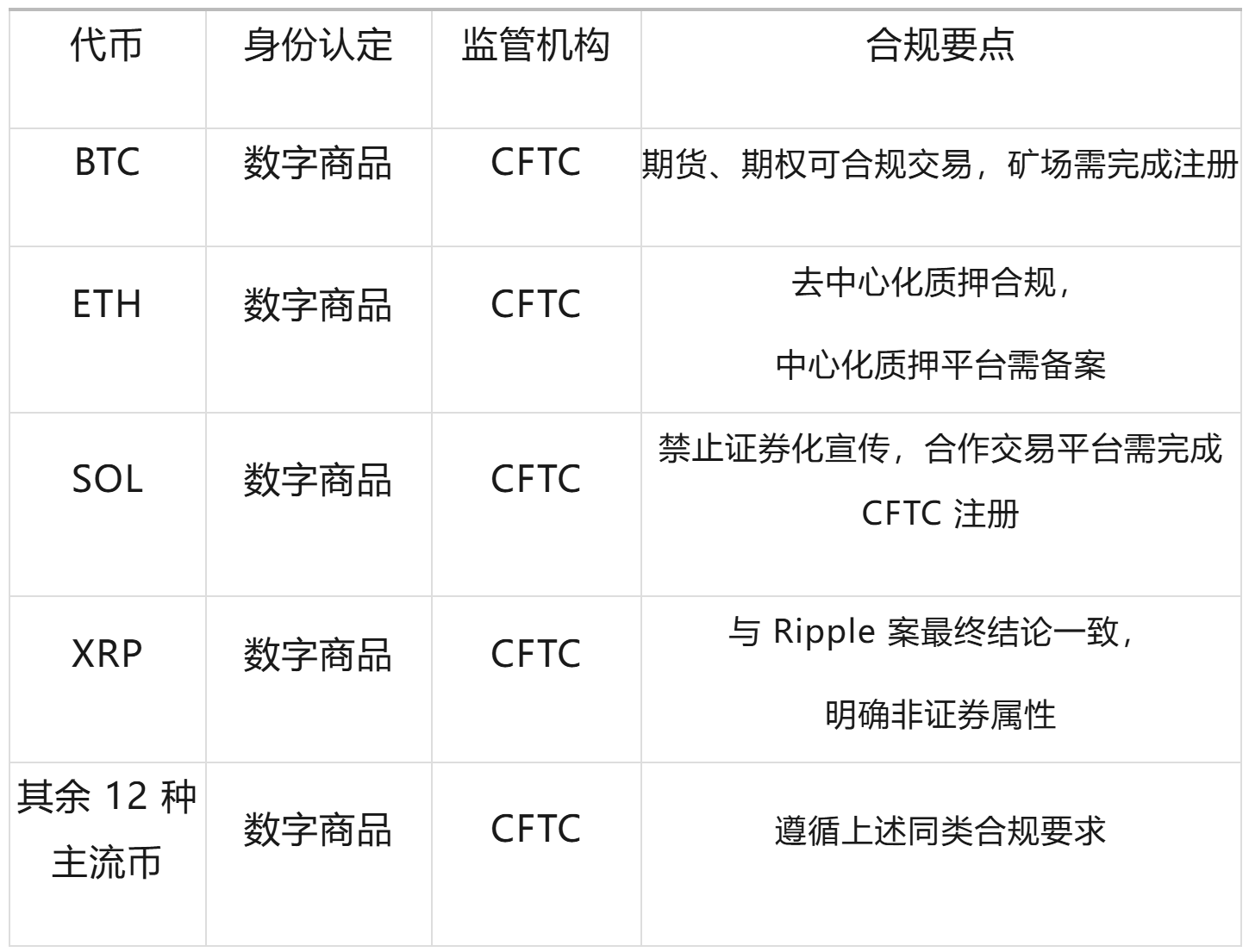
Digital commodities: BTC, ETH, SOL, XRP, and 16 other mainstream cryptocurrencies are regulated by the CFTC under the Commodity Exchange Act and are no longer subject to SEC securities regulations.
Digital securities: Tokens that meet the Howey test standards (investing in a common enterprise and relying on the efforts of others to earn profits), are regulated by the SEC.
Stablecoins: Classified under banking regulation, SEC, or CFTC jurisdiction based on the type of anchor asset and issuance mechanism.
NFT: Non-fungible tokens used purely for collection and artistic purposes are generally not recognized as securities; however, if they possess obvious investment attributes, they fall under SEC regulation.
Other functional tokens: Tokens primarily for practical use will be classified based on actual use and project characteristics.
3. Comprehensive legalization of core industry behaviors
Mining: Compliant mining facilities can operate legally after registration.
Staking: Decentralized staking is completely legal, while centralized staking platforms need to register with the CFTC.
Airdrop: Airdrops of non-security tokens are compliant as long as they avoid any promotional content relating to securities attributes.
4. Dynamic conversion mechanism for asset attributes
The regulatory attributes of tokens are not static and can be dynamically adjusted based on the degree of decentralization and maturity of the project. A typical example is that after ETH completed its merge, it officially transitioned from a potential security to a digital commodity.
2. Regulatory attribution and identity of mainstream coins
3. Market and industry far-reaching impacts
Institutional confidence has been significantly boosted, with traditional banks and asset management institutions showing a marked increase in willingness to enter the market, while compliant ETFs, futures, and other financial products continue to expand, leading to a significant increase in overall market liquidity and capital volume.
The compliance costs for project parties have significantly decreased, and the non-security nature of mainstream cryptocurrencies is clear, eliminating the need for SEC registration as securities. Project parties can focus on technological research and ecological construction, thereby accelerating the pace of industry innovation.
The compliance path for DeFi is completely clear. Decentralized behaviors such as staking and mining have gained legal status, while centralized platforms only need to complete CFTC registration to conduct business, achieving a balance between industry innovation and risk control.
Establish a global regulatory benchmark. The U.S. regulatory framework provides a reference model for the world, promoting the coordination and unification of regulatory systems such as the EU's MiCA and the UK's FCA, effectively reducing cross-border regulatory arbitrage.
4. Recommendations for different participants
1. Ordinary holders
The identity of mainstream coins is clearly defined as commodities, which can be traded on compliant platforms such as Coinbase and Binance.US, participating in decentralized staking while also ensuring proper tax reporting related to capital gains.
2. Niche / Newly issued token participants
You can assess the token attributes yourself through the Howey test, focusing on whether there are investment commitments, highly centralized operational teams, and other characteristics. Consult a professional lawyer if necessary to avoid securities violation risks.
3. Miners and staking participants
Mining facilities must complete compliance registration, prioritizing decentralized staking channels; if using centralized platforms, ensure that they have completed CFTC registration to reduce compliance risks.
4. Project operators
Based on the 'Five Asset Classification Law', token attributes are clearly defined, and non-security tokens are prohibited from securities promotion, while projects meeting securities standards must complete registration with the SEC in a timely manner.
5. Industry future outlook
Supporting legislation accelerates implementation. This document provides official administrative guidance for Congress (clear bills) and will promote the comprehensive legislative process for crypto in the U.S., further consolidating its leading position in global crypto regulation.
Technological innovation is entering an explosive period. After the decrease in compliance costs, the innovative vitality in cutting-edge fields such as Layer2, DeFi, and RWA will be fully released, attracting more capital and professional talent into the industry.
International regulatory cooperation is strengthening, promoting international organizations such as G20 and FATF to adopt similar regulatory frameworks, reducing cross-border regulatory conflicts, and supporting the global compliance development of the crypto industry.
Summary
This document can be considered America's 'constitutional moment' for crypto regulation, as it not only clarifies the legal status of mainstream coins but also brings core activities such as mining, staking, and airdrops into compliance, laying the institutional foundation for the long-term stable development of the industry. It is recommended that various participants timely adjust their strategies based on their holding attributes to seize compliance development dividends while being alert to compliance risks under the new regulatory system, and to plan prudently for the new phase of the industry.

Disclaimer: The content of this article is for reference only and does not constitute any investment advice. Investors should rationally view cryptocurrency investments based on their own risk tolerance and investment goals and should not blindly follow trends.