
In the end, I understood: the crypto world is not a casino, but a battlefield.
I borrowed 200,000 in capital from friends everywhere, constantly summarizing failed cases, learning various cryptocurrency trading skills, strategies, and market analysis.
Summarized a trading method with a win rate as high as 90%. It took 90 days to roll the funds to over 20 million. Truly not easy!
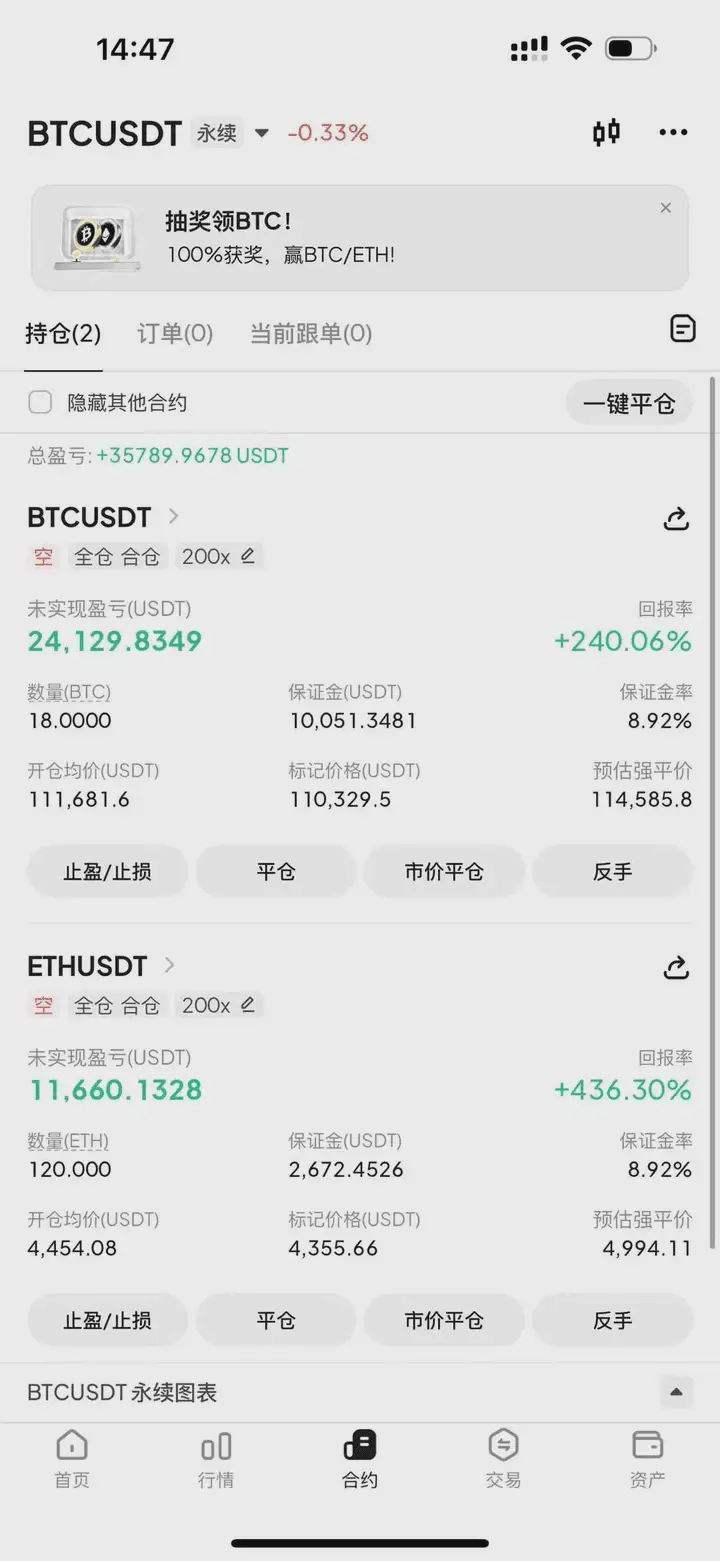
I have personally tested two strategies! 2000 can turn into 100,000!
First move: Grasp the wealth code of three 'tenfold coins'.
Math doesn't lie:
2000 → 10,000 → 100,000 → 1,000,000 → You only need to seize the opportunity to multiply ten times correctly 3 times.
But what is truly difficult are these two things:
Small capital must dare to charge; don't hesitate and miss the explosion.
If the coin rises 5 times, can you still hold it? Don't get washed out halfway.
Remember: 90% of profits come from that last 'crazy surge.'
Second trick: The correct way to roll over and double up.
The three core elements I summarized are: remember them well.
Wait—only trade trend breakthroughs, avoid oscillations.
Steady—always use only 10% of your position, even with 10x leverage, it is equivalent to 1x risk.
Aggressive—add to positions immediately with profits, creating a snowball effect.
Stop-loss must be as machine-like as possible; cut losses at 2% without daydreaming about 'waiting a bit longer.'
Don't short in a bull market—you're going against the tide, and in the end, you will only lose more (refer to MYX)
My personal test record:
Last year, only using $50,000 in capital:
The first wave of market action made 200,000 in 3 weeks.
The second wave made 1 million in two months.
Only trade 6 positions, with 80% profit coming from 2 positions.
The secret is simple:
95% of the time, wait for opportunities, 5% of the time, strike hard!
Blood and tears advice:
Don't believe in what they say about "stable profits every day."
Those who make big money are those who seize a few certain opportunities and amplify their efforts.
Looking back now, the hardest part has never been the technique.
But:
Be able to endure—wait for it, and strike hard.
I won’t hide the method, I’m willing to lead the rhythm.
But whether to get on board depends on your decision at that moment.
Don't wait for the next wave of market to fly up and then regret not taking action.
This path has tripped over countless times, summarizing some rules to share with you:
1. BTC is the big brother, altcoins are the younger brothers.
Where Bitcoin goes, the market follows. Ethereum can occasionally pull a wave by itself, but altcoins are almost unqualified to resist.
2. BTC and USDT are seesaws.
If U rises, be careful that Bitcoin may drop; when Bitcoin skyrockets, remember to hoard some U.
3. Remember key points in time.
Midnight 0-1 AM: It's the easiest time to spike, set orders before sleeping, and you can often make a profit while lying down.
Morning 6-8 AM: Determine the day's trend. If it drops from 0-6, and still drops from 6-8, buy with closed eyes; if it rises from 0-6 and still rises from 6-8, sell quickly.
5 PM: Americans come online, and the market often fluctuates, with big ups and downs occurring here.
4. "Black Friday"? Don't be superstitious.
On Fridays, prices often drop, but they can also remain flat or rise; it largely depends on the news.
5. Principles of spot trading: Holding is the key to earning.
For coins with volume, don't panic if they drop.
Got extra money? Add to your position in batches, lowering the average price to break even faster.
No spare cash? Bear with it, patiently wait, three days to a month, it will generally come back.
6. Don't fidget.
Frequent trading in spot markets is far less effective than holding onto a quality coin.
I bought DOGE at $0.089 and have held it until today, multiplying over 20 times.
In summary:
Trading cryptocurrencies is not about IQ, but rather about patience and execution.
The market is always right; the only wrong one is yourself.
In the cryptocurrency market, a trading strategy with a 95% win rate (trading RSI indicator strategy) can, once mastered, lead to a stable monthly income of seven figures and an annual income of eight figures!
RSI calculation formula.
RSI is typically calculated using the following formula:
RSI = 100 - [100 / (1 + RS)]
Where RS (Relative Strength) is the average closing price of x days of gains divided by the average closing price of x days of losses.
The most common period is 14 days, but traders can adjust this value according to their preferences and trading styles.
RSI levels
Between 0 and 30: Extremely oversold
Values below 30 indicate that the market is in a state of severe overselling.
Traders will focus on potential changes in price trends, meaning that an existing downtrend may turn into a new uptrend.
However, this is not absolute. Always remember that a strong momentum downtrend may cause the indicator to stay in the extremely oversold zone for a long time.
Therefore, blindly buying just because this value is below 30 is not a good strategy.
Between 30 and 50: Slightly oversold to neutral
Values above but close to 30 indicate that the market is in a slightly oversold state. If the value is closer to 50, it is more likely to be in a neutral state.
Between 50 and 70: Neutral to slightly overbought.
Values above but close to 50 are also considered neutral. However, if the value is close to the 70 level, it indicates that the market is in a slightly overbought state.
Between 70 and 100: Extremely overbought.
This area is considered an extremely overbought zone, where the market believes the upward trend may lose momentum and a real trend reversal may occur, turning into a downtrend.
Nevertheless, similar observations apply to oversold conditions.
Strong uptrends may attract more buyers into the market, causing the relative strength index to soar rapidly. This does not mean the market cannot continue to rise strongly indefinitely.
Again, it should be noted that one should not automatically close long positions (or open short positions) just because the indicator is in the extremely overbought state.
"Please remember, these ranges are only indicative and should never be used as pure trading signals.
If there are no additional elements to confirm overbought or oversold conditions, the probability of false signals will be very high.
What settings to use?
The best parameter selection for this indicator completely depends on personal preference, mainly depending on the strategy you use and the time frame it is executed in.
The default setting is 14 periods, with an upper limit of 80 and a lower limit of 30. Typical swing traders sometimes use a 20-period setting, as this roughly corresponds to a 1-month trading cycle on a daily chart.
Another option is to set the upper and lower limits to 80 and 20, respectively, tightening the range slightly. This will result in fewer signals, but the signals will become more reliable and reduce the occurrence of false signals.
Overbought and oversold levels.
The horizontal axis represents time, while the vertical axis ranges from 0 to 100 (which is why this indicator is called an oscillator).
◎ Above 50: the technical trend is positive.
◎ Below 50: the technical trend is negative.
It measures the speed and direction of price changes.
The general rule is:
◎ When the value is above 70, it is called an 'overbought' signal, which means the price has risen significantly in a relatively short time, increasing the likelihood of a (temporary) decline.
◎ When the value is below 30, it is called an 'oversold' signal, which means the price has dropped significantly, increasing the likelihood of a (temporary) rebound.
Visually, the indicator appears as follows, where you can identify peaks above 70 and troughs below 30:

The RSI is shown using the stock price chart of energy company Cenovus Energy as an example:
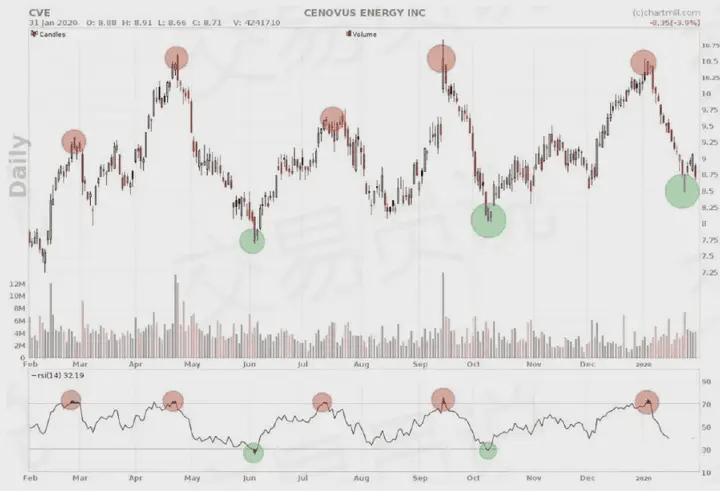
The red circles in the chart represent sell signals, while the green circles represent potential buy signals.
Any trader who buys at the green circle and sells at the red circle has made a considerable profit!
This chart shows that RSI levels provide good signals primarily in sideways consolidating markets.
Three different ways to use these levels in a trading strategy.
We emphasize that the reliability of the RSI indicator highly depends on the market stage of the stock or market.
We distinguish the following stages:
The price is in a horizontal channel (consolidation area).
The price shows a clear upward trend.
The price shows a clear downward trend.
1. Horizontal price channel
In horizontal price channels, we have seen classic buy and sell signals (buy at <30, sell at >70) are relatively reliable.
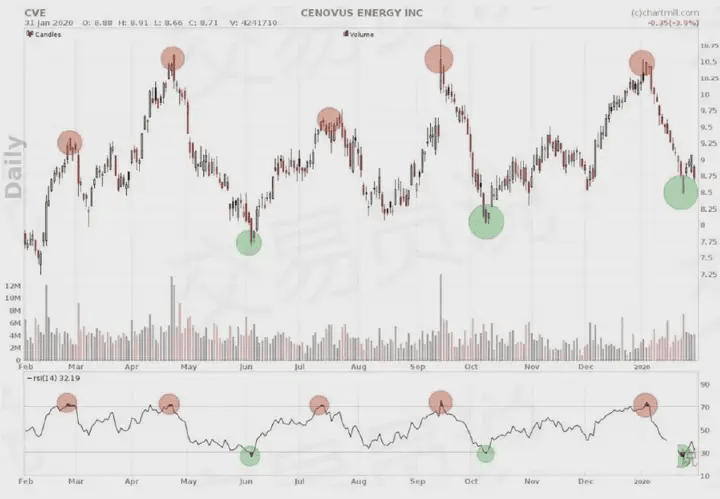
The price fluctuates in a wide horizontal channel between approximately $10.75 and $7.50.
Every time it reaches one of the two limits, the price will drop or rise. In this case, RSI has shown accurate signals.
2. Uptrend
In prices showing a clear upward trend, the classic methods have much less effect. The strong upward trend in the chart below is obvious.
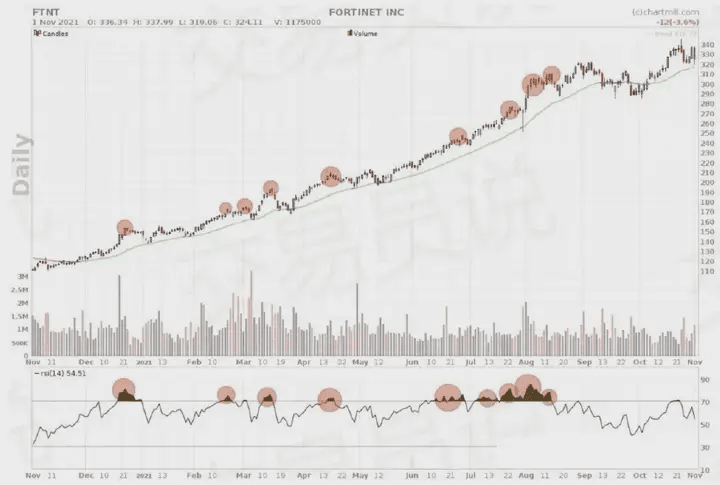
As long as the trend continues to rise, it is advisable to ignore sell signals. In this case, you can try to buy during temporary declines in an uptrend.
Of course, you can also use the RSI indicator to achieve this purpose. In the chart below, we show the same chart but ignore the sell signals.
And marked the moment when the RSI value drops below the 50 level.
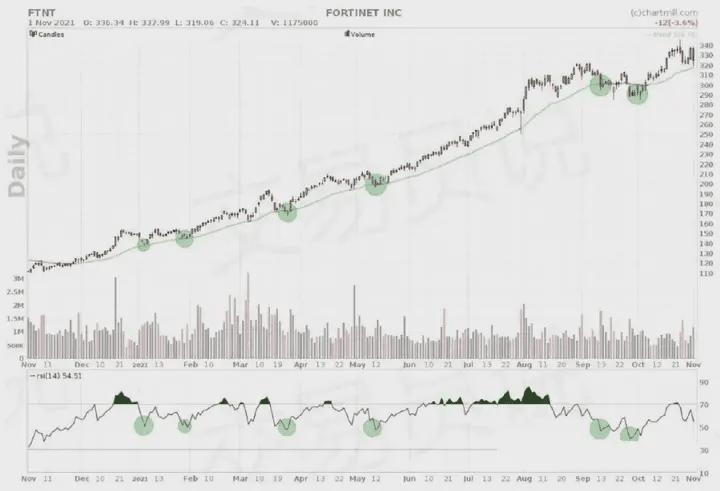
In an uptrend, buying when RSI drops below 50 usually yields very good results and allows you to increase positions in the same coin (or other varieties).
3. Downtrend
Similar to an uptrend, in a sharp downtrend, if the price temporarily rebounds, RSI can also be used to short.
In the following chart, we marked the points where the trend indicator shows a downtrend (red line) and the occasional price rebounds when the trend indicator turns neutral (gray) but never turns positive (green).
At these moments, when the RSI value exceeds 50, the indicator shows sell signals.
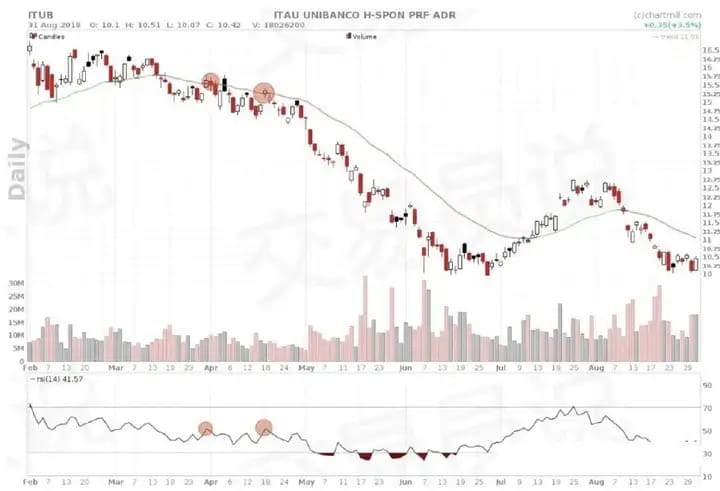
In coins that show strong price trends (up or down), the classic lower limit and upper limit (30 and 70) are often too extreme in many cases.
In this case, the 50 level is more suitable for identifying overbought or oversold periods.
The power of divergence: Early detection of new price trends.
Divergence means there is a discrepancy between the price evolution on the chart and the trend of the indicator.
Because these divergences usually occur when the existing long-term trend is about to end, active investors use them to identify early changes in long-term price trends, thus opening new positions in the direction of the reversal trend.
Divergence is divided into bullish (positive) divergence and bearish (negative) divergence.
Bullish RSI divergence
Bullish divergence occurs when the price chart still shows lower lows while the RSI chart line shows the opposite trend.
This is a signal indicating that the intensity and momentum of the downward price trend are weakening (at least temporarily), thus increasing the likelihood of a temporary price rebound.
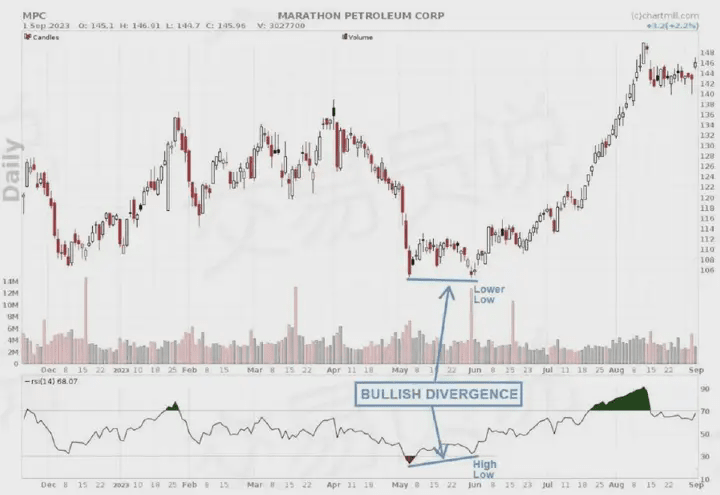
Bearish RSI divergence.
When the indicator shows a lower peak while the price continues to rise,
This will lead to bearish divergence.
This indicates that the intensity and momentum of the rise are weakening (at least temporarily),
And a (medium-term) price drop may occur.
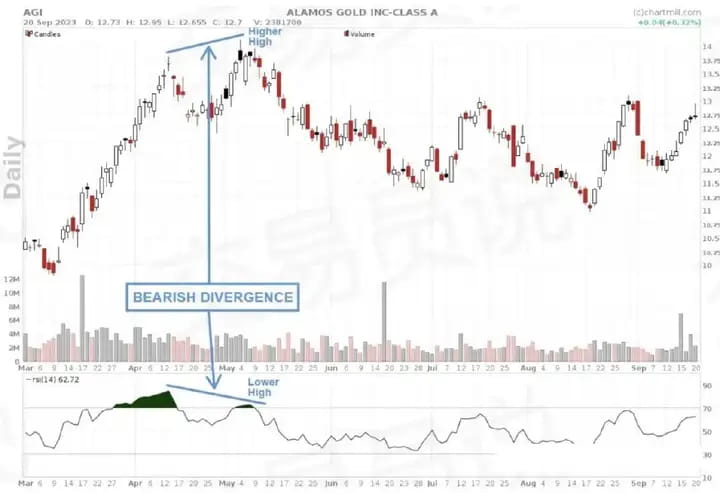
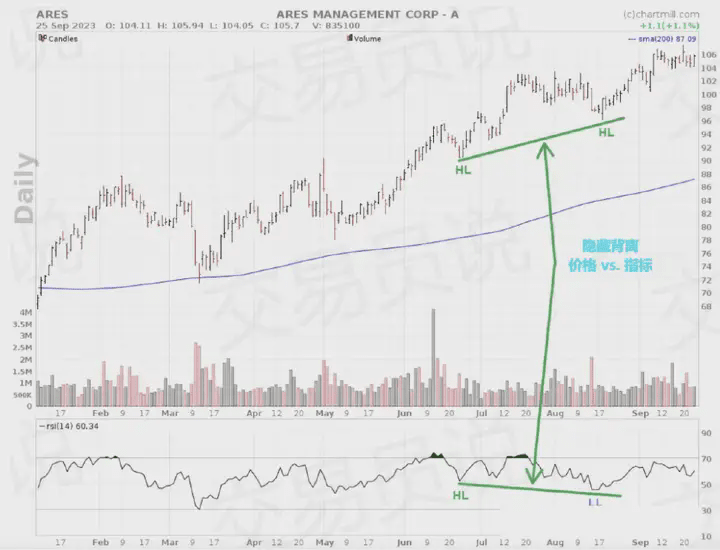
Hidden divergence: Utilize temporary price changes within the existing trend.
This form of divergence is a derivative form of classic divergence,
Mainly appears in stocks with a clear upward or downward trend.
Hidden divergence occurs when the price temporarily declines in an uptrend or temporarily rebounds in a downtrend.
Example 1: Hidden divergence in an uptrend
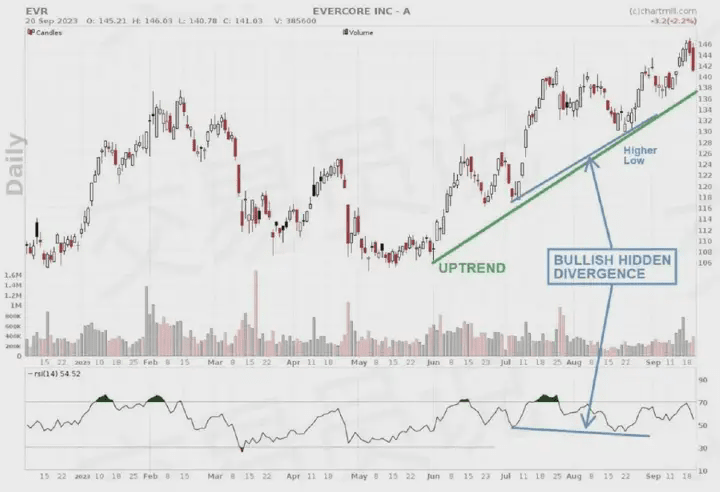
The following chart shows the Evercore stock chart, which has been in an uptrend since early June 2023.
The recent price decline has led to the formation of a new higher low, but in terms of RSI,
but it forms lower lows, thus creating bullish hidden divergences.
Example 2: Hidden divergence in a downtrend.
Similar hidden divergences also occur in downtrends. Chemours stock reached a peak between July and August 2023 before the price dropped and formed several consecutive lows.
However, the recent lower highs in price have formed higher lows in the indicator, identified as bearish hidden divergences.
How to use the RSI indicator for swing trading.
How to use the RSI indicator for swing trading.
As we mentioned at the beginning, the Relative Strength Index (RSI) is one of many technical indicators used by technical analysts to profit from short- to medium-term price fluctuations in the market.
Next, we will detail the different steps for successfully using the RSI indicator in swing trading strategies.
1. Choose the right time frame.
A typical swing trading strategy will hold positions for several days to weeks, so positions may also be held overnight.
The default setting for swing trading is a 14-period on a daily chart, corresponding to a 14-day time frame.
Shorter time periods generate more signals, but the margin of error will also increase.
However, using longer periods may miss some price fluctuations.
2. Identify the current trend.
Trading in the direction of the main trend has the highest probability of success.
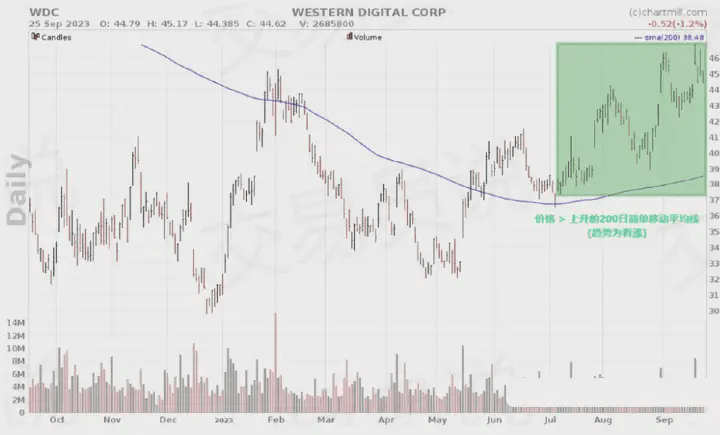
For example, you can use the 200-day moving average to determine the long-term trend.
For long positions, only choose stocks where long-term moving averages are in an upward trend and the price is above the moving averages.
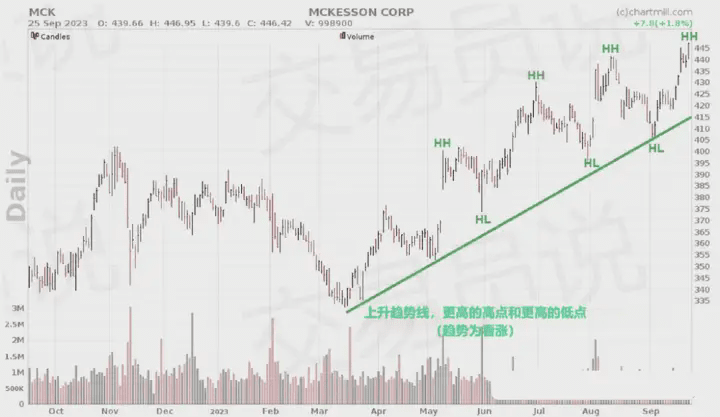
Another purely visual method to determine the current trend is to use an uptrend line (requiring at least three connection points).
3. Identify (and optimize) RSI signals.
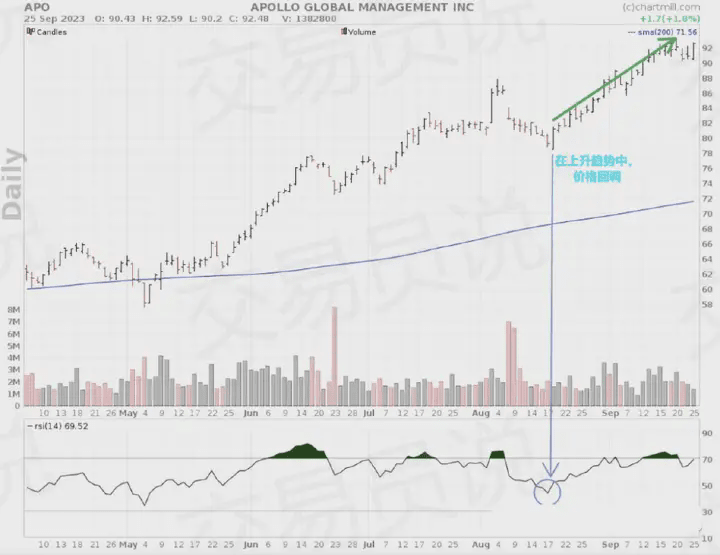
As mentioned above, typically, the RSI indicator's values of 70 and 30 are used to identify overbought and oversold assets, and these levels may indicate potential trend changes.
However, don't be too rigid about these levels; many factors depend on the momentum and strength of the existing trend. For example, in a strong bullish market, a temporary price reversal does not always lead to RSI dropping below the 30 level.
Similarly, in a strong bearish market, a temporary price rebound does not necessarily mean RSI will rise above the 70 level.
In the above case, when the RSI value rises from the 50 level, it may have triggered a valid buy or sell signal.
4. Do not rely solely on indicators.
Technical analysis and its indicators do not guarantee trading success.
Trading purely based on this indicator or any other indicator is the fastest way to incur losses!
As mentioned above, trading should only follow the direction of the long-term trend. After all, this will help you avoid many false signals.
Additionally, always pay attention to price action. Chart patterns, candlestick formations, and support and resistance levels that appear simultaneously with indicator signals are important confirmation signals that can significantly improve the reliability of trading setups.
Remember, the quantity of signals is not important; quality is key.
5. RSI Divergence
In the previous text, we have learned about the types of divergence and their meanings.
Hidden divergence is especially important when looking for entry points in a strong trend.
Hidden divergence is a derivative form of classic divergence, mainly appearing in stocks with obvious upward or downward trends.
Hidden divergence occurs when the price temporarily pulls back in an uptrend or temporarily rebounds in a downtrend.
6. Precisely determine entry and stop-loss points
Make a trading plan and execute the trades according to the plan!
Based on your strategy, determine entry and stop-loss points in advance. This ensures you can accurately identify and limit risks.
After all, protecting account funds is the primary task of every trader.
Exit points can be a predetermined fixed price level, but another option is to use a trailing stop.
To profit from the trend for as long as possible and protect a larger portion of cumulative profits as the price continues to move in a favorable direction.
7. Position size and risk management
Equally important as the trading setup itself is how you determine position size and its related risk (in relation to the set stop-loss).
Only those who can properly manage losing positions and ensure that losses remain small can maintain long-term success.
Suffering five consecutive losses of 1% of total funds is not a disaster.
However, several individual open positions that cause portfolio losses of dozens of percentage points are disastrous!
Frequently Asked Questions
1. What is the difference between RSI and Relative Strength?
"RSI" and "Relative Strength" are sometimes confused because they both contain the term "Relative Strength."
However, they refer to entirely different concepts:
Relative Strength Index (RSI): a technical indicator used to measure the strength and momentum of price changes in financial instruments.
It is an oscillator ranging from 0 to 100. RSI helps traders identify overbought and oversold market conditions, potential trend reversals, and divergences between price and momentum by comparing the magnitude of recent gains to recent losses over a specified period (usually 14 days).
Relative Strength (Relative Strength, in the investment field): a tool to measure the performance of an investment or asset class relative to another.
It is used for portfolio management and asset allocation, so it is not an indicator like RSI.
Relative strength can be calculated by dividing the performance of one asset class (or investment) by the performance of another asset, used to determine which assets are performing stronger (outperforming) or weaker (underperforming) relative to a benchmark or another asset.
2. What is the difference between RSI and Stochastic RSI?
Stochastic RSI is a momentum indicator, like the regular stochastic indicator, mainly used to identify overbought or oversold levels.
Adding the term 'RSI' means that stochastic RSI is derived from the regular RSI indicator.
The difference from the regular stochastic indicator is that stochastic RSI relies on RSI values rather than the price of the underlying asset.
However, the formula used to calculate the value remains unchanged.
3. Is RSI a good indicator?
The Relative Strength Index is a valuable tool in technical analysis, but traders and investors should be aware of its limitations.
For example, it is commonly used to identify overbought (above 70) and oversold (below 30) conditions. However, these levels do not provide certainty.
In fact, the market may remain in extreme conditions for a long time, and relying solely on RSI as entry and exit points may lead to (and often does) false signals.
This also applies to so-called divergence signals (when RSI and price move in opposite directions).
This is a signal pointing to a potential reversal, but it is not always reliable. This divergence can also last quite a long time, leading to missed trading opportunities or premature entries.
Moreover, its effectiveness will vary depending on the selected period (typically 14 days). Shortening the period will make the indicator more sensitive but may produce more false signals.
Extending the period will reduce sensitivity but may lead to delayed signals.
This does not mean that RSI signals lack value when combined with other technical or fundamental information.
4. Can RSI be used for day trading?
Yes, it is very popular among day traders.
It is a multifunctional technical indicator that can be applied to various time frames, including intraday charts, making it suitable for day trading strategies.
Day traders can adjust the period according to their trading style and trading assets. Shorter periods (like 9 or 5) are more sensitive and suitable for ultra-short-term trading;
Longer periods (like 14 or 21) are better suited for slightly longer intraday trading.
Finally, sharing a secret! The pyramid trading strategy! It can double or even triple your profits in one trade.
Of course, improper use can also bring the risk of liquidation.
This is the topic I want to share with you today: how to use this strategy to increase potential profits.
Friends new to this strategy must first understand its principles and then see how to integrate it into their trading style.
What is pyramid trading?
Pyramid trading refers to adding funds to a profitable position.
If the market moves in the direction of your trade, it proves that your trading decision is correct.
The pyramid trading strategy fits such timing; it helps further amplify profit potential while reducing risk exposure.
This is also the most attractive part of pyramid trading; as long as it is used properly, you won't have any additional risks.
In other words, when the trade is favorable to you, this strategy actually mitigates risk.
Here are the basic ideas for pyramid trading:
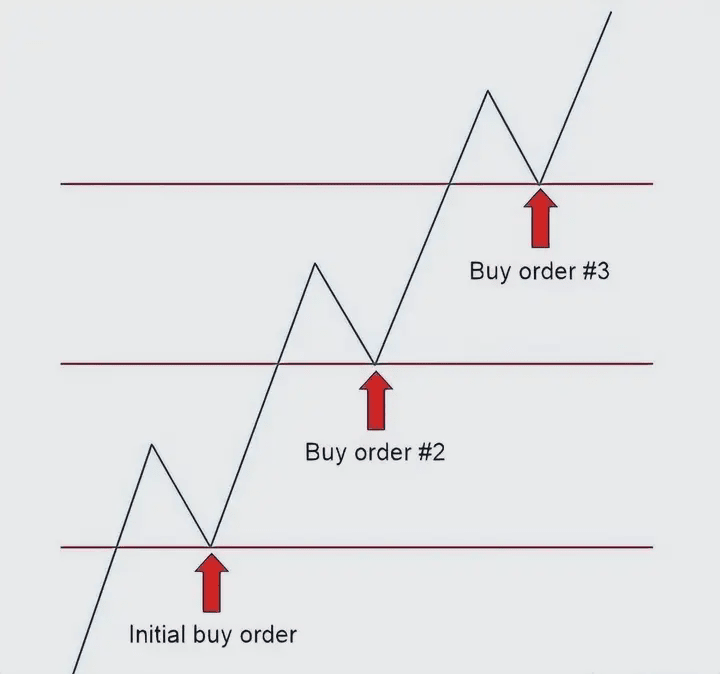
In the above image, the market is in a clear uptrend, showing higher highs and higher lows.
This is a perfect staircase-like upward pattern, very suitable for adding funds to profitable positions.
The first opportunity to set buy orders occurs when the market retests a former resistance level that has turned into support.
Then there will be a second and third buying opportunity.
Remember that the market is in a strong trend, and it has broken through every key price level, which is an important condition for pyramid trading.
Pyramid trading strategy: How to double or even triple your profits?
The key to successfully pyramid trading is: maintain a reasonable risk-reward ratio.
Your risk can never be greater than half the potential risk. Assuming the profit target is 200 points, the stop-loss must be less than 100 points. Keep the risk-reward ratio at 1:2.
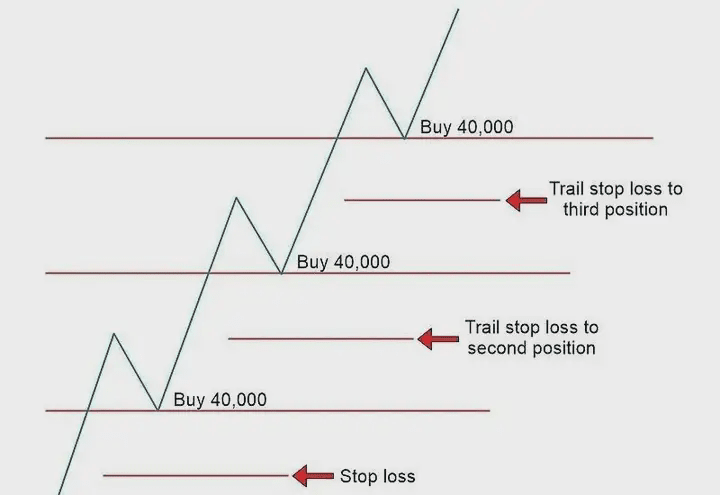
Assuming the account is $20,000, every time the price retests a key level, we buy another 40,000 units, which is equivalent to 4 mini lots.
Each position's profit target is different, while the stop-loss is always only 100 points. Assuming the trend continues to rise:
The market breaks through a resistance level and then retests it as a new support level. You find a bullish pin bar, so you buy 40,000 units, risking 2%;
You decide to let this trade develop naturally;
The market breaks through the second resistance level and retests it as a new support level;
You notice the market continues to rise, so you decide to add another 40,000 units and move the stop-loss below the second position;
The market has broken through a new resistance level for the third time, and a retest has occurred.
Because the market momentum is very strong, you decide to buy another 40,000 units, still moving the stop-loss down to below the third position.
Thus, you have accumulated quite a few positions, and you find your risk has reached 120,000 units. But is it really so? The position is indeed that large, but the actual risk is not that high; the worst case is actually just a profit of 6%.
And the best case is that you make a profit of 24%. Is it possible? Let me do a calculation to find out.
The logic behind pyramid trading.
Using the previous example, but marking the potential risks and profit situations for each addition:
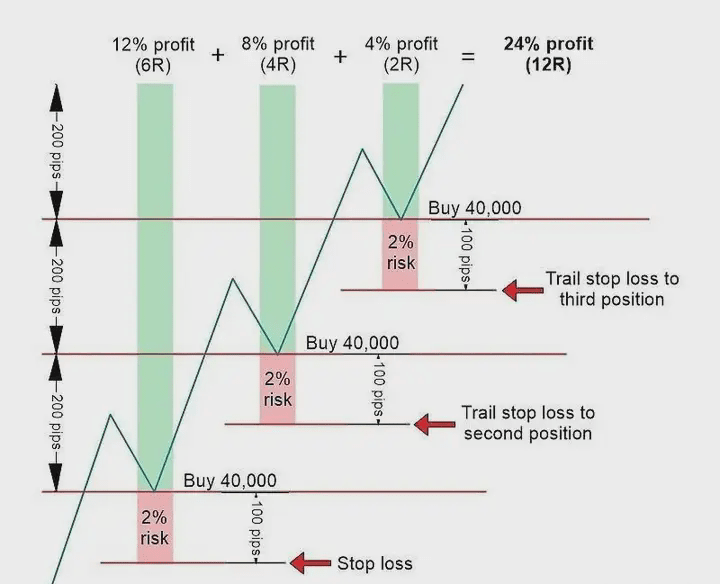
As the market rises strongly, your first trade can bring a maximum profit of 12%. If you can add a few more trades to increase your position, your profit can reach double, up to 24%.
First transaction of 40,000 units:
The worst case is a loss of 2%.
The best case is a profit of 12%.
Second trade of 40,000 units:
The worst case is breakeven (the first trade profits 2%, but the second trade loses 2%)
The best case is a profit of 20% (the first trade profits 12%, but the second trade profits 8%)
Third and fourth trades of 40,000 units:
The worst case is a profit of 6% (the first trade profits 6%, the second trade profits 2%, but the third trade loses 2%)
The best case is a profit of 24% (the first trade profits 12%, the second trade profits 8%, the third trade profits 4%)
From the above calculations, it can be seen that the worst-case scenario in this scenario is a loss of only 2%, while the best case is a profit of 24%.
Conclusion
Pyramid trading can be a very advantageous way for our trading. However, it is not without drawbacks and should not be overused.
If you find that you've attempted to add to your position multiple times in a month, you may not have fully grasped the opportunities for its use.
Every trading strategy has its applicable scenarios; seizing such opportunities can lead to success.
Even if pyramid trading is a good strategy, do not be overly greedy when trading.
Here are some key points to remember when using pyramid trading:
Only use pyramid trading strategies in strong trending markets.
Before entering a trade, be sure to define support and resistance levels.
Before entering, plan where to take profits and exit.
Maintain a reasonable risk-reward ratio throughout.
After each addition to the position, adjust the stop-loss based on the new position to mitigate risk.
Don't complicate things; keep the position size consistent for each addition.
Don't be greedy; always adhere to your trading plan.
Team Aze still has positions, believe first then gain, leading you out of confusion, follow Aze's steps closely, Aze only trades real ETH and SOL contracts. Contracts are not luck; they are solid technical analysis and the latest news, along with extensive trading experience. If you want to ride with Aze, pay attention.