
When we watch the news from the Middle East these days, doesn’t it feel chaotic? Yet it is precisely this complex situation that brings out the most realistic logic: the more complex the situation, the more control one has over the three things — 'how the money flows, how identities are recognized, and how public funds are distributed'.
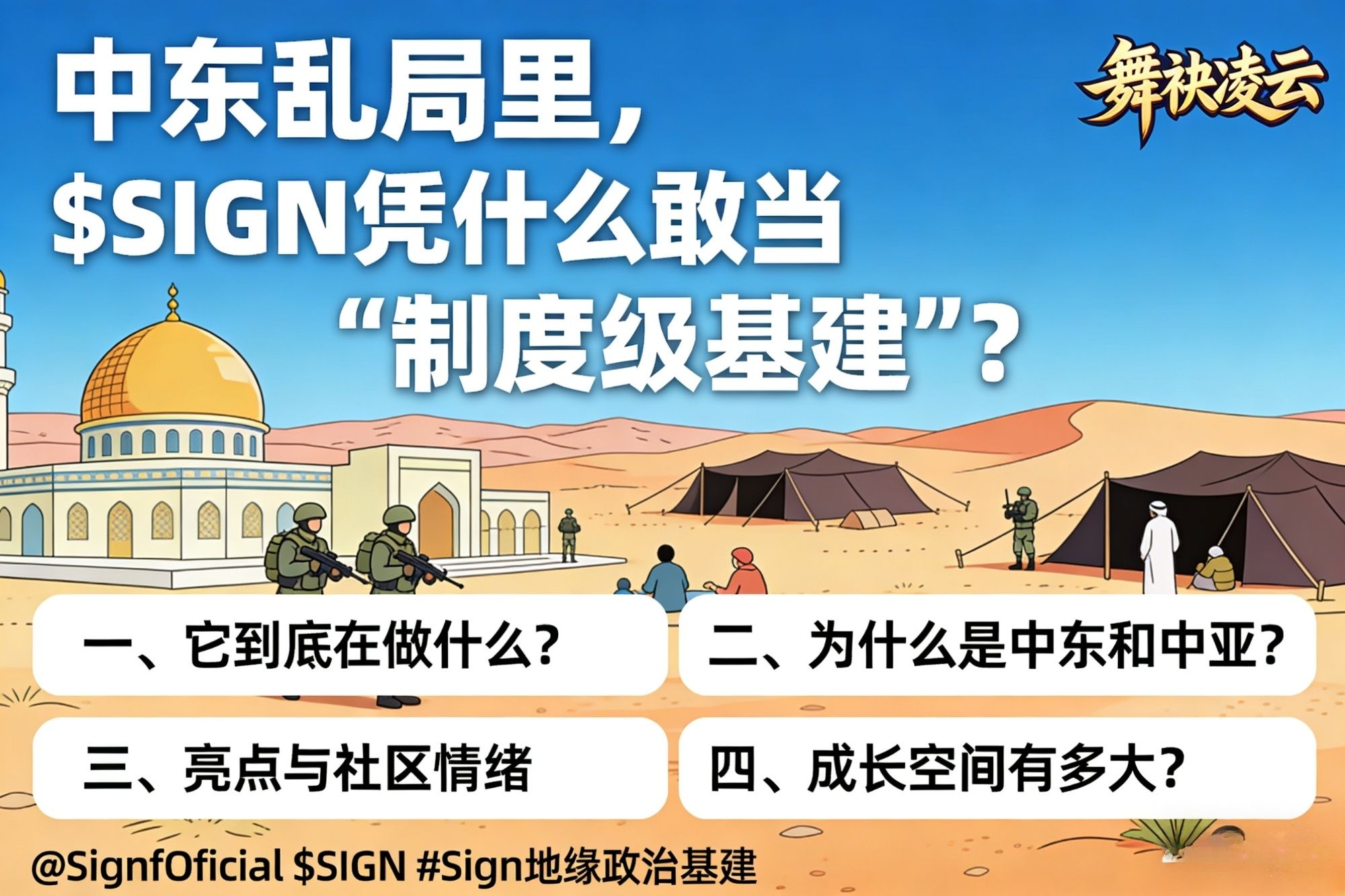
What is needed behind this is not just simple software, but a complete set of sovereign-level digital infrastructure. This is why I have been paying close attention to $SIGN recently.
1. What exactly is it doing?
In simple terms, what SIGN offers is not a single application story, but a set of combinations: Money / ID / Capital, plus an auditable evidence layer.
Imagine, a country wants to issue a CBDC or provide welfare subsidies to its citizens; what is the biggest fear? The fear of opaque processes, the fear of fund misappropriation, the fear of identity theft. $SIGN This system aims to ensure that 'who approves, who signs, and according to what rules it is executed' is all recorded on-chain, turning it into evidence that no one can deny. This is not just technology; it is a reconstruction of trust at the institutional level.
2. Why the Middle East and Central Asia?
Let's take a look at the map. The Middle East and Central Asia are currently in the stage of reconstructing settlement and identity systems. Many countries want to bypass the old SWIFT system; many countries want to establish new digital identities. At this time, whoever has a mature, compliant, and auditable infrastructure solution will be the guest of honor.
The brilliance of SIGN lies in its aim not to grab C-end users, but to target B-end and G-end — those institutions and countries that most need the 'institutional locking effect'. If any country truly implements this set, it will not bring a wave of market trends, but long-term business binding. The depth of this ecological expansion is unparalleled by ordinary DeFi projects.
3. Highlights and community sentiment
I am optimistic about this project for several particularly compelling reasons:
1. Strategic support is solid: it is not a project that relies on hype; behind it is a solid compliance logic and sovereign-level application scenarios. Such projects inherently have stronger risk resistance than purely emotional coins.
2. Security guarantees are trump cards: in this circle, security is the lifeline. By making the 'evidence layer' the core, SIGN itself embodies the highest level of security — every operation is traceable and auditable, fundamentally reducing the space for wrongdoing.
3. Community sentiment is starting to ferment: the recent discussions in the community are no longer about 'when to list on Binance', but rather 'which country has started piloting'. This shift in focus indicates that those who truly understand the field are beginning to realize that the position of SIGN happens to be the golden track for sovereign-level digital transformation in the next three to five years.
4. How large is the growth space?
If there are more pilots and PoCs in the Middle East/Central Asia moving towards 'real deployment', the growth potential of $SIGN will not just be the number of on-chain users, but how many countries and institutions are willing to hand over their money routes and evidence chains to this framework.
I have high hopes for this project because it is not chasing trends but becoming a trend itself. Short-term prices will, of course, follow emotions, but long-term growth potential depends on how much real capital flow, subsidies, and settlements are brought in. Once the 'backup layer' is officially activated, its value anchoring will transform from on-chain TVL to the total value of evidence chains for sovereign-level/institutional-level business bets.
This road is long, but if the direction is right, we need not fear the distance.