

Last year I helped a friend with something. He worked in the Gulf for two years in supply chain and wanted to secure a business loan upon returning home. He had all the materials prepared — bank statements, contracts, and platform data. However, the credit officer took a glance and said: we cannot cross-verify the sources of these materials; they do not meet the risk control requirements.
My friend was stunned on the spot. It's not data fabrication; it's that the banking system doesn't have a mechanism to acknowledge his reality. Sitting next to him, the first thought in my mind was: this isn't a problem of one person; it's the most absurd structural contradiction of the entire digital economy era — you have the data, but you can't prove that it's true.
It was later when I came across @SignOfficial that I realized someone was seriously solving this problem.
When we usually talk about "trust", it seems like an emotion. But in business and government systems, trust has hard costs.
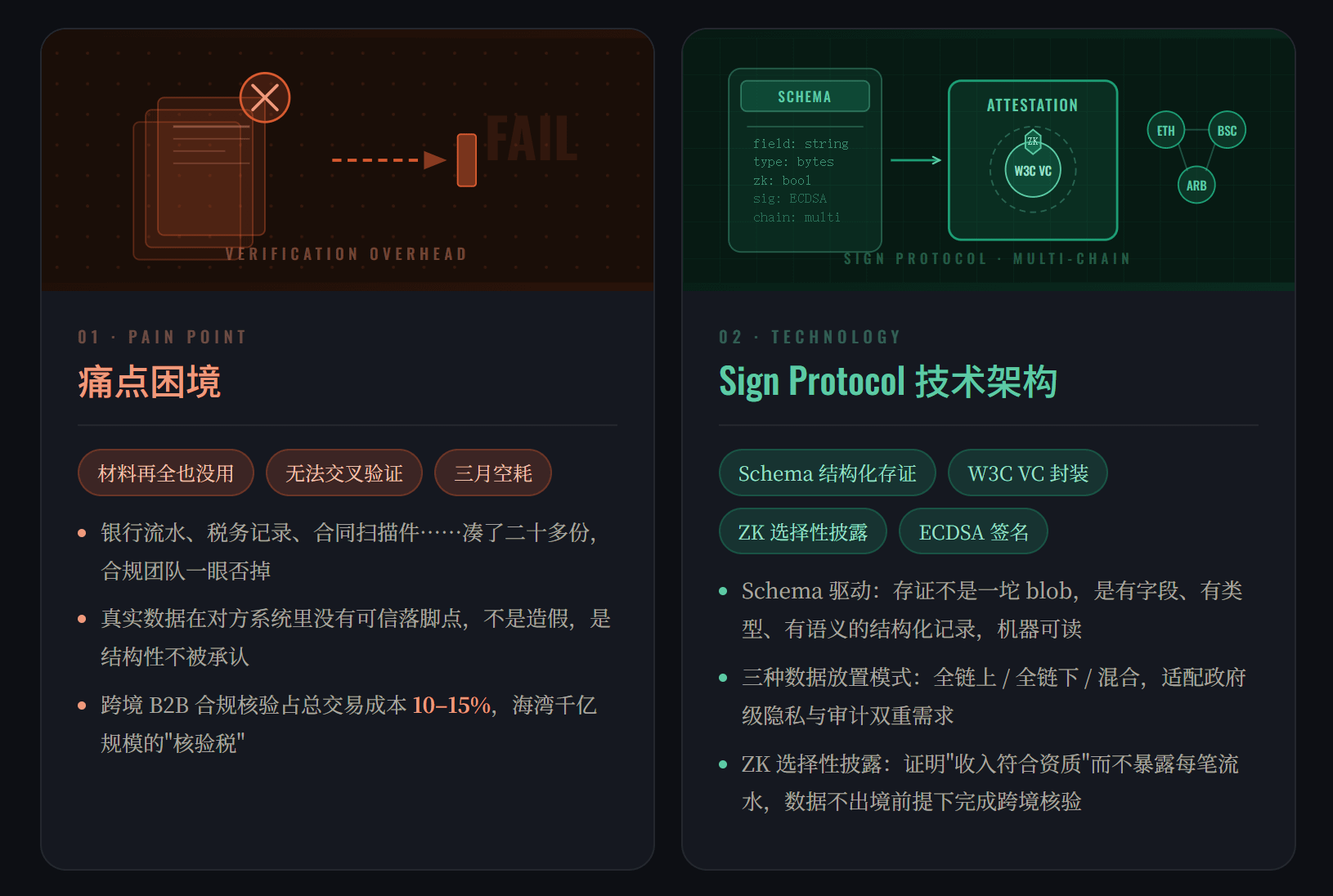
For a cross-border contract signed by Country A, Country B needs to verify it, involving notarization, translation, embassy certification, and even at the fastest, it takes three to four weeks. A company applying for government subsidies needs to prove that it meets qualifications, with materials scattered in tax bureaus, industrial and commercial systems, and banks—there is no unified "trusted exit."
This kind of friction is referred to in the industry as verification overhead, but most people are not aware of how costly it is. McKinsey has data showing that in cross-border B2B transactions, the compliance verification phase accounts for 10%-15% of the total transaction cost. The scale of cross-border trade in the Gulf region is measured in hundreds of billions of dollars each year, so think about how heavy this "verification tax" is.
$SIGN What needs to be done is to turn this cost from institutional friction into technological infrastructure—using on-chain Attestation to make the verification process itself trustworthy, traceable, and reusable.
The junior sister feels this is not just about making a DApp; it’s about equipping the entire digital economy with a set of notarization infrastructure.
The concept of on-chain evidence storage is not new, but most projects do "store a hash to prove I stored it"—what's the use? The other party still does not recognize it because they cannot access the structured data behind the hash to verify it.
@SignOfficial The Sign Protocol addresses a deeper issue: it's not just about storing, but about making what has been stored usable.
How exactly is this done? A few key designs:
Schema-driven structured evidence storage
The Sign Protocol introduces a Schema mechanism, where each Attestation must follow a predefined data structure. What does this mean? It means that the stored evidence is not just a blob, but a structured record with fields, types, and semantics. The compliance systems of funders can parse it directly without needing manual translation. The core difference from traditional notarization is: machine-readable, not just human-readable.
Multi-mode data placement
Not all data is suitable for being on-chain; Sign Protocol supports three modes:
Full-chain (completely transparent, suitable for public auditing)
Full off-chain (data entity stored off-chain, with only verifiable anchor points stored on-chain, suitable for large or sensitive data)
Hybrid mode (on-chain references + off-chain payload, commonly used in sovereign deployments)
This design is very clever. In government-level deployments, much data involves citizen privacy, so it cannot all be on-chain, but it still needs to be auditable. The hybrid mode finds a balance between these two constraints.
ZK selective disclosure
This is the part the junior sister finds the most valuable in the entire architecture.
Selective disclosure of Zero-Knowledge Proof means simply: I can prove that "my income meets the qualification for a loan" without needing to show you every transaction in my bank statement. The principle of information minimization protects privacy while completing verification.
This is especially important in the regulatory environment of the Middle East. Gulf countries have a strong awareness of data sovereignty, and many countries explicitly state that citizens' data cannot leave the country. ZK selective disclosure allows cross-border verification to take place without the data leaving the country—this is a technological compliance breakthrough, not a makeshift solution.
The junior sister wants to mention a perspective that many people may not have considered.
Gulf countries are currently developing digital government, CBDC, and digital identity, which on the surface seems like a technological upgrade, but behind it is a larger strategic proposition: how to establish their own digital sovereignty system without relying on traditional Western financial infrastructure.
This is not a conspiracy theory; it's their publicly stated policy direction. Saudi Vision 2030 and UAE's digital economy strategy have as one of their core goals to reduce dependence on the dollar clearing system and establish localized, trustworthy digital infrastructure.
Here comes the question: if you want to build a new financial and governmental system, what is needed at the very bottom?
What is needed is a set of evidence layers recognized by all parties, capable of cross-system verification and not relying on a single authoritative institution.
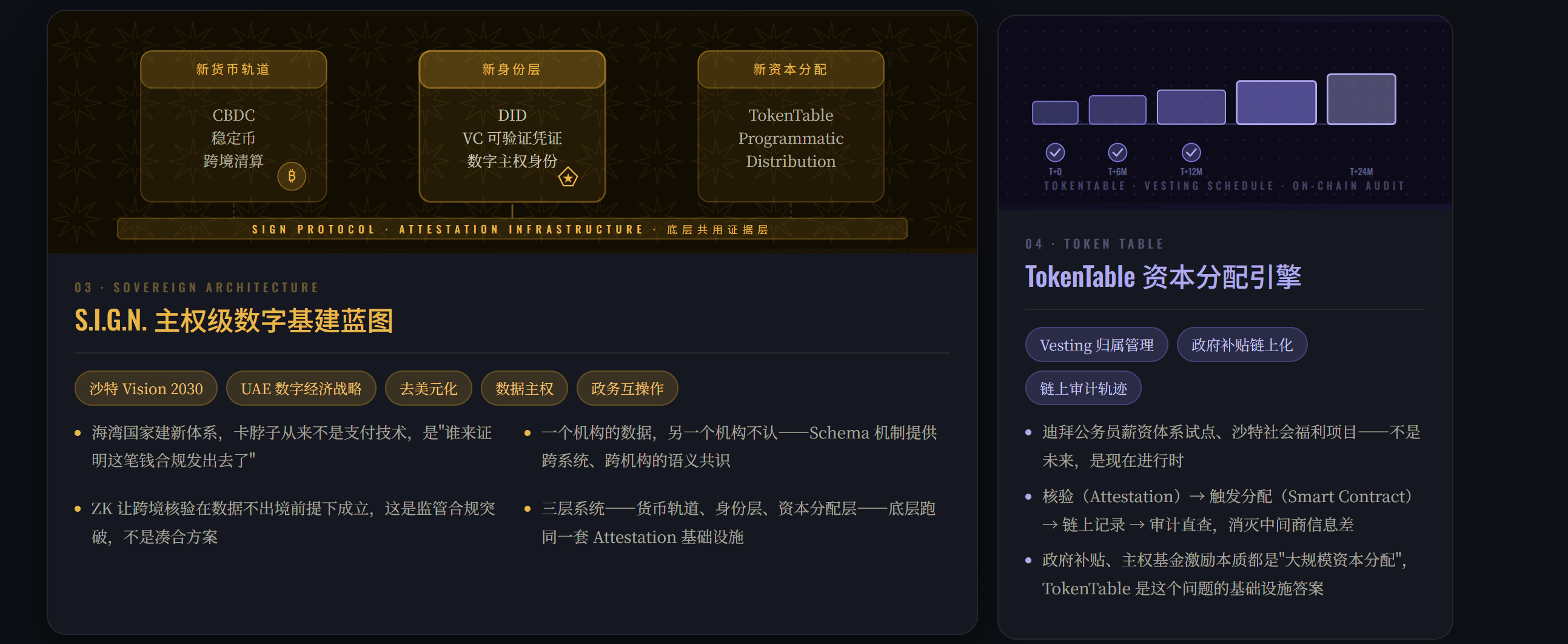
This is precisely the positioning of the S.I.G.N. architecture. It is not a product, but a sovereign-level digital infrastructure blueprint, a three-layer system—new currency track (CBDC + stablecoins), new identity layer (DID + VC), new capital distribution layer (programmatic distribution)—all running on the same set of Attestation infrastructure.
Later, I spoke with a few friends who were working on projects in the Gulf; they said that the biggest headache for local governments now is not whether to digitalize, but how to ensure mutual trust between the systems of various departments after digitalization. One agency's data is not recognized by another agency because there is no common evidence standard. This is why the Schema mechanism of Sign Protocol is so crucial, as it provides a set of semantic consensus across systems and institutions.
$SIGN The value here is not the "blockchain concept," but a practical intergovernmental interoperability solution.
There is another product line that is often overlooked, which is TokenTable, but the junior sister believes it is the part of SIGN that has the most commercial landing imagination.
The TokenTable is about large-scale token distribution and ownership management—vesting schedules, programmatic releases, distribution audit trails, all fully traceable on-chain.
Viewed alone, this looks like a Web3 tool. But within the framework of S.I.G.N.'s New Capital System, the meaning is entirely different:
Government subsidies, social welfare, sovereign fund incentive programs—these are essentially all about the "large-scale capital distribution" problem.
The traditional method: budget approval → manual disbursement → paper vouchers → audit sampling, with information loss at each link, making it very hard to trace back when issues arise.
The TokenTable method: qualification verification (Sign Protocol Attestation) → triggering automatic allocation (smart contract) → on-chain evidence manifest records the entire process → audit can be checked directly, with no intermediaries profiting from information asymmetry.
This logic has already been piloted in Dubai's civil servant salary system, and Saudi Arabia is also exploring this path in certain social welfare projects. It's not the future; it's currently ongoing.
Why are there many projects in the market that say they are "building trust infrastructure"? Why should it be SIGN? The junior sister's judgment is: it is not the technology that leads, but the standards.
Sign Protocol is now running on multiple chains, and SignScan provides cross-chain unified queries (REST + GraphQL), while the Schema registry is accumulating. Once a certain country or industry uses its Schema standard to define the format of "compliance records," subsequent systems must be compatible with this standard to be integrated.
This is exactly the same as the expansion logic of the PDF format and Swift message standards in earlier years—it's not because the technology is the best, but because it has become a de facto standard.
In sovereign procurement scenarios, this advantage is especially significant. The cost of changing suppliers in government systems is extremely high, and the migration of the evidence layer means converting historical record formats and breaking audit continuity, which is basically an irreversible lock-in. Once S.I.G.N. is successfully implemented in a Gulf country, subsequent maintenance contracts, system expansions, and interconnectivity with surrounding countries will all come naturally.
This kind of growth does not rely on emotion, but on the sovereign procurement cycle. It is slow, but once started, others cannot come in.
The junior sister has researched many projects, but most talk about "we want to change the world," and then when the white paper is opened, there are a bunch of abstract architecture diagrams. What is different about SIGN is that it is solving a problem that everyone has encountered, but no one has ever seriously built infrastructure for—proving your authenticity.
On a personal level, it's about deposit disputes and financing materials; on a corporate level, it's about compliance verification and cross-border settlement; on a national level, it's about sovereign credit and government mutual trust. The same issue, three levels, one infrastructure connecting them.
The peculiarity of the Middle Eastern market lies in the fact that it is currently in a window period of "the old system is insufficient, and the new system has not yet been built." Moreover, there is money, political will, and a clear demand for digital sovereignty. Such a window period is rare in history; seizing it means becoming the infrastructure player of the next decade.
$SIGN The growth logic I will say in one sentence: once the sovereign procurement cycle starts, the contract cycle begins at five years, and the migration cost is catastrophic; latecomers have no entry point at all. This is not a barrier; it is physical isolation. Those who don't understand will say it grows slowly. Those who do understand know that slow things are the hardest to eliminate.
